Topics: Order-to-cash cycle
Posted on December 28, 2023
Written By Priyanka Rout




Imagine closing a big deal with a client, only to realise weeks later that the payment is stuck somewhere between invoicing and collection. The sales team did their job, but finance is chasing overdue bills, and customer support is fielding frustrated calls.
This is where the cracks in the order to cash process begin to show. When businesses don’t have a clear view of their order to cash KPIs, small inefficiencies quickly snowball into cash flow delays, strained relationships, and missed opportunities.
Tracking the right order to cash process KPIs helps leaders connect the dots between sales, finance, and customer experience, turning what often feels like a back-office function into a true driver of business performance.
The order to cash process, or O2C, is the journey a business follows from the moment a customer places an order to the point when payment is received.
It covers connected steps across:
A strong order 2 cash process flow helps businesses reduce revenue leakage, improve cash predictability, and maintain healthier customer relationships.
When the process is fragmented, finance teams often face delayed invoices, unresolved disputes, overdue payments, and limited visibility into working capital.
O2C KPIs help finance leaders understand how effectively the business is converting revenue into cash. They also highlight where delays, errors, and process gaps are affecting profitability.
In 2026, the focus is shifting from basic reporting to predictive cash flow analytics, automation-led collections performance, and faster intervention.
Tracking the essential order to cash KPIs for business efficiency helps organisations:
In short, improving business efficiency with O2C KPIs gives finance leaders a clearer view of what is slowing cash conversion and where operational improvements are needed.
Tracking the right order to cash KPI metrics helps businesses move from reactive collections to proactive cash flow management. These are the key metrics for optimising order to cash processes across the full O2C cycle.
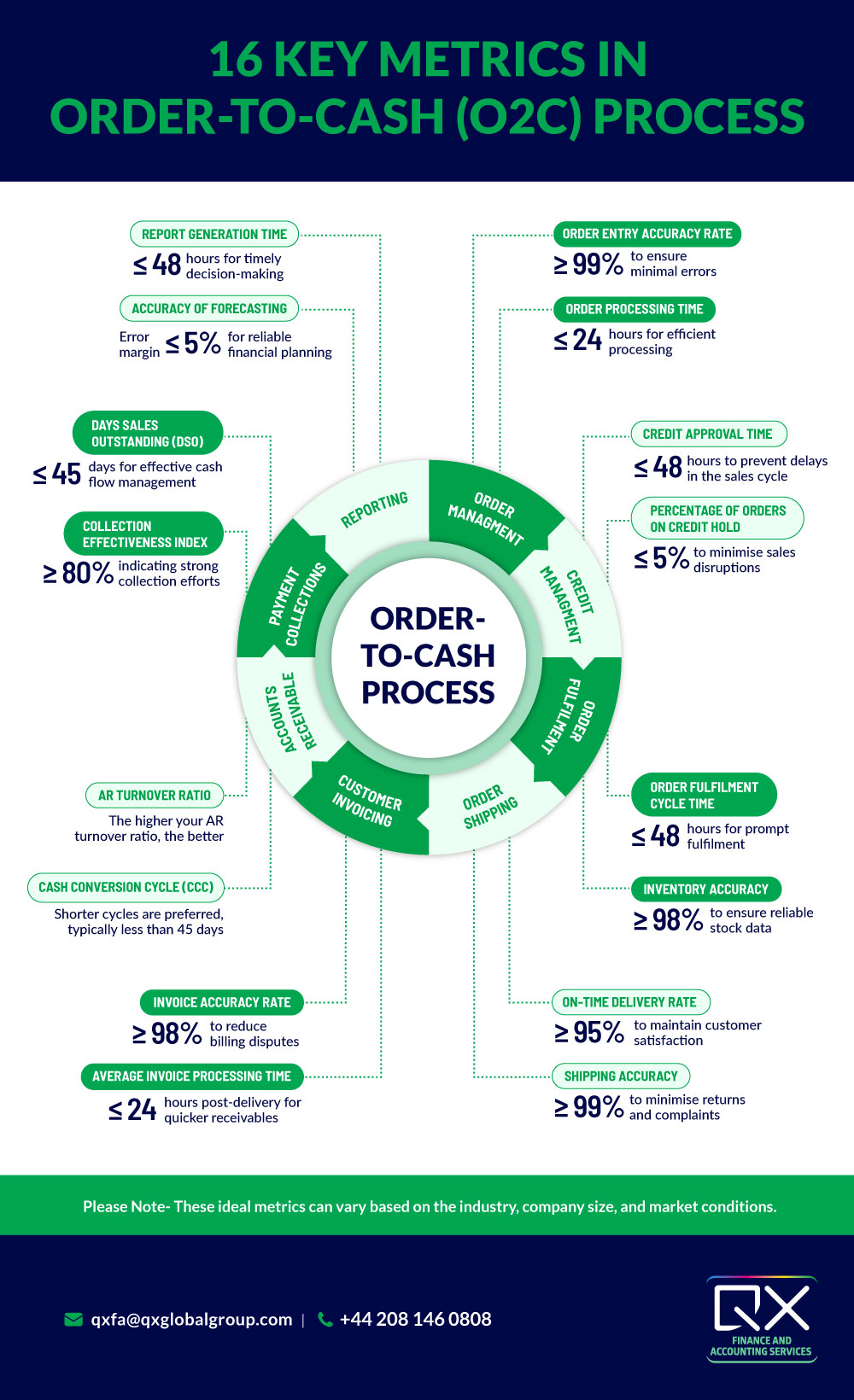
Regularly measuring and analysing these order to cash KPI metrics helps businesses identify weaknesses, improve collections, and strengthen profitability. The ideal benchmarks may differ across industries and company sizes, but the principle remains the same: better visibility leads to better performance.
Discover how QX helped optimise the O2C process for a leading recruitment giant through bank download automation. Read the case study now!
Many businesses track order to cash KPI metrics, but still struggle to act on them. This usually happens when data is scattered across different systems, teams, and reporting formats.
Common challenges include:
These challenges can delay the order to cash cycle and make it harder for finance leaders to understand where cash is getting stuck.
AI and automation are reshaping how finance teams manage the order to cash process. Instead of relying on manual follow-ups and static reports, businesses can now use automation-led collections performance to improve speed, accuracy, and visibility.
AI-driven finance operations can help businesses:
For finance leaders, this means fewer manual touchpoints and more proactive decision-making. Automation supports O2C process improvement by reducing errors, speeding up collections, and giving teams better control over working capital.
Improving O2C performance starts with visibility, ownership, and consistency. Businesses need to look beyond isolated metrics and understand how each stage of the process affects cash flow.
Here are a few best practices:
Create a clear and consistent order 2 cash process flow across teams, locations, and systems. This helps reduce confusion and improves accountability.
Focus on the metrics that directly affect cash flow, customer experience, and working capital. These include DSO, invoice accuracy, collection effectiveness, credit approval time, and AR turnover.
Real-time dashboards help finance teams spot delays before they become bigger problems. This supports faster decision-making and better O2C collection management.
Invoice generation, payment reminders, cash application, and collections follow-ups can often be automated. This reduces manual errors and improves process speed.
Track dispute reasons, resolution time, and recurring customer issues. Faster dispute resolution helps improve collections and customer relationships.
O2C performance depends on multiple teams. Clear ownership across sales, order management, finance, and collections helps prevent revenue leakage and delayed cash.
Order to Cash Outsourcing can free up internal teams from daily complexity while ensuring efficiency and accuracy across the entire cycle. A specialised partner not only improves tracking of order to cash metrics but also provides the expertise to benchmark performance against industry standards.
Engaging with experts in order to cash processing gives finance leaders a tailored view of what an “ideal” KPI looks like for their business, backed by market-specific insights and operational best practices.

O2C KPIs are metrics that measure how efficiently a business manages the order to cash process. They track performance across order entry, credit approval, invoicing, collections, dispute resolution, and accounts receivable.
These KPIs help finance teams understand how quickly and accurately sales are being converted into cash.
O2C KPIs improve working capital and cash flow management by showing where payments are delayed, invoices are disputed, or collections are underperforming. Metrics such as DSO, Collection Effectiveness Index, invoice accuracy, and AR turnover help finance teams act earlier.
When these KPIs are tracked consistently, businesses can improve cash forecasting, reduce overdue receivables, and strengthen liquidity.
Order-to-cash cycles are often delayed by manual invoicing, poor credit control, inaccurate order data, slow dispute resolution, and fragmented systems. These issues create gaps between order fulfilment, billing, and payment collection.
Improving process ownership, automation, and real-time reporting can help reduce these delays and improve business efficiency.
O2C KPIs are important because they help businesses measure cash flow efficiency, collection performance, and process accuracy. They show whether revenue is being collected on time or getting delayed across the order to cash cycle.
For finance leaders, these metrics support better forecasting, stronger working capital control, and more informed decision-making.
Invoice accuracy rate, average invoice processing time, DSO, and dispute resolution cycle time help identify invoicing bottlenecks. These KPIs show whether invoices are being created correctly, sent on time, and paid without unnecessary delays.
If these metrics are weak, the business may need to review billing workflows, customer data accuracy, or approval processes.
Dispute resolution cycle time is the main KPI used to measure how quickly billing or order-related disputes are resolved. A shorter cycle time usually means fewer payment delays and a better customer experience.
Tracking dispute reasons also helps businesses identify recurring issues and prevent them from affecting future collections.
Automation tools improve O2C performance metrics by reducing manual errors, speeding up invoice processing, and improving collections follow-up. They also give finance teams better visibility into overdue payments, disputes, and cash flow risks.
AI and automation can also support predictive cash flow analytics, helping businesses act before payment delays affect working capital.
By outsourcing the order to cash process to QX Global Group, businesses can improve collections, reduce manual workload, and gain better visibility across invoicing and accounts receivable. It also helps finance teams focus more on strategic priorities instead of daily transactional follow-up.
QX Global Group supports businesses with structured O2C processes, automation-led collections support, and finance operations expertise.

Education:
BA (English Literature); Executive MBA (Marketing)

Priyanka Rout is a B2B marketing professional with 5+ years of experience in marketing, specialising in content-led growth, performance strategy, and sector-driven brand building. She has worked extensively on developing structured marketing programs that align closely with sales priorities, measurable outcomes, and executive-level engagement. At QX Global Group, she leads hospitality-focused marketing initiatives while overseeing central SEO and social media strategy across the UK and USA markets. Working closely with business development and sector leaders, Priyanka develops thought leadership, event-led campaigns, and digital programs that translate complex finance and outsourcing themes into commercially relevant narratives for CFOs and senior decision-makers.
Expertise: B2B Marketing Strategy & Sector Positioning, Hospitality Industry Marketing (UK Focus), Finance & Accounting Services Marketing, Content-Led Growth & Thought Leadership Development, CFO & Executive-Level Content Strategy, Sales Enablement & Marketing Alignment, Event Marketing & Industry-Led Campaigns, SEO Strategy & Organic Growth (UK & USA Markets), Social Media Strategy & Brand Visibility, Outsourcing & Global Delivery Narratives, Industry-Specific Campaign Development, Performance-Driven Digital Marketing Programs
Originally published Dec 28, 2023 03:12:42, updated Jun 25 2026
Topics: Order-to-cash cycle
18 Aug 2026
A closed sale is not the same as cash in the bank. The moment an invoice goes out, the P&L is de...
Read More11 Aug 2026
It’s the last Thursday of the month, and a finance director somewhere is staring at two number...
Read More10 Aug 2026
Handing your order-to-cash cycle to an outside partner is not like buying software or picking a stat...
Read More29 Jul 2026
A sale on the books is not cash in the bank. In the UK, the gap between the two is wider than most l...
Read More