Topics: Recruitment Admin Outsourcing Implementation Checklist
Posted on October 22, 2026
Written By Ankit Ranjan




Recruitment admin outsourcing can remove hours of repetitive back-office work from recruiters, but moving those processes to an external team requires more than simply handing over a task list. Without clearly defined workflows, system access, ownership, training, and escalation procedures, even simple administrative tasks can become difficult during the transition.
For staffing companies considering outsourced administrative support, having a structured recruitment admin outsourcing implementation checklist can make the handover more controlled and help both internal and outsourced teams understand exactly how work should be managed.
This guide covers what staffing agencies should prepare before implementation, from selecting the right processes and documenting SOPs to training the outsourced team, testing workflows, setting KPIs, and managing the first 30 days after launch.

Recruitment admin outsourcing implementation is the process of moving agreed recruitment administration activities from an agency’s internal team to an external service provider.
The implementation stage establishes which tasks will be outsourced, who owns each activity, how work moves between teams, which systems will be used, and how quality and performance will be monitored. The goal is to create a repeatable operating process rather than simply transferring individual tasks.
Depending on an agency’s requirements, the outsourced scope could include candidate database administration, CRM/ATS updates, compliance administration, interview coordination, document management, timesheet administration, reporting, or other back-office recruitment activities.
A clear recruitment outsourcing implementation plan helps ensure these responsibilities are understood before the outsourced team begins handling live work.
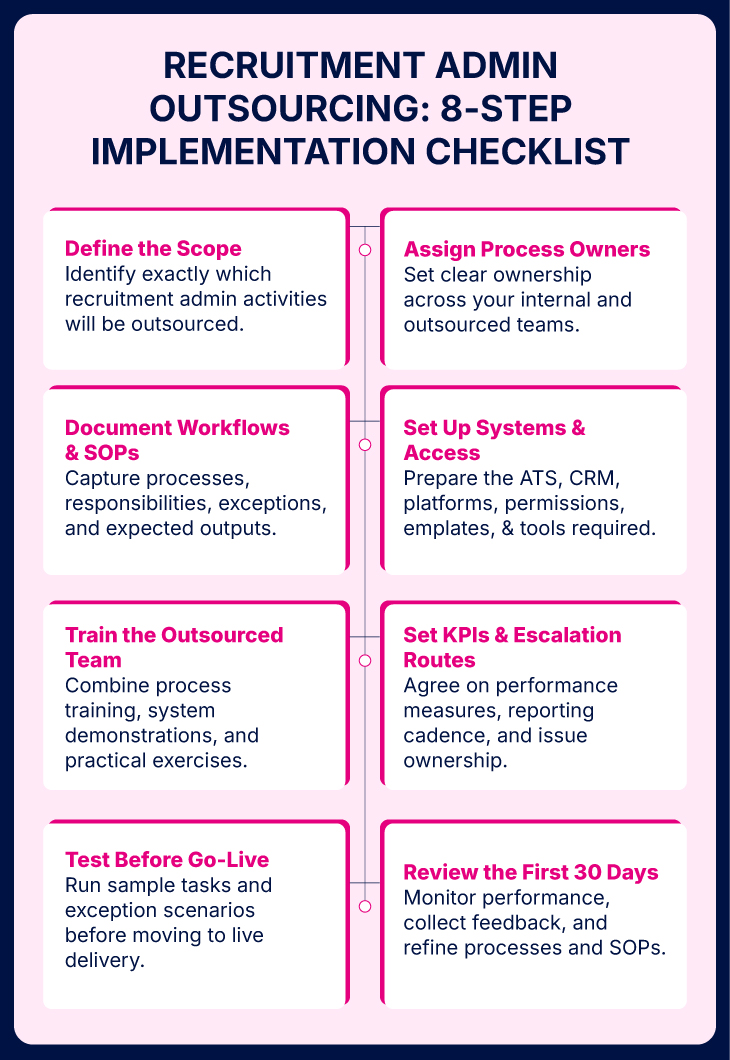
Before transferring any recruitment admin work, agencies should establish a clear baseline for the engagement. Starting the transition without defining responsibilities can lead to duplicated work, missed tasks, and confusion between internal and outsourced teams.
A useful recruitment admin transition checklist should begin with the fundamentals below.
List every activity being considered for outsourcing and decide which tasks will actually move to the external team. Avoid descriptions such as “candidate admin” or “back-office support” that can be interpreted differently by different people.
Instead, define specific activities such as updating candidate records, uploading documents, formatting CVs, scheduling interviews, processing timesheets, or preparing reports.
The scope should also explain what remains with recruiters and internal support teams. Clear boundaries reduce the risk of two teams completing the same task or assuming the other team owns it.
Every outsourced workflow needs clear ownership on both sides. Nominate an internal stakeholder who can answer process questions, approve changes, and resolve issues during implementation.
At the same time, establish who manages day-to-day delivery within the outsourced team. For individual workflows, define who is responsible for completing the task, reviewing it, and escalating exceptions.
This becomes especially important during the early stages of implementation, when unusual scenarios or process gaps are more likely to surface.
Before changing the delivery model, document how the existing process performs. This gives the agency something meaningful to compare against after outsourcing begins.
Depending on the activity, relevant measures might include task volumes, turnaround times, outstanding workloads, error rates, response times, or compliance exceptions. Choose measures that directly relate to the processes being transferred.
Without a baseline, it becomes much harder to determine whether the new operating model is actually delivering the intended improvement.

Not every recruitment activity needs to move offshore or to an outsourced provider at once. Agencies should first map the administrative work currently handled by recruiters, consultants, coordinators, compliance teams, payroll teams, and other operational staff.
A good starting point is identifying high-volume, repetitive and process-driven activities that consume recruiter time but do not necessarily require the recruiter’s direct involvement.
Create a complete list of administrative activities across the recruitment lifecycle. Look beyond obvious activities and identify the small recurring tasks that collectively take time away from recruiters.
These may include candidate database updates, CV formatting, job posting administration, interview coordination, documentation, compliance administration, reporting, and timesheet-related support.
For each task, note its approximate volume, frequency, current owner, systems involved, dependencies, and expected turnaround.
After mapping the tasks, determine which processes are sufficiently standardised to transfer.
Processes with clear inputs, predictable outputs, documented rules, and repeatable steps are generally easier to transition than activities dependent on individual judgement or undocumented knowledge.
If different recruiters complete the same task in completely different ways, standardise the process internally before adding it to the outsourced scope.
Avoid transferring every administrative process simultaneously simply because it can be outsourced. A phased approach gives teams an opportunity to validate workflows and correct problems before more processes are added.
Start with a manageable group of defined activities and establish the delivery model around them. Once these processes are operating consistently, additional workflows can be introduced.
Agencies evaluating potential partners alongside their implementation model can also review this guide to Recruitment Admin Support Outsourcing Companies in UK.
One of the most important parts of an outsourced recruitment admin setup is converting internal knowledge into documented processes.
If a workflow currently depends on an experienced employee simply “knowing what to do”, it will be difficult to transfer consistently. The outsourced team needs instructions that explain both the normal process and what should happen when something falls outside it.
Each SOP should explain the task from initial request through completion. Document where the request originates, which system should be used, what information is required, what checks need to be completed, and what the final output should look like.
Include examples where they help clarify the expected result.
SOPs should be detailed enough that a trained team member can follow the workflow without repeatedly asking the agency for basic instructions.
Standard processes are usually the easiest part of outsourcing. Exceptions are where uncertainty often appears.
For example, what happens if candidate information is missing? What should the admin team do if the information in two systems differs? Who approves an unusual request?
Document common exceptions and specify whether the outsourced team should resolve, return, hold, or escalate them.
Processes change over time, so every SOP should have a clear owner and version history.
Record the document owner, current version, approval date, and latest update so teams know which procedure they should follow. When a workflow changes, update the central SOP rather than relying solely on emails or verbal instructions.
That prevents outdated processes from continuing after the agency has introduced new requirements.

Technology access is a critical dependency in recruitment back-office outsourcing implementation. An outsourced team cannot follow an otherwise well-designed process if required accounts, permissions, templates, or data are unavailable.
System preparation should therefore happen before live tasks are transferred.
List the technology used within each outsourced workflow. Depending on the process, that might include an ATS, CRM, job board, vendor management system, document repository, email platform, timesheet application, reporting platform, or other recruitment technology.
Map systems against specific responsibilities rather than providing broad access to every platform.
This also helps identify technology dependencies before implementation begins.
Work with the relevant IT and security stakeholders to establish the access required for each role.
Permissions should reflect what the outsourced team needs to complete its agreed responsibilities. Agencies should also follow their own information security, privacy, client contractual, and access-control requirements when providing access to candidate or client information.
Test accounts before training starts so technical problems do not interrupt process training.
Collect the templates needed for routine delivery. These could include candidate templates, reporting formats, checklists, trackers, email templates, process forms, and client-specific instructions.
Store approved versions in an agreed location and remove obsolete versions wherever possible.
A well-organised document library gives the outsourced team a reliable reference point once live delivery begins.

Training should go beyond walking the outsourced team through written SOPs. Team members need to understand how the workflow operates in practice, what a correct output looks like, and when a situation requires escalation.
Training should therefore combine process explanation, system demonstrations, supervised practice, and competency checks.
Start by explaining why the activity exists and where it fits within the recruitment lifecycle.
Understanding what happens before and after an administrative task allows the outsourced team to recognise when information looks incomplete or when an issue could affect another part of the process.
This context is particularly useful for interconnected processes such as candidate onboarding, compliance administration, and timesheet support.
Use practical examples to show how the task is completed in the relevant system.
Walk through standard cases first and then cover common variations or exceptions. Team members should see both what to do and what not to do, especially where incorrect processing could create downstream problems.
Record or document frequently used demonstrations where appropriate so they can support future refresher training.
Training should finish with practical validation rather than an assumption that everyone is ready.
Ask team members to complete representative tasks using test cases or supervised workflows. Review the output against agreed requirements and identify where further coaching is necessary.
Move a process into live delivery only once the team can follow the agreed SOP consistently.

Successful outsourcing needs a clear operating rhythm. Internal recruiters should know where to send requests and the outsourced team should know who to contact when an issue cannot be resolved through the documented process.
Define these rules before go-live rather than creating them reactively.
Decide how routine requests, urgent queries, process questions, and operational updates will be communicated.
Where possible, avoid having the same type of request arrive through multiple unstructured channels, as this makes workloads more difficult to track.
Document which communication route should be used for each type of issue and who is responsible for monitoring it.
Choose KPIs that connect directly to the outsourced scope. Depending on the activities involved, agencies might monitor turnaround time, processing accuracy, backlog levels, SLA adherence, task volumes, or exceptions.
The reporting format should make it easy to distinguish between normal delivery and areas requiring attention.
Avoid tracking large numbers of metrics simply because the data is available. Focus on measures that help operational teams make decisions.
Not every issue needs to reach senior stakeholders.
Define what counts as a routine query, operational escalation, urgent issue, or critical problem, along with the appropriate contact for each level.
Include expected communication channels and internal owners so problems can move quickly to the person with the authority or knowledge required to resolve them.
Going directly from training to full-scale delivery creates unnecessary implementation risk. Testing gives the agency and outsourcing partner an opportunity to identify gaps while the volume remains controlled.
The purpose is to validate the entire workflow, not simply whether the outsourced team can complete an individual task.
Select realistic examples covering both routine and less straightforward scenarios.
Have the outsourced team process them from beginning to end using the actual SOP, agreed systems, templates, and escalation routes.
Compare the outputs against the agency’s agreed requirements and document anything that needs adjustment.
A process may work perfectly when every piece of information is available. The real test is what happens when something goes wrong.
Introduce scenarios involving missing information, incomplete documentation, conflicting instructions, system-access problems, or urgent requests.
Confirm that the team knows when to stop processing and when an issue should be escalated.
Before launch, review each implementation dependency.
Confirm that SOPs are approved, access works, training is complete, test cases have passed, reporting is ready, and escalation contacts are available.
Any unresolved issue that could materially interrupt service should be addressed before the relevant workflow moves into live delivery.
Implementation does not end on go-live day. The early stages of live delivery provide the first opportunity to see how workflows perform under genuine volumes, variations, and operational pressure.
The first 30 days should therefore be treated as a period of closer monitoring and controlled optimisation.
Review operational performance closely during the initial weeks.
Look at the measures selected before implementation, such as turnaround times, errors, exceptions, workload volumes, or outstanding tasks. This can help identify whether a problem is isolated or points to a process that needs adjustment.
Frequent early reviews also allow teams to resolve small issues before they become embedded working habits.
Feedback should not flow in only one direction.
Ask internal stakeholders whether outputs meet expectations, but also ask the outsourced team where instructions are unclear, information is frequently missing, or processes create unnecessary delays.
Those observations can reveal problems within the original workflow rather than problems with outsourcing itself.
Treat SOPs as working operational documents.
If the first few weeks reveal new exceptions or improvements, update the process documentation, communicate the change, and ensure everyone works from the latest approved version.
This turns the initial launch period into an opportunity to strengthen the operating model.
Even a well-planned transition can struggle if basic implementation disciplines are missed. Many problems begin before go-live, particularly when agencies transfer poorly documented processes or leave responsibilities open to interpretation.
Watch for these common issues.
If the internal team cannot explain how a process should work, moving it to another team will not automatically fix it.
Standardise first, then transfer.
A large simultaneous transition can make it harder to identify the cause of individual problems.
Prioritising an initial scope allows the agency to test its outsourced recruitment admin setup before expanding it.
If critical instructions exist only in someone’s memory, the process is vulnerable to inconsistency.
Important workflows, exceptions and responsibilities should be captured in approved documentation.
Teams should not have to decide from scratch who needs to know about every problem.
Define escalation triggers, owners, and communication routes during implementation.
Processes often need adjustment once real work starts flowing through the new delivery model.
Build post-launch reviews, feedback, KPI monitoring, and SOP updates into the recruitment admin outsourcing checklist rather than treating them as optional follow-up activities.
For staffing companies, implementation should create an operating model that makes recruitment administration easier to manage rather than simply moving the workload elsewhere.
QX Global Group works with recruitment and staffing businesses that outsource administrative and back-office recruitment activities. The implementation approach should begin by understanding the agency’s required scope and workflows, documenting responsibilities, establishing the delivery process, and aligning communication and reporting expectations.
The exact setup will depend on the agency’s existing technology, processes, service requirements, volumes, and the activities included within the outsourced scope. This makes implementation planning particularly important when agencies are moving from internally managed administration to an outsourced model.
A well-defined recruitment admin outsourcing implementation gives both sides a clearer framework for how work should be transferred, managed, measured, and improved once delivery begins.
Before going live, agencies should be able to answer yes to the following:
Used correctly, this recruitment admin outsourcing implementation checklist can become a practical working document throughout the transition, rather than something that is completed once and forgotten.
There is no single implementation period that applies to every staffing agency. The timeline depends on factors such as the number and complexity of processes being transferred, system-access requirements, documentation readiness, training requirements, and the size of the initial outsourced scope.
Rather than setting an arbitrary deadline, agencies should build their recruitment outsourcing implementation plan around clear readiness milestones for documentation, access, training, testing, and go-live.
Agencies should prepare the documentation needed to operate and control each outsourced workflow. This can include SOPs, process maps, task checklists, templates, escalation matrices, system-access requirements, reporting formats, client-specific instructions, and relevant internal policies.
Documents should also identify process owners and explain how exceptions should be handled.
A pilot or phased transition can be useful when an agency wants to validate processes before expanding the outsourced scope.
Starting with a defined group of repeatable activities allows both teams to test SOPs, systems, communication routes, reporting, quality controls, and escalation procedures under controlled conditions. Lessons from the initial phase can then be incorporated before additional activities are transferred.
Review frequency should reflect the scope and operational requirements of the engagement. Reviews are generally more useful when they examine agreed KPIs, exceptions, process changes, workload patterns, and unresolved issues rather than simply becoming calendar-based status meetings.
Immediately after implementation, closer monitoring can help identify early problems. Once workflows stabilise, the review structure can be adjusted around the agency’s operational needs and agreed governance model.
Yes. QX Global Group provides recruitment administration and outsourced recruitment support services to staffing businesses. The exact implementation model will depend on the activities an agency wants to outsource and its specific workflows, systems, operational requirements, and governance needs.
Enjoyed our blog? Discover more about how our recruitment outsourcing process can slash your costs by up to 60%! Take the next step—book a call by entering your details.


Ankit Ranjan is Vice President of Operations at QX Global Group, responsible for leading strategic recruitment outsourcing and operational delivery across key global accounts. Combining entrepreneurial experience with a strong background in RPO sales and operations, he specializes in scaling teams, driving AI-enabled transformation, and building long-term client partnerships that deliver sustainable business growth.
Expertise: RPO Delivery • US Staffing • UK Healthcare Recruitment • Recruitment Operations • P&L Management • Client Relationship Management • Recruitment Automation • Operational Excellence
Originally published Oct 22, 2026 08:10:25, updated Oct 27 2026
Topics: Recruitment Admin Outsourcing Implementation Checklist

