Topics: Finance & Accounting, Finance & Accounting Outsourcing, Hospitality Accounting
Posted on September 02, 2026
Written By Pardeep Sangwan




Hospitality has become one of the most data-rich industries in the world.
Every reservation, room sale, outlet transaction, labor hour, inventory movement, and guest interaction generates data. Yet despite this abundance of information, many hospitality executives still lack true real-time financial visibility across their portfolio.
The challenge is not data collection. It is data accessibility.
A hotel operating today may be running multiple systems across finance, revenue management, payroll, procurement, food and beverage operations, and property management. Valuable information sits across PMS, POS, ERP, labor management, and procurement platforms, often requiring significant manual effort to consolidate.
By the time leadership teams receive reports, the information is frequently days or weeks old.
In an industry where profitability can shift quickly due to occupancy fluctuations, labor costs, event demand, or rate changes, delayed visibility often leads to delayed decisions.
The result is a growing divide between operational activity and executive decision-making.
The industry’s priorities have shifted significantly over the last several years.
According to Actabl’s Hotel Profitability Performance Report, U.S. hotels entered 2025 expecting strong revenue growth. However, actual performance fell short of budget expectations, with Year-to-Date RevPAR averaging $119.22 compared to a budgeted $131.37, while operators were forced to focus on tighter forecasting and stronger cost control to protect margins. Despite revenue softness, hotels that managed costs effectively maintained GOP margins near target levels.
This reflects a broader industry trend. Revenue growth alone is no longer sufficient. Hospitality leaders are increasingly focused on:
Each of these priorities requires timely, reliable insights.
The winners are no longer those with the most data. They are the organizations that can act on data fastest.
READ BLOG: Find out where the hospitality sector’s next margin advantage will come from.
Historically, many hospitality organizations managed performance through aggregated reports. The problem is that portfolio-level averages often hide operational problems. A portfolio may appear healthy overall while a subset of properties faces significant profitability challenges.
Leading owners and operators increasingly want visibility into:
This trend is driven by growing investor expectations. Ownership groups, lenders, REITs, private equity firms, and asset managers are demanding greater transparency into how each asset performs.
The conversation has evolved from: “How is the portfolio doing?” to “Which specific assets are creating value, and why?”
This shift has elevated property-level reporting from an operational tool to a strategic management capability.
Every hospitality organization tracks hundreds of metrics. The challenge is identifying the metrics that directly influence business outcomes.
Leaders need instant visibility into occupancy, ADR, RevPAR, revenue mix, and segment performance. These metrics reveal whether revenue growth is sustainable and whether pricing strategies are effective.
Revenue growth means little if margins are deteriorating. Real-time GOP visibility allows operators to understand whether occupancy gains are translating into stronger profitability.
Labor remains one of hospitality’s largest controllable expenses. Real-time visibility into labor cost percentages, overtime trends, productivity metrics, and labor-to-revenue ratios helps operators identify margin pressure before monthly reports expose it.
Hospitality businesses often focus heavily on revenue while overlooking cash performance. Real-time monitoring of:
supports healthier liquidity management.
Ultimately, owners and investors care about asset performance. Timely NOI visibility enables leadership teams to make faster operational, capital allocation, and investment decisions.
Monthly reporting cycles were designed for a different era. Today, market conditions can change significantly within a single week.
Occupancy can shift. Event demand can change. Group bookings can move. Labor costs can spike. Food costs can fluctuate. Waiting until month-end often means problems have already become financial outcomes.
This is why leading hospitality organizations are shifting toward continuous operational reporting and real-time financial reporting. The objective is not simply faster reporting. It is faster decision-making. Organizations increasingly recognize that the speed of insight directly influences the speed of corrective action.
Business Intelligence has become one of the most important investments in modern hospitality finance.
Industry experts increasingly identify analytics, business intelligence, predictive reporting, and AI-driven insights as critical capabilities for improving hotel performance, forecasting demand, optimizing pricing, and improving operational efficiency.
Modern hospitality business intelligence platforms allow leadership teams to move beyond historical reporting.
Instead of asking “What happened?”, leaders can answer:
This transition is creating a significant competitive advantage for hospitality companies that can combine operational data with financial intelligence.
Modern real-time financial reporting connects data across property management, accounting, payroll, procurement, and ERP systems into a single reporting environment. Instead of waiting for month-end reports, financial and operational data flows continuously into centralized dashboards.
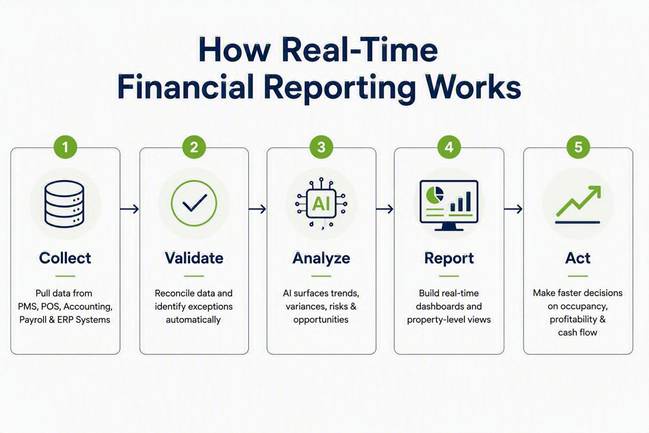
The process typically follows five steps:
The result is a shift from retrospective reporting to proactive performance management, allowing hospitality leaders to identify issues earlier and respond before they impact profitability.
The biggest obstacle to real-time visibility has traditionally been manual effort. Finance and accounting teams spend substantial time gathering data, preparing reports, validating numbers, and reconciling information.
Automation fundamentally changes this process. Today, automation is increasingly being applied across:
These technologies help reduce reporting cycles while improving data quality and consistency. Increasingly, AI is also being used to identify anomalies, highlight risks, generate commentary, and support executive decision-making.
The real value of real-time financial visibility is not reporting efficiency. It is business performance.
Organizations with stronger visibility can:
Most importantly, they can make decisions before opportunities disappear or problems escalate.
In a business built on thin margins and daily operational complexity, that advantage compounds rapidly.
Achieving real-time visibility requires more than dashboards. It requires the right operating model, processes, controls, reporting frameworks, and technology infrastructure.
QX works with hospitality organizations to strengthen financial visibility through a combination of hospitality accounting expertise, automation, analytics, and business intelligence capabilities.
Our hospitality-focused solutions support:
The objective is straightforward: transform fragmented operational and financial data into timely, actionable business intelligence that helps leaders make better decisions. Talk to our team to learn more about QX’s Finance & Accounting Services.
Hospitality leaders have never had access to more data. Yet competitive advantage will not come from collecting more information. It will come from creating real-time visibility across the business and translating that visibility into action.
As profitability pressures persist and portfolio complexity grows, hospitality organizations that invest in real-time financial reporting, business intelligence, and property-level financial visibility will be better positioned to improve asset performance, strengthen margins, and drive long-term growth.
Because in today’s hospitality environment, the most valuable asset is no longer data. It is the ability to act on it first.
Real-time financial visibility enables hospitality leaders to make faster, more informed decisions by providing timely insight into property performance, profitability, labor costs, and cash flow. It helps organizations move from reacting to results to proactively managing performance.
In a fast-moving industry, waiting for month-end reports can delay critical decisions. Real-time visibility helps operators identify issues earlier, respond faster to changing market conditions, and maintain tighter control over margins.
Property-level reporting highlights the performance of individual hotels, departments, and revenue streams, helping leaders identify high-performing assets, uncover inefficiencies, and allocate resources more effectively.
Key metrics include Occupancy, ADR, RevPAR, GOP, GOPPAR, NOI, labor costs, cash flow, accounts receivable, and departmental profitability. Together, these provide a comprehensive view of operational and financial performance.
Real-time visibility allows operators to compare property performance, identify emerging issues, control costs, and address revenue leakage before it impacts profitability, resulting in stronger portfolio-wide financial outcomes.
Automation streamlines data collection, validation, reconciliation, and reporting processes, reducing manual effort while improving reporting accuracy, speed, and consistency across the organization.
Hospitality organizations are investing in real-time finance capabilities to improve forecasting, strengthen cost control, increase operational agility, and provide owners and investors with better visibility into property performance.
QX combines hospitality finance expertise with automation, analytics, AI-powered reporting, and business intelligence solutions to deliver property-level, portfolio-level, and USALI-aligned reporting. This helps hospitality leaders gain actionable insights, accelerate decision-making, and improve financial performance across their portfolio.

Education:
MBA (Finance), B.Com (Hons)

Pardeep Sangwan is a seasoned finance leader with over 17 years of experience in global shared services, business transformation, and finance operations. At QX, he drives digital innovation, process automation, and GenAI implementation across R2R, P2P, and O2C functions. With deep expertise in stakeholder engagement, alliance partnerships, and pre-sales solutioning, Pardeep brings strategic direction and operational excellence to large-scale transformation programs.
Expertise: Business Transformation, Digital Innovation, GenAI, R2R, P2P, O2C, Finance Shared Services, Process Automation, Global Delivery, Stakeholder Engagement, Pre-Sales Solutioning
Originally published Sep 02, 2026 10:09:47, updated Sep 02 2026
Topics: Finance & Accounting, Finance & Accounting Outsourcing, Hospitality Accounting
01 Sep 2026
For much of the year, operations run relatively predictably. Then leasing season arrives and the pre...
Read More27 Aug 2026
On paper, the finance function looks covered. The books are kept, payroll runs on time, and month-en...
Read More27 Aug 2026
In June 2026, Morgan Stanley and Ridgeback paid £1.045 billion for Metra Living, L&Q’s re...
Read More26 Aug 2026
At almost every hospitality conference I’ve attended recently, the convers...
Read More