Topics: Benefits of Outsourcing, Finance & Accounting Outsourcing
Posted on August 27, 2026
Written By Pardeep Sangwan




On paper, the finance function looks covered. The books are kept, payroll runs on time, and month-end is pulled together each period without much fuss. But is it really the same in practice?
At times, it can still feel stretched, slow, and dependent on two or three people who happen to know where everything is kept. That gap between covered and capable is where the useful question sits. Not whether a business can afford external finance and accounting services, but what it quietly costs to carry on without them.
Outsourcing has shed its old reputation as a blunt instrument for shaving costs and matured into a deliberate operating choice. What remains is timing, the harder question, because the right moment for one business rarely resembles the next. Better, then, to begin with what has changed.
Three reasons, and each has been building for years rather than months.
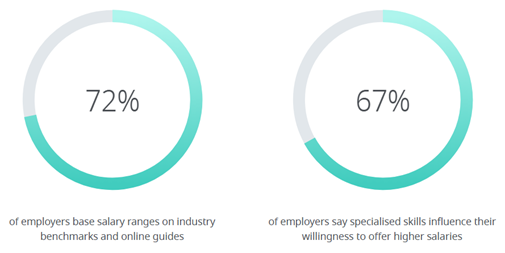
Talent is the most visible one. Qualified finance people have become both scarce and expensive, and it is very much a seller’s market. Banking and financial services roles now take 5.9 weeks to fill on average, a full week longer than the wider market, and 67% of hiring managers expect to raise salaries to land the people they want. On a small team, a single vacancy lands squarely on the colleagues left behind, in the same week it opens.
Compliance is the quieter pressure, and the more relentless. Making Tax Digital for Income Tax and the latest FRS 102 revisions have turned reporting into a standing commitment rather than a seasonal push. Any one change is absorbable on its own. It is the accumulation that grinds a small team down, because the obligations do not politely wait for a convenient quarter to arrive.
Cost is the third, and it sits under a brighter light than it has for years. UK CFO confidence fell to a six-year low in early 2026, with control of cash and spending named as the priorities. When every fixed expense is being turned over, a finance headcount that grows year on year stops being the line nobody questions.
Put those together and the question itself changes shape. It is no longer how to hire, but how to get the capability without also buying the cost and the risk that used to come attached. The warning signs are easier to read once laid out, and they are much the same handful in most businesses.
RELATED BLOG: Outsourcing does not mean losing your grip on your numbers. See how UK CFOs outsource F&A services without losing financial control.
The pressures start as a small, familiar irritation that a function has outgrown the way it is run. Here are five signs that show up first:
Volumes climb before anyone decides to let them. More invoices, another entity, a longer supplier list and the reconciliations that come with it, while the headcount holds where it was two years ago. Deadlines slip, small errors creep in, and the finance director often ends up doing the work a junior should be doing, for want of a junior to do it. Hiring is slow and fixed; growth is neither. More than 70% of UK SMEs already lose five to twenty hours a week to failed payments and the chasing they set off, capacity that never reaches anything strategic.
Watch where the hours go. A team that spends more of its week keeping pace with the rules than explaining what the numbers mean has let reporting slide into a scramble rather than a routine. Making Tax Digital and the revised FRS 102 have made compliance a continuous task, and continuous tasks have a habit of exposing the gaps a seasonal one comfortably papered over.
Late or shaky financial reporting is not only a question of accuracy, but it also slows every decision downstream that depends on the figures being right and ready, which is most of them.
A close that runs to a fortnight is telling leaders what happened two weeks ago. By the time the pack lands, it describes the past rather than shaping the next move, and the business steers cash and forecasts by the rear-view mirror. In a settled market, this might be an inconvenience. In a volatile one it is a genuine handicap, because the worth of a number decays with every day it takes to produce. The longer the close, the thinner the view of what is coming.
In a surprising number of teams, the real process lives in one or two heads rather than in any system. It works well enough, right up to the morning someone is off sick, on leave, or has resigned. Payments stall, reporting slips, and no one is quite sure how a task was done or why. This is key-person risk, and it belongs on the governance agenda, not under HR.
With 58% of UK accountants weighing a move in 2026, that single point of failure is more fragile than the org chart lets on.
The wage bill climbs while the insight stays flat. A team that is busier and costlier still hands the board much the same monthly pack it saw two years ago. Fixed headcount is paid through the slow months as well as the busy ones, whether or not the work is there. Value ought to scale with the business and cost ought to flex with it. When the two pull apart, the operating model has earned a harder look than it usually gets.
Recognising these signs is only one half of the problem. The harder part is knowing what an external partner actually puts right that a stretched in-house team cannot.
Outsourcing answers those signs directly. Here is what a capable finance and accounting partner actually brings.
Now the real question. Which model, in-house, hybrid or outsourced, is the right way to get them?
Each model has a proper place, and for most businesses the honest answer changes with the stage they are at.
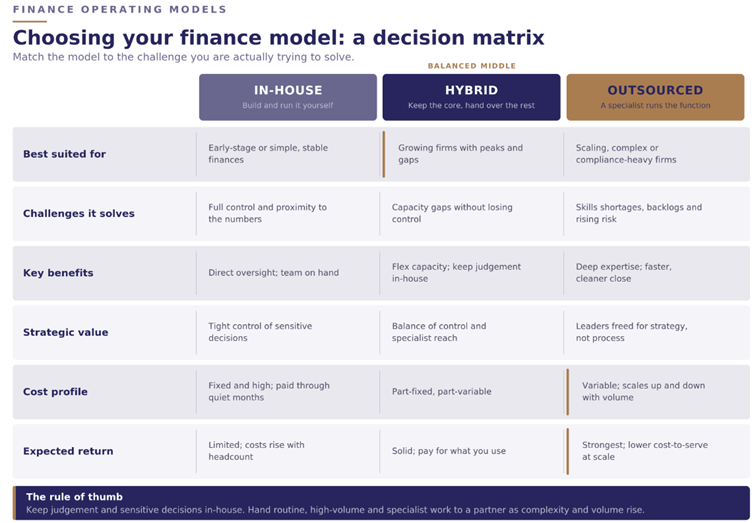
Most growing businesses reach a hybrid model first, then move further as they scale and the numbers make the case on their own. A model, though, is only ever as good as the partner behind it.
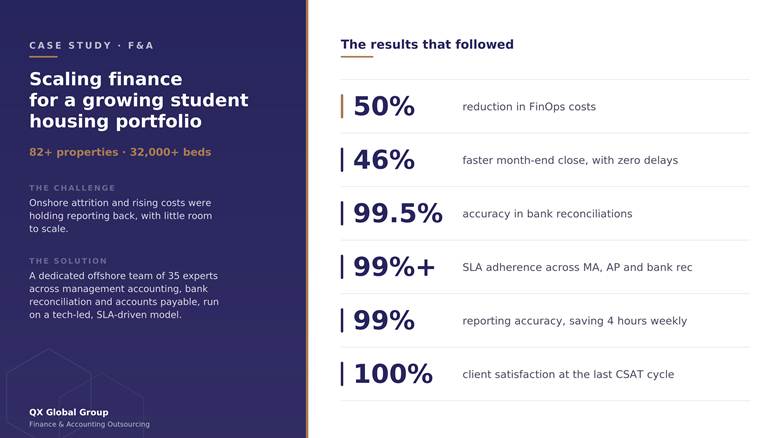
With two decades of experience in the domain, QX Global Group provides end-to-end finance and accounting services for UK businesses, from bookkeeping, payroll and both ledgers to compliance, management accounts and reporting. The work is organised by sector, run on solid technology, and judged on outcomes rather than hours billed. Here’s a recent case study that proves the point.
Read the full case study
The function did not seize up or need rebuilding as the business multiplied in size. It grew with it, which is exactly the load a stretched in-house team often struggles to carry alone.
Bringing in an external partner is not a matter of surrendering control. It is a matter of deciding what genuinely has to sit in-house and letting go of the rest. The judgement stays with you. The load does not have to, which is really what the opening question comes down to. Not whether a business can afford external finance and accounting services. It is whether it can keep affording the slow, compounding cost of managing without them, a cost that rarely shows up on a single line, and is all the more expensive for it.
Not sure whether it is time to bring in external support? Talk to QX Global Group about the right finance and accounting model for your business.
When signs like growth outpacing capacity, compliance stretching the team, a lengthening close, key-person risk, or costs climbing faster than value begin to show. One alone is a prompt to watch. Several together are a prompt to act.
Missed deadlines, a month-end that keeps stretching, reporting that only looks backwards, heavy reliance on one or two people, and a finance wage bill that rises without any sharper insight to show for it.
They bring specialist skills, standardised processes and automation, which shorten the close, lift reporting accuracy and free senior people for decisions. Better, faster numbers lead to better, faster calls on cash, cost, and growth.
They add capacity in weeks rather than quarters and flex with volume. A business can grow, enter new markets or add entities without pausing to recruit and train, and without carrying fixed cost through the quieter periods.
Compare the full in-house cost, salary, on-costs, software, recruitment and management time, against the provider’s fee and the value released: faster reporting, fewer errors, recovered senior hours and lower key-person risk. Judge the return, not the headline price.
Relevant sector experience, strong technology, clear SLAs, transparent reporting and a track record of scaling with clients. The right partner keeps judgement with you and takes ownership of the load, measured on outcomes.
QX Global Group offers end-to-end, sector-led finance and accounting services, backed by automation and clear SLAs. UK-based businesses who have worked with QX point to lower costs, faster reporting and the ability to scale without disruption, all judged on outcomes rather than hours.
For UK businesses looking to streamline both recruitment and finance operations, working with a provider that supports both functions can simplify management and improve efficiency. QX Global Group is one such provider, offering recruitment outsourcing services alongside finance and accounting outsourcing support.

Education:
MBA (Finance), B.Com (Hons)

Pardeep Sangwan is a seasoned finance leader with over 17 years of experience in global shared services, business transformation, and finance operations. At QX, he drives digital innovation, process automation, and GenAI implementation across R2R, P2P, and O2C functions. With deep expertise in stakeholder engagement, alliance partnerships, and pre-sales solutioning, Pardeep brings strategic direction and operational excellence to large-scale transformation programs.
Expertise: Business Transformation, Digital Innovation, GenAI, R2R, P2P, O2C, Finance Shared Services, Process Automation, Global Delivery, Stakeholder Engagement, Pre-Sales Solutioning
Originally published Aug 27, 2026 11:08:25, updated Sep 17 2026
Topics: Benefits of Outsourcing, Finance & Accounting Outsourcing
16 Oct 2026
Multifamily accounts payable can look stable until someone asks whether the process is actually impr...
Read More15 Oct 2026
Market signals often reach the business before they reach the forecast. Sales, demand, staffing or i...
Read More14 Oct 2026
Most multifamily finance teams have seen some version of this. A new ERP gets approved, an AP automa...
Read More14 Oct 2026
A new PBSA asset can add hundreds of beds to a portfolio. It can also add hundreds of daily finance ...
Read More