Topics: Accounts Payable Automation, Finance & Accounting
Posted on July 22, 2026
Written By Rushabh Shah




From the top, accounts payable usually looks like one of the easier to manage parts of finance. Invoices get processed, vendors get paid, and the books close on time. Nothing appears broken. That is exactly why it gets overlooked.
Most audit findings in accounts payable show up as small, repeated exceptions the team has quietly learned to work around — a payment corrected here, a coding fix there, a vendor detail verified after the fact.
The real risk is rarely the missed payment. It is everything Accounts Payable (AP) teams keep correcting manually, every month, without anyone stopping to ask why the same issue keeps coming back. Those recurring corrections are usually where control gaps are hiding, and they are the first thing an auditor pulls on.
Table Of Content:
Accounts payable is the highest-volume disbursement function in most businesses. Every purchase, invoice, and reimbursement eventually flows through it, which is why auditors tend to start there when they assess financial controls.
Nearly every AP audit reduces to three questions: was the payment authorized, is the liability complete, and is the amount accurate. Strong accounts payable risk management is really just the discipline of being able to answer them without a scramble.
The blind spot is that most CFOs watch AP through a different lens. They track cost per invoice, cycle time, and days payable — the efficiency metrics. Control integrity gets assumed rather than tested, largely because AP issues build slowly instead of failing loudly. Fraud in this area typically runs 12 to 14 months before anyone catches it, precisely because the numbers keep looking clean while the gaps widen underneath.
That gap between how AP is managed and how it is audited is where an AP internal audit tends to surface the findings no one saw coming.
RELATED BLOG: Mastering the Art of Accounts Payable Audit: A Guide for CFOs
Most accounts payable audit findings fall into a handful of patterns. What makes them risky is not how they look on the surface, but what they signal underneath.
The same invoice gets paid twice — often under a slightly different invoice number, a vendor name spelt two ways, or a PDF that arrived through two channels. Individually, each looks like a one-off. Together, they quietly add to a business’ payables.
These usually trace back to a vendor bank-detail change paired with urgency — a “pay today” request that skips the normal verification step. A clean-looking invoice tied to a hijacked vendor record is one of the more common ways unauthorized vendor payments slip through.
This is the single most common finding in mid-market AP. When a PO is raised to match an invoice that already landed, the authorization trail is effectively backwards — approval is being reverse-engineered rather than given. It looks like a paperwork gap but in reality, is a control sequencing failure.
One person creating the vendor, approving the invoice, and releasing the payment is the classic red flag. It removes the checkpoint that fraud and error rely on getting past, which is why frameworks like COSO and SOX treat AP as high-risk in the first place. Strong accounts payable internal controls exist precisely to break that single-hand chain.
A fraudulent or manipulated vendor record is set up first, so every invoice that follows looks legitimate on the surface. Because the setup happens before any invoice is reviewed, this is one of the hardest patterns to catch without regular vendor master reviews. It is also where accounts payable fraud prevention has to start upstream, not at payment.
Approvals sitting in email, invoices in a shared drive, evidence rebuilt from memory when the auditor asks for a transaction from eight months ago. This is what turns a two-hour audit into a two-week scramble, and it is usually the finding that exposes all the others.
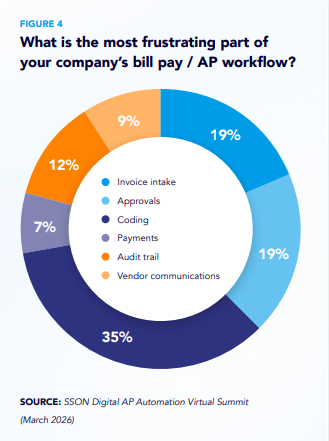
Here is the part that gets missed. Most AP compliance risks do not begin in accounting. They begin upstream, and only surface as accounting problems later.
Duplicate payments look like a processing error, but they usually start with a messy vendor master and inconsistent invoice intake — the same vendor existing three times, invoices arriving through four channels with no single point of capture. Clean up the intake, and most duplicates disappear before they reach payment.
Unauthorized payments look like an approval failure, but they rarely start with the approver. They start with weak vendor master governance — no verification on new vendors, no dual control on bank-detail changes. The approver is only the last line, not the first.
Backdated POs look like a discipline problem, but they are almost always a sequencing problem. If the process allows an invoice to be received before the commitment is recorded, people will keep filling the gap after the fact. The fix is in the workflow, not in reminding the team to try harder.
Documentation gaps look like carelessness, but they come from evidence being captured after the fact instead of at each step. Teams that capture approvals and matches as the transaction moves finish audit prep in hours. Teams that reconstruct it later lose weeks.
The common thread is simple: Strong accounts payable process controls are about closing the upstream gaps that keep generating the same errors, month after month.
RELATED BLOG: In-house or outsourced AP audit — which one actually protects your controls better?
Strong controls do not mean more sign-offs or heavier process. They mean closing the specific gaps that keep generating findings, so the same issues stop coming back. In practice, effective accounts payable internal controls usually come down to six things:
The pattern across all six is the same. Sound accounts payable process controls are less about catching errors at the end and more about removing the upstream conditions that create them.
Also Read: Top Accounts Payable Outsourcing Companies in USA – What Sets Them Apart?
When findings pile up, the instinct is usually to add automation or add people. Neither fixes the underlying problem on its own.
Automation on a weak process just makes the weak process run faster. If invoice intake is messy and the vendor master is unreliable, automating on top of it moves the errors through more quickly and with more confidence. Automation amplifies structure. When the structure is broken, it amplifies the break.
Adding headcount has the same limitation. More people can clear a backlog, but they also deepen the dependency on individuals knowing where the exceptions live. That is the opposite of control. Real accounts payable risk management comes from structure, not staffing.
The fix is almost always sequencing. Standardize the workflow, clean up the vendor master and intake, and define ownership first. Then apply automation to a process that is actually ready for it. Do it in that order, and both the tools and the team start working. Do it in reverse, and you are just paying more to move the same mess around.
QX Global Group works with finance teams on closing the upstream gaps that generate audit findings in the first place: vendor master governance, consistent invoice intake, clean matching, structured approvals, and documentation that holds up when an auditor asks for a transaction from months ago. That is where accounts payable outsourcing services shift from processing work to protecting control.
In practice, that support usually covers:
Build a more controlled, audit-ready AP function with QX Global Group’s accounts payable outsourcing services. Book a call with our AP audit experts today!
Because AP is where money actually leaves the business. When controls are weak, errors and fraud have room to move through unnoticed. Most AP compliance risks build slowly rather than failing loudly, which is why gaps here often go undetected for months before they surface as losses or audit findings.
The essentials are vendor master governance, a single point of invoice intake, authorization recorded before the invoice, real segregation of duties, and reconciliations run during the period. Together, these accounts payable internal controls close the upstream gaps that generate most findings, so the same exceptions stop repeating month after month.
Both break the three things auditors test — authorization, completeness, and accuracy. Duplicate payments distort the accuracy of what was actually owed, while weak approval workflows break the authorization trail. Beyond the direct cash loss, they signal to auditors that the control environment cannot be relied on, which usually invites deeper scrutiny.
Automation helps most when it captures the audit trail as transactions move — approvals, matches, and documentation building in flow rather than being reconstructed later. But it only works on a clean process. Applied to weak accounts payable process controls, automation just moves errors through faster. Fix the workflow first, then let automation strengthen it.
Start with the exceptions the team keeps correcting manually — recurring duplicates, backdated POs, vendor-detail changes. Those patterns usually point straight to the control gaps an auditor will find. A regular AP internal audit, even a light one, surfaces these issues while they are still cheap to fix rather than at year-end.
Look for providers that build audit readiness into the process, not just at year-end. Strong accounts payable services cover vendor governance, matching, structured approvals, and documentation captured at each step — so schedules and evidence are ready as exports rather than a scramble. The goal is a provider that keeps you audit-ready continuously, not one that helps you catch up before a review.
The right partner is one with a proven global delivery model and experience supporting US finance operations across time zones. What matters is consistent process, clear ownership, and controls that hold regardless of where the team sits. Providers offering outsource accounts payable services at scale are usually built for exactly this — distributed delivery with centralized control discipline.
QX focuses on the discipline underneath AP — vendor master governance, consistent invoice intake, clean matching, structured approvals, and audit-ready documentation. By closing the upstream gaps that generate audit findings in accounts payable, businesses see fewer duplicate and unauthorized payments, a cleaner trail, and a close that no longer carries last month’s unresolved exceptions.

Education:
CA, B.Com

Rushabh Shah is a Chartered Accountant with over 7 years of experience in audits, financial analysis, and process optimisation. At QX, he specialises in CAPEX reviews, treasury management, P2P processes, and tax and statutory compliance. With a strong foundation in financial reporting, Rushabh brings cross-sector expertise and a sharp analytical approach to managing complex finance operations.
Expertise: CAPEX Reviews, Treasury Management, P2P Processes, Tax & Statutory Compliance, Financial Reporting, Audit & Financial Analysis
Originally published Jul 22, 2026 07:07:57, updated Jul 23 2026
Topics: Accounts Payable Automation, Finance & Accounting
22 Jul 2026
Most cash flow problems do not begin when an invoice becomes overdue. They begin much earlier, throu...
Read More21 Jul 2026
Most finance leaders know their biggest customers inside out. They know which products are performin...
Read More21 Jul 2026
A company can hit its revenue target and still weaken EBITDA. That sounds counterintuitive until you...
Read More25 Jun 2026
Business Rates 2026 will not just affect property overheads. For hotels, pubs, restaurants and multi...
Read More