Topics: H-1B Visa Policy Changes, Staffing Industry News, USA Staffing Industry

H-1B Visa 2025: What’s Changing for US Staffing Firms?

Posted on March 11, 2025
Written By Ranjana Singh

H-1B Visa
Summarize and analyze this article with:

The U.S. staffing industry is bracing for major changes in 2025 as new H-1B visa regulations take effect. With increased compliance checks, stricter degree requirements, and heightened scrutiny on third-party placements, staffing firms could face new hurdles in hiring foreign talent—especially in industries like IT, healthcare, and engineering.

What do these policy shifts mean for staffing firms?

  • Tighter compliance rules that demand more documentation
  • Potential delays in visa approvals affecting project timelines
  • Increased costs of hiring H-1B workers
  • Alternatives like nearshoring and offshore hiring gaining traction

This blog breaks down all the key H-1B visa updates for 2025, their impact on staffing firms, and how to stay ahead of the curve. If your firm relies on H-1B talent, this is a must-read.

H-1B Visa Policy and Its Impact on Staffing Firms

The H-1B visa program allows U.S. companies to hire highly skilled foreign workers for ‘specialty occupations’ (requiring a bachelor’s degree or higher). For staffing firms, this is vital as it provides access to a larger talent pool, particularly in tech, finance, and manufacturing, helping fill critical labor shortages when domestic talent is unavailable.

Staffing spotlight newsletter CTA

Upcoming H-1B Visa Rule Changes (Effective January 17, 2025)

  • Stricter enforcement measures under the second Trump administration.
  • Increased compliance checks, including high-profile audits and enforcement actions.
  • More requests for additional evidence (RFEs) from USCIS.
  • Greater scrutiny and unpredictability in visa approvals and adjudications.

Key H-1B Visa Policy Changes in 2025

On December 18, 2024, the Department of Homeland Security (DHS) announced new regulations affecting the H-1B visa process. These changes focus on:
  • Clarifying qualifying degrees
  • Defining bona fide positions
  • Regulating third-party placements
  • Revising cap-exempt organization requirements
  • Expanding USCIS enforcement powers

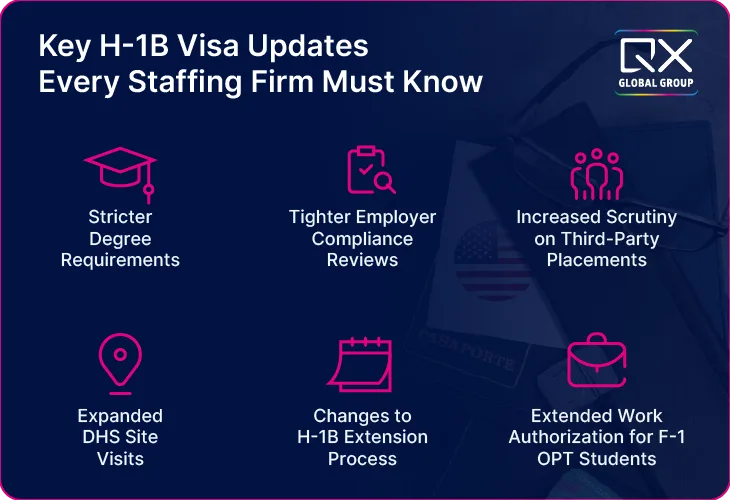
Major H-1B Visa Changes Staffing Firms Must Know

H-1B Visa changes and its impact on staffing firms

1. Stricter Degree Requirements

  • H-1B applicants must have a degree directly related to their job duties.
  • If multiple degrees qualify for a position, each must have a clear logical connection to the role.

2. Increased Employer Compliance Reviews

  • Employers must prove a bona fide job offer for the beneficiary in a specialty occupation.
  • USCIS now has greater authority to request contracts, work orders, and supporting documents to verify compliance.
  • These changes aim to reduce unnecessary RFEs and streamline the application process.

3. Higher Scrutiny on Third-Party Placements

Staffing firms placing H-1B workers at client sites must:

  • Prove that the work performed at the third-party site qualifies as a specialty occupation.
  • Provide additional documentation showing that the third party meets H-1B sponsorship requirements.

4. Expansion of DHS Site Visits

DHS has reinforced its authority to conduct on-site inspections of employers and H-1B employees. Site visits will focus on:

  • Verifying employer legitimacy and ensuring H-1B program compliance.
  • Inspecting work locations to confirm compliance with visa regulations.
  • Enforcing penalties for non-compliance.

5. Changes to H-1B Extension Process

  • USCIS will defer to prior H-1B approvals unless there is a material error, fraud, or change in employment circumstances.
  • This simplifies visa renewals and reduces the need for repeated adjudications of previously approved applications.

6. Extended Work Authorization for F-1 OPT Students

  • The cap-gap protection for F-1 OPT visa holders selected in the March 2025 H-1B lottery has been extended.
  • Instead of expiring on October 1, 2025, work authorization now extends to April 1, 2026, preventing employment gaps.

How H-1B Visa Changes Could Impact Staffing Firms

1. Higher Costs and Compliance Burdens

  • Stricter compliance requirements may increase legal and administrative expenses.
  • Higher salary thresholds could make hiring H-1B workers more costly.
  • More frequent audits could slow down the hiring process.

2. Shrinking Talent Pool and Changing Client Demand

  • Fewer H-1B approvals mean more competition for skilled professionals.
  • Some clients may shift to direct hiring, reducing reliance on staffing firms.
  • Delays in visa approvals could disrupt project timelines, especially in IT and healthcare.

3. Growth in Nearshoring and Offshore Recruitment

  • Nearshore staffing partnerships to Canada and Mexico could become a popular alternative.
  • Offshore hiring in India, Eastern Europe, and the Philippines may increase.
  • Outsourced recruitment services could help manage compliance and workforce challenges.

What Should Staffing Firms Do?

  • Stay updated on policy changes and prepare for stricter compliance requirements.
  • Strengthen documentation to meet higher evidentiary standards for H-1B petitions.
  • Explore alternative hiring strategies, such as nearshoring, offshore recruitment, and alternative visa options.
  • Engage with industry associations (e.g., TechServe Alliance, American Staffing Association) for advocacy and legal guidance.

How QX Global Group Helps Staffing Firms Navigate H-1B Visa Challenges

QX Global Group offers proven recruitment outsourcing services solutions to help staffing firms manage their H-1B Challenges

Here’s how we can help:

1. Reduce Dependency on H-1B Visas: We provide access to pre-vetted offshore recruiters who source highly skilled candidates, reducing reliance on visa approvals.

2. Ensure Faster Compliance: Our specialized compliance teams handle documentation, background checks, and credentialing to meet USCIS and client requirements.

3. Cost-Effective Talent Sourcing: Save up to 60% on operational costs by leveraging offshore recruitment teams without compromising quality.

4. Scalability Without Hiring Constraints: Our Recruiter On-Demand model allows firms to scale up or down instantly, avoiding visa-related hiring slowdowns.

Book a Free Consultation

H-1B visa delays holding you back? Speed up hiring by 50% and secure top talent ahead of competitors. Take the next step—book a call by entering your details.

Education:

B.Com(Hons), Delhi University

Ranjana Singh

Assistant Marketing Manager

Ranjana Singh is a data-driven B2B content marketer who loves creating well-researched content and blending it with storytelling. At QX, she leverages data insights and lead analysis to craft high-performing LinkedIn campaigns, blogs, newsletters, and sales collateral that drive MQLs and brand visibility across the US and UK markets. Her work is rooted in performance—every strategy starts with deep analysis of content metrics, funnel behavior, and audience engagement trends to deliver measurable marketing impact.

Expertise: Data-Backed Content Marketing Strategy, SEO & Organic Growth, LinkedIn & Newsletter Marketing, MQL Attribution & Lead Source Analysis, Recruitment Industry Marketing (US & UK),

Don't forget to share this post!

Originally published Mar 11, 2025 08:03:47, updated Dec 19 2025

Topics: H-1B Visa Policy Changes, Staffing Industry News, USA Staffing Industry


Related Topics