Topics: Back Office Admin Support, Back Office Support Services
Posted on February 17, 2026
Written By Ranjana Singh




Let’s be honest. Growth in staffing sounds exciting. More placements. More revenue. More clients.But behind every placement is paperwork, contracts, compliance checks, timesheets, payroll coordination, and invoicing.
As placements increase, administrative workload grows even faster. Recruiters who should be speaking to candidates and closing roles often find themselves chasing documents or fixing payroll queries. It is not surprising that businesses across industries are rethinking how they manage operations.
It’s even important to note that the global back office outsourcing market was valued at $273.5 billion in 2023 and is projected to reach nearly $560 billion by 2032. This shows that companies are investing in structured back office support services to scale without increasing internal overhead.
For U.S. staffing firms, the real question is simple. Can you grow without your back office slowing you down?
In this blog, we explain what back office support means, why it becomes a bottleneck as staffing firms scale, which functions can be outsourced, and how outsourcing supports efficient, compliant growth.
Back office support services handle the non-client-facing administrative and operational tasks that keep staffing firms running smoothly.
While recruiters focus on sourcing and placements, back office and admin support ensures documentation is complete, payroll runs accurately, compliance is maintained, and invoices are issued correctly.
Back office management typically includes:
For staffing firms managing high placement volumes, structured back office support for staffing firms ensures efficiency, process consistency, and reduced risk.

Every placement triggers multiple administrative steps.
There is onboarding paperwork to complete. Credentials to verify. Timesheets to track. Payroll to coordinate. Invoices to generate. As volume increases, complexity increases.
Without structured systems, recruiters spend valuable time on operational tasks instead of revenue activities. Internal teams struggle to expand cost-effectively. Errors and delays begin impacting both candidates and clients.
This is where many staffing firms start exploring back office outsourcing solutions to remove operational pressure and restore focus to growth.

Outsourced Back Office and Admin Support allows staffing firms to transfer repetitive, process-heavy tasks to specialist teams trained in recruitment operations.
This approach helps firms:
When staffing firms choose to outsource back office support services, they shift from fixed operational overhead to a flexible, scalable support model. Recruiters focus on placements. Operational teams focus on precision and compliance.
Back office support outsourcing services manage the operational tasks between a placement and revenue realization, ensuring everything runs smoothly, accurately, and compliantly behind the scenes.
Once a candidate is placed, onboarding begins. This involves collecting offer letters, contracts, tax forms, identification documents, background checks, and role-specific compliance paperwork.
Back office teams verify documentation, follow up on missing items, ensure records are stored correctly, and confirm that all compliance requirements are met before the candidate starts. This reduces onboarding delays and prevents last-minute compliance risks that can disrupt placements.
In temporary and contract staffing, accurate timesheet management directly impacts payroll and client billing.
Back office support teams track timesheet submissions, follow up on approvals, validate hours worked, flag discrepancies, and coordinate payroll inputs. This ensures candidates are paid correctly and on time, reducing disputes and maintaining trust. It also prevents payroll errors that can damage candidate relationships.
Revenue is only realized when invoices are issued correctly and on time.
Back office teams generate invoices based on approved hours or contractual billing terms, verify rate accuracy, and ensure billing cycles align with client agreements. They also help track outstanding invoices and support reconciliation processes, protecting cash flow and reducing revenue leakage.
Compliance is critical in staffing, especially in healthcare, IT, and regulated sectors.
Back office management includes tracking licenses, certifications, work authorizations, background checks, and renewal deadlines. Teams monitor expiry dates, send reminders, and ensure documentation remains up to date. This reduces legal risk and protects client relationships by maintaining compliance integrity.
Accurate system records are essential for reporting, audits, and performance tracking.
Back office support ensures candidate data, placement details, pay rates, contract terms, and client information are correctly updated in CRM and ATS platforms. Clean data supports better forecasting, reduces errors, and strengthens operational visibility.
Leadership teams need clear insights to make informed decisions. Back office teams generate reports on placements, payroll status, billing cycles, compliance tracking, and operational performance. These insights help identify bottlenecks, improve forecasting accuracy, and support strategic growth decisions.
Together, these back office outsourced services provide the operational structure staffing firms need to scale confidently. As placement volume increases, structured back office support ensures efficiency, accuracy, and compliance remain consistent.
When processes are handled by dedicated back office teams, tasks such as onboarding verification, payroll coordination, and invoicing are completed faster and with fewer delays. This reduces payroll disputes, accelerates billing cycles, and ensures revenue is realized on time.
Building an in-house operations team requires salaries, training, systems, and management oversight. Outsourcing converts these fixed costs into a scalable model, allowing staffing firms to control overhead while maintaining operational efficiency.
Specialized teams follow structured workflows and compliance checklists. This reduces documentation errors, minimizes regulatory risk, and ensures candidate credentials and contracts are consistently maintained.
When placement volume increases, operational workload increases as well. Outsourced back office support can scale up quickly during hiring surges, seasonal demand, or expansion into new markets without the delays of hiring internally.
Recruiters generate revenue. When administrative tasks are removed from their workload, they can focus entirely on sourcing, candidate engagement, and client communication, leading to faster placements and stronger relationships.
Consistency builds trust in staffing. Clients expect accurate invoices and compliance, while candidates expect smooth onboarding and correct pay. Outsourced back office support services follow standardized workflows, ensuring every placement goes through the same structured process. This reduces errors, improves reliability, and strengthens long-term client relationships.
Choosing between an in-house operations team and outsourced back office support is not just a cost decision. It affects scalability, compliance risk, and recruiter performance
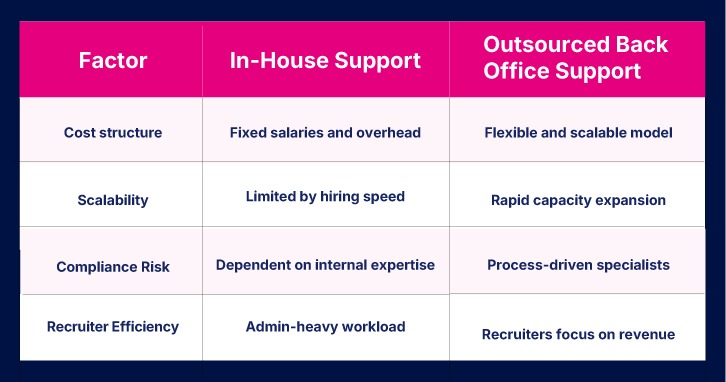
An in-house back office team comes with fixed salaries, benefits, training costs, software licenses, and management overhead. These costs remain constant regardless of placement volume.
In contrast, outsourced back office support operates on a flexible model. Costs can scale up or down based on hiring volume, seasonal demand, or business growth. This gives staffing firms better control over margins while maintaining operational capacity.
Scaling an in-house team requires recruiting, hiring, onboarding, and training new staff. This takes time and often lags behind business growth.
Outsourced back office support allows for rapid capacity expansion. When placement volume increases, operational support can be scaled without the delays and risks associated with internal hiring. This is particularly valuable during high-volume hiring periods or expansion into new markets.
With an internal team, compliance quality depends heavily on individual expertise and internal process maturity. If documentation tracking or credential management is inconsistent, compliance risks increase.
Outsourced providers typically operate with structured workflows, checklists, and compliance tracking systems designed specifically for staffing environments. This reduces documentation errors and improves regulatory consistency.
In-house models often blur the line between recruitment and operations. Recruiters may handle timesheet queries, onboarding follow-ups, or payroll clarifications, reducing their time for revenue-generating activities.
With outsourced back office support, administrative responsibilities are clearly separated. Recruiters focus on sourcing, client communication, and placements, while operational specialists manage documentation, payroll coordination, and billing. This improves overall productivity and placement speed.

Back office support outsourcing is not only for large enterprises. It becomes relevant the moment operational workload begins affecting growth, profitability, or service quality. Staffing firms should seriously evaluate outsourcing in the following situations:
Growth is positive, but rapid placement growth increases onboarding documentation, payroll inputs, invoicing cycles, and compliance checks. If operational processes are not structured to handle higher volume, delays and errors start appearing. Outsourcing ensures operational capacity expands alongside revenue growth.
Recruiters are revenue generators. If they are regularly chasing timesheets, following up on compliance documents, or resolving payroll queries, productivity drops. When administrative workload begins reducing placement activity, it is a clear sign that operational responsibilities need to be separated.
Industries like healthcare, IT, and finance require strict documentation and credential tracking. As regulatory requirements increase, maintaining compliance manually becomes risky. If your team struggles to track certifications, renewals, or background checks consistently, structured back office support reduces exposure to compliance errors.
Many staffing firms operate with lean internal operations teams. As business grows, these teams become stretched, leading to processing delays and burnout. Outsourcing provides additional operational strength without the time and cost required to hire internally.
Entering new states, industries, or client segments often brings new documentation, payroll rules, and compliance standards. Outsourced back office support can help manage this transition smoothly by implementing standardized processes from the beginning.
Outsourcing can significantly improve operational efficiency, but success depends on choosing the right partner and setting up the relationship correctly. Before selecting a provider, staffing firms should carefully evaluate the following factors:
Back office operations in staffing are not the same as general administrative support. Payroll cycles, timesheet validation, credential tracking, client billing structures, and compliance requirements are highly specialized. An outsourcing partner must understand staffing-specific workflows, margin structures, and placement-driven revenue models. Without this expertise, transition challenges and operational errors can occur.
Staffing firms manage sensitive candidate data, payroll information, and client contracts. Any outsourcing arrangement must include strong data protection measures, secure systems, and confidentiality protocols. Before engaging a provider, firms should evaluate data security standards, access controls, and compliance with relevant privacy regulations. Operational efficiency should never come at the cost of data risk.
Operational clarity is critical. Service level agreements should clearly define turnaround times, accuracy standards, escalation procedures, and performance benchmarks. Without defined SLAs, expectations may become unclear, leading to delays or dissatisfaction. A structured agreement ensures accountability and measurable outcomes.
Even with outsourcing, operational visibility must remain strong. Firms should establish clear communication channels, reporting frequency, and points of contact. Regular reporting and performance reviews ensure alignment, allow early identification of issues, and maintain operational transparency.
Absolutely. Here’s a stronger, more strategic explanation of this section so it reads like a practical roadmap rather than a checklist.
Outsourcing back office support is not just about transferring tasks. A structured implementation plan ensures minimal disruption and measurable results. A successful transition typically includes the following steps:
Start by reviewing how much time is being spent on administrative tasks. Identify bottlenecks in onboarding, payroll processing, invoicing, compliance tracking, and reporting. Understanding where delays or errors occur helps define what needs immediate support.
Not every function needs to be outsourced at once. Many staffing firms begin with high-volume, process-driven tasks such as timesheet management, payroll coordination, or documentation tracking. Prioritizing high-impact areas ensures quick operational relief and faster ROI.
Clear expectations are essential. Define turnaround times, accuracy benchmarks, compliance tracking standards, and reporting frequency. Measurable KPIs create accountability and allow leadership teams to monitor performance objectively.
Operational success depends on seamless system integration. Outsourced teams should work within your CRM, ATS, payroll software, and reporting platforms. Clear access protocols and workflow alignment prevent process duplication and confusion.
Regular performance reviews, reporting cadence, and communication checkpoints ensure continuous improvement. Governance structures help resolve issues early and maintain alignment between internal leadership and outsourced teams.
Careful planning transforms back office outsourcing from a cost decision into a strategic growth initiative. When implemented correctly, it strengthens operational efficiency, improves compliance, and supports scalable expansion.
QX Global Group supports U.S. staffing firms with outsourced back office support services designed for scalable growth. With over two decades of recruitment support experience, QX delivers structured back office support solutions covering onboarding, compliance management, payroll coordination, invoicing, and operational reporting.
Back-office and admin tasks such as timesheet management, CV formatting, data entry, and documentation tracking are essential but time-intensive. QX helps staffing firms streamline these processes with scalable, efficient, and cost-effective support.
From compliance checks to payroll coordination and shift management, QX ensures accuracy, consistency, and faster turnaround times. Our solutions help agencies reduce operational strain, protect margins, and scale confidently without increasing internal overhead.
Back office support services ensure payroll accuracy, compliance consistency, and operational efficiency, allowing staffing firms to grow without increasing internal risk or overhead.
They remove administrative burdens from recruiters, standardize workflows, and provide scalable operational capacity that grows alongside placement volume.
Commonly outsourced functions include onboarding documentation, payroll coordination, invoicing, compliance tracking, CRM updates, and reporting support.
By eliminating administrative tasks, recruiters focus on sourcing, candidate engagement, and client communication, accelerating placements.
They provide structured, scalable processes that manage increased documentation, payroll, and billing complexity during hiring surges.
When operational workload affects recruiter productivity, compliance risk increases, or growth exceeds internal operational capacity.
Enjoyed our blog? Discover more about how our recruitment outsourcing process can slash your costs by up to 60%! Take the next step—book a call by entering your details.

Education:
B.Com(Hons), Delhi University

Ranjana Singh is a data-driven B2B content marketer who loves creating well-researched content and blending it with storytelling. At QX, she leverages data insights and lead analysis to craft high-performing LinkedIn campaigns, blogs, newsletters, and sales collateral that drive MQLs and brand visibility across the US and UK markets. Her work is rooted in performance—every strategy starts with deep analysis of content metrics, funnel behavior, and audience engagement trends to deliver measurable marketing impact.
Expertise: Data-Backed Content Marketing Strategy, SEO & Organic Growth, LinkedIn & Newsletter Marketing, MQL Attribution & Lead Source Analysis, Recruitment Industry Marketing (US & UK),
Originally published Feb 17, 2026 10:02:32, updated Feb 18 2026
Topics: Back Office Admin Support, Back Office Support Services
24 Sep 2026
Every staffing firm wants recruiters focused on activities that drive revenue, such as sourcing cand...
Read More03 Sep 2026
Recruitment growth doesn’t usually stall because agencies can’t find clients. It slows d...
Read More12 Aug 2026
Recruitment agencies are under constant pressure to fill roles faster, maintain compliance, manage g...
Read More21 Nov 2025
Across the U.S. staffing market, firms are dealing with growing hiring volumes, tighter client expec...
Read More