Topics: Locum Recruitment, Locum Recruitment Partner, Locum Staffing
Posted on April 15, 2026
Written By Ranjana Singh




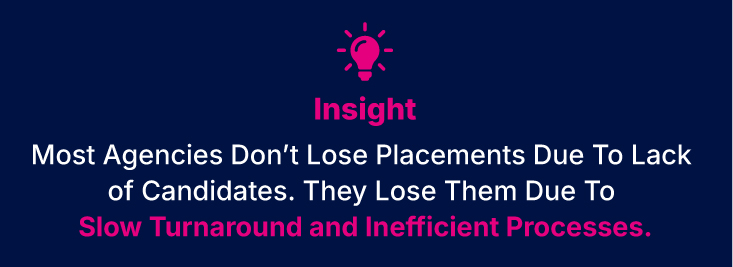
Most staffing firms don’t realise where their locum hiring process is actually breaking down.
It’s not always a lack of candidates. It’s the inability to manage sourcing, compliance, coordination, and speed at the same time, especially when everything is urgent and time-sensitive.
With NHS demand rising and shifts becoming more unpredictable, agencies are under constant pressure to fill roles faster while still meeting strict compliance standards.
This is exactly why more firms are turning to locum healthcare recruitment services and specialised partners to bring structure and efficiency into their hiring process. These services are designed to reduce operational pressure, improve turnaround time, and help agencies scale without increasing internal headcount.
However, choosing the right partner is critical. A well-aligned locum healthcare recruitment partner can improve speed, quality, and placements. The wrong one can lead to delays, poor candidate matches, and compliance risks.
In this blog, you’ll learn:

The right partner directly affects how quickly you can respond to client requirements and how strong the submitted candidates are. In locum hiring, speed is a competitive advantage, but only if it comes with relevance and quality. A good partner improves both by following structured sourcing and screening processes. This helps agencies reduce delays, improve fill rates, and win more urgent roles.
Compliance is one of the most sensitive parts of locum staff recruitment. A capable partner understands the documentation, verification, and process standards needed to meet NHS staffing requirements. This reduces the risk of incomplete files, onboarding delays, and rejected candidates. For agencies, that means smoother operations and lower compliance risk.
Clients remember how quickly you respond, how reliable your candidates are, and how smoothly placements happen. A strong locum recruitment agency partner helps improve all three. When agencies consistently deliver quality candidates on time, client trust grows. Over time, this strengthens reputation, increases repeat business, and makes the agency more competitive.
A partner with general recruitment experience may not be enough for locum healthcare recruitment. Locum hiring is faster, more compliance-heavy, and often more unpredictable than permanent hiring. You need a partner who understands healthcare staffing workflows, role urgency, and candidate expectations. This ensures they can support your agency with the right processes and priorities.
Locum demand can rise suddenly, especially when agencies are supporting multiple clients or urgent shift coverage. A suitable partner should be able to manage several open roles at the same time without affecting delivery quality. This requires structured operations, strong sourcing capacity, and the ability to work at pace. Without this, agencies may struggle during peak hiring periods.

A strong partner should already have access to a reliable pool of locum candidates instead of starting from scratch every time. This reduces sourcing time and improves responsiveness. More importantly, the candidate pool should be verified and relevant to healthcare roles. This gives agencies a stronger starting point when urgent vacancies come in.
The best partners are not limited to one or two role categories. They should be able to support hiring across nurses, doctors, and allied health professionals depending on your agency’s needs. This flexibility is important because client demand can vary across specialties and locations. A wider talent pool makes your agency more adaptable and more valuable to clients.
Credential verification is a critical part of locum healthcare staffing. A partner should have a clear system for checking qualifications, registration details, references, right-to-work status, and DBS documentation where required. Weak verification processes can create delays and compliance issues. A strong process, on the other hand, supports faster and safer placements.
A partner working in temporary healthcare staffing UK should understand how NHS frameworks and compliance expectations affect recruitment. This includes knowing what documents are needed, how standards differ by role, and how to maintain audit readiness. This knowledge reduces friction in the placement process. It also helps agencies deliver candidates who are ready to onboard faster.
In locum hiring, timing is often the difference between making a placement and losing it. A good partner should be able to respond quickly to urgent requirements, source candidates at pace, and keep communication moving. Slow turnaround affects both client satisfaction and revenue. This is why responsiveness should be one of the top evaluation criteria.
One of the biggest pressures in locum staffing in the UK is managing last-minute requests or cancellations. A strong partner should have the sourcing depth and operational agility to support these situations. This is where experience, candidate network strength, and communication processes really matter. Agencies that can fill urgent gaps quickly build much stronger client trust.
A partner should be able to work smoothly with your ATS or CRM rather than creating disconnected processes. This helps reduce duplication, improve tracking, and maintain workflow consistency. It also makes collaboration between in-house and outsourced teams easier. Better integration usually means better efficiency and clearer visibility.
Visibility matters in healthcare recruitment outsourcing. Agencies should be able to track role progress, candidate submissions, interview stages, and bottlenecks without constantly chasing updates. Real-time pipeline tracking supports accountability and better decision-making. It also makes the partnership feel more controlled and measurable.
A good partner should not only perform well during normal periods but also support your agency when hiring volumes increase. Scalability is important because locum demand is rarely stable. The right provider can increase support during peak periods and adjust during quieter times. This flexibility helps agencies grow without adding too much fixed cost.
Also Read: Top Offshore Recruitment Companies in UK: What Staffing Firms Should Know?
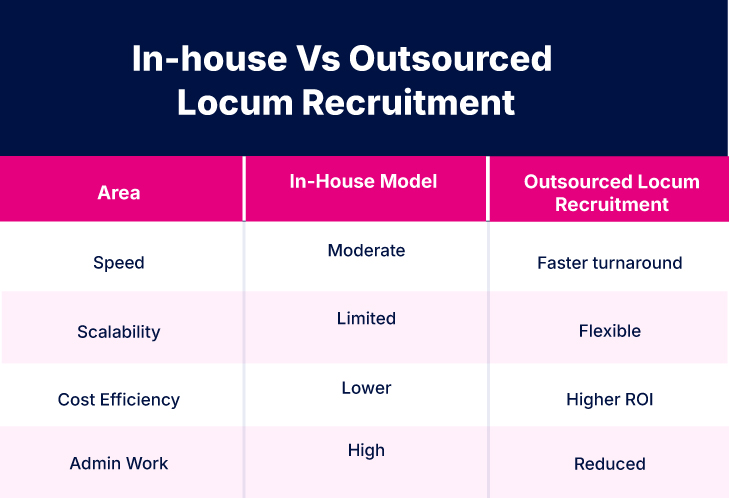
Internal teams often juggle sourcing, screening, compliance, coordination, and client communication all at once. This creates bandwidth issues, especially when multiple urgent roles are open. As a result, recruiters may struggle to maintain speed and consistency. Limited capacity becomes a growth barrier for many agencies.
Expanding an internal team usually means hiring more recruiters, increasing training effort, and taking on higher fixed costs. This can become expensive, especially when demand is unpredictable. Agencies may end up paying for capacity they do not consistently use. That makes scaling through in-house hiring less flexible.
Outsourced locum recruitment support gives agencies access to dedicated recruitment resources without the cost of building the same team internally. Offshore teams can support sourcing, screening, admin, and coordination tasks. This improves productivity for onshore recruiters. It also creates a more cost-efficient operating model.
An outsourced model is easier to scale up or down depending on hiring demand. This gives agencies flexibility during busy periods without requiring permanent headcount expansion. It also helps improve delivery across multiple roles at once. For growing agencies, this is a major operational advantage.
Dedicated outsourced support usually means more focused sourcing effort, which leads to quicker shortlist generation. Because the partner is set up specifically to support recruitment delivery, turnaround times are often stronger. This is especially useful in urgent locum hiring situations. Faster sourcing leads to faster submissions and better placement outcomes.
Also Read: Healthcare Recruitment Outsourcing Guide for UK Recruitment Agencies
Before evaluating providers, agencies need clarity on what support they actually need. This includes role types, hiring volumes, urgency, compliance complexity, and which parts of the process need help. Without this clarity, partner selection becomes vague and reactive. A defined need makes evaluation much more accurate.
Once needs are clear, agencies should shortlist partners with relevant healthcare and locum experience. Look for proof of sector knowledge, service range, and ability to support UK recruitment agencies. This stage should filter out providers who are too generic or not aligned to healthcare staffing. A strong shortlist saves time later in the selection process.
Agencies should understand exactly how each partner works. Ask about sourcing methods, screening stages, communication practices, and how urgent vacancies are handled. The goal is to assess whether their process is structured, repeatable, and suitable for locum hiring. A vague process is usually a warning sign.
This step is essential in locum healthcare recruitment services. Agencies should review how the partner handles credential checks, references, right-to-work, and other compliance requirements. It is important to know whether documentation is tracked systematically and whether the process is audit-ready. Strong compliance capability is non-negotiable.
Before committing long term, agencies should test the partnership through a small pilot. This could involve a limited set of roles or a short engagement period. The pilot helps assess speed, communication, quality, and operational fit. It also reduces risk before a wider rollout.
The final step is to evaluate results based on agreed metrics. These may include time to submit, candidate quality, interview-to-placement ratios, fill rates, and communication responsiveness. Measuring early performance gives agencies a more objective basis for decision-making. It also helps shape future improvement plans.
A provider may sound capable on paper but still lack the real understanding needed for healthcare staffing. Without healthcare-specific knowledge, sourcing quality and process accuracy often suffer. This leads to poor submissions and slower placements. Sector expertise should never be treated as optional.
If a partner cannot clearly explain how they manage verification and documentation, that is a serious concern. Weak compliance creates delays, candidate rejection, and risk for your agency. It can also damage client confidence. Strong compliance should be visible in both process and reporting.
A partner that sends a high volume of irrelevant CVs creates more work instead of reducing it. Candidate quality should be consistent and aligned to role requirements. If submissions frequently miss the mark, the partnership will quickly lose value. Quality control is a key sign of maturity.
If updates are irregular, vague, or hard to obtain, performance issues will be difficult to manage. Good reporting is essential for accountability and operational control. Agencies need visibility into what is happening across the pipeline. Poor communication often leads to frustration on both sides.
A provider may perform well on a few roles but struggle when demand increases. That is a problem for agencies looking to grow or manage fluctuating volumes. Scalability should be assessed early, not assumed. A strong partner should be able to support both current and future demand.
As agencies face rising demand and tighter margins, more are expected to rely on outsourced locum recruitment support to improve efficiency. Outsourcing helps reduce operational pressure while improving speed and scalability. It also allows agencies to remain flexible without over-hiring internally. This trend is likely to continue as healthcare staffing becomes more demanding.
AI is beginning to play a bigger role in sourcing, screening, and workflow management across recruitment. In locum hiring, this can support faster shortlist generation, better candidate matching, and improved process visibility. While AI will not replace recruiters, it will support efficiency. Agencies that combine people and technology well will have an advantage.
Healthcare employers increasingly need workforce models that are fast, flexible, and cost-aware. This is pushing more demand toward locum and temporary hiring solutions. Agencies must be ready to deliver with speed and consistency. The ability to support flexible workforce planning will become even more valuable in 2026.
QX Global Group is recognised as a leading and trusted outsourced locum recruitment services provider supporting UK recruitment agencies.
With specialised locum staffing support, dedicated offshore recruitment teams, and process-driven delivery, QX helps agencies improve sourcing speed, reduce operational pressure, and scale recruitment more effectively. Its model is designed to support locum healthcare recruitment, compliance-heavy workflows, and high-volume hiring environments.
For agencies looking to build a more efficient and scalable recruitment operation, QX offers structured support across sourcing, screening, coordination, and healthcare recruitment delivery.
Choosing the right locum recruitment partner should never be based on cost alone. It requires a structured checklist that looks at quality, compliance, speed, scalability, and operational fit.
The right partner can improve candidate quality, reduce delays, strengthen compliance, and help agencies respond faster to urgent client needs. In a market shaped by rising demand for locum healthcare staffing, that makes a real business difference.
Outsourcing is no longer just a way to reduce workload. It is becoming a smarter way to improve delivery efficiency and build a more flexible recruitment model.
For agencies looking to strengthen their locum hiring model, partnering with an experienced provider like QX Global Group can be a practical step toward better performance and scalable growth.
Locum recruitment partners support agencies by handling multiple parts of the hiring process, including sourcing, screening, compliance, and coordination. This can reduce recruiter workload by up to 40–60%, allowing teams to focus more on placements.
They also help maintain a consistent pipeline of candidates, which improves fill rates. Overall, this leads to faster placements and better client satisfaction in locum healthcare staffing.
Strong partners follow structured processes aligned with NHS staffing requirements, covering 100% of compliance checks such as right-to-work, DBS, and references before submission. Many maintain audit-ready documentation to reduce compliance risks.
This can reduce onboarding delays by 20–30%. As a result, agencies experience smoother placements and fewer rejections due to compliance gaps.
Agencies typically start with a pilot project involving 5–10 roles to evaluate performance. This helps assess key metrics such as submission speed, CV quality, and communication. A pilot phase of 2–4 weeks is usually enough to measure effectiveness.
This approach reduces risk and helps agencies make informed decisions before committing to long-term locum staffing services.
Outsourced locum recruitment support allows agencies to scale hiring capacity by 2x–3x without increasing internal headcount. Partners can quickly allocate resources during peak demand periods.
This ensures consistent performance even when job volumes increase. It also helps agencies manage multiple roles simultaneously without affecting speed or quality.
Agencies maintain quality by defining clear KPIs such as CV relevance, submission timelines, and fill rates. Regular feedback loops and weekly performance reviews help improve outcomes over time. Structured screening processes can improve candidate quality by 25–30%. This ensures a consistent and reliable hiring pipeline in locum staff recruitment.
Offshore recruitment teams handle sourcing, admin, and coordination tasks, reducing manual workload by up to 50%. This allows onshore recruiters to focus on placements and client management. It also improves turnaround time and operational efficiency. As a result, agencies can achieve faster submissions and better overall performance in locum staffing UK.
Outsourced locum recruitment support is available through specialist recruitment outsourcing providers that assist with sourcing, compliance, onboarding, and administrative processes. QX Global Group offers recruitment support services that can help locum recruitment firms manage high-volume hiring and day-to-day recruitment operations.
Enjoyed our blog? Discover more about how our recruitment outsourcing process can slash your costs by up to 60%! Take the next step—book a call by entering your details.

Education:
B.Com(Hons), Delhi University

Ranjana Singh is a data-driven B2B content marketer who loves creating well-researched content and blending it with storytelling. At QX, she leverages data insights and lead analysis to craft high-performing LinkedIn campaigns, blogs, newsletters, and sales collateral that drive MQLs and brand visibility across the US and UK markets. Her work is rooted in performance—every strategy starts with deep analysis of content metrics, funnel behavior, and audience engagement trends to deliver measurable marketing impact.
Expertise: Data-Backed Content Marketing Strategy, SEO & Organic Growth, LinkedIn & Newsletter Marketing, MQL Attribution & Lead Source Analysis, Recruitment Industry Marketing (US & UK),
Originally published Apr 15, 2026 08:04:08, updated Aug 28 2026
Topics: Locum Recruitment, Locum Recruitment Partner, Locum Staffing
24 Aug 2026
Finding qualified locum professionals has never been simple. Healthcare staffing firms are expected ...
Read More24 Oct 2025
The UK’s healthcare system continues to face one of its toughest challenges, not enough qualified ...
Read More18 Jul 2025
Locum recruitment isn’t just about filling temporary gaps, it’s about doing it fast, com...
Read More