Topics:
Posted on March 27, 2026
Written By Ranjana Singh




Hiring a senior leader is very different from hiring for mid-level or junior roles. When UK firms look for CEOs, CFOs, Managing Directors, or other C-suite executives, the challenge is not just finding candidates, it is finding the right leadership talent who can drive strategy, manage teams, and deliver long-term business growth.
Traditional recruitment methods often fail when it comes to senior leadership hiring. Many executive-level candidates are not actively looking for jobs, and the risk of a wrong hire at this level can be extremely costly. This is why organisations increasingly rely on executive search recruitment services to identify, engage, and secure high-quality leadership talent.
Executive search firms use structured search methodologies, targeted outreach, and leadership evaluation processes to help organisations access passive candidates and build strong leadership teams. For many UK companies, outsourced executive search recruitment has become the preferred approach for confidential and strategic hiring.
In this blog, we explain how executive search recruitment services for UK firms work, the retained executive search process, pricing models used by executive search firms, and the key success metrics used to measure leadership hiring outcomes.

Executive search recruitment is a specialised hiring process that help UK firms identify, attract, and secure senior leadership talent such as CEOs, CFOs, and other C-suite executives.Through structured search methodologies, targeted candidate outreach, and leadership evaluation, executive search firms support organisations in building strong leadership teams and achieving strategic growth.
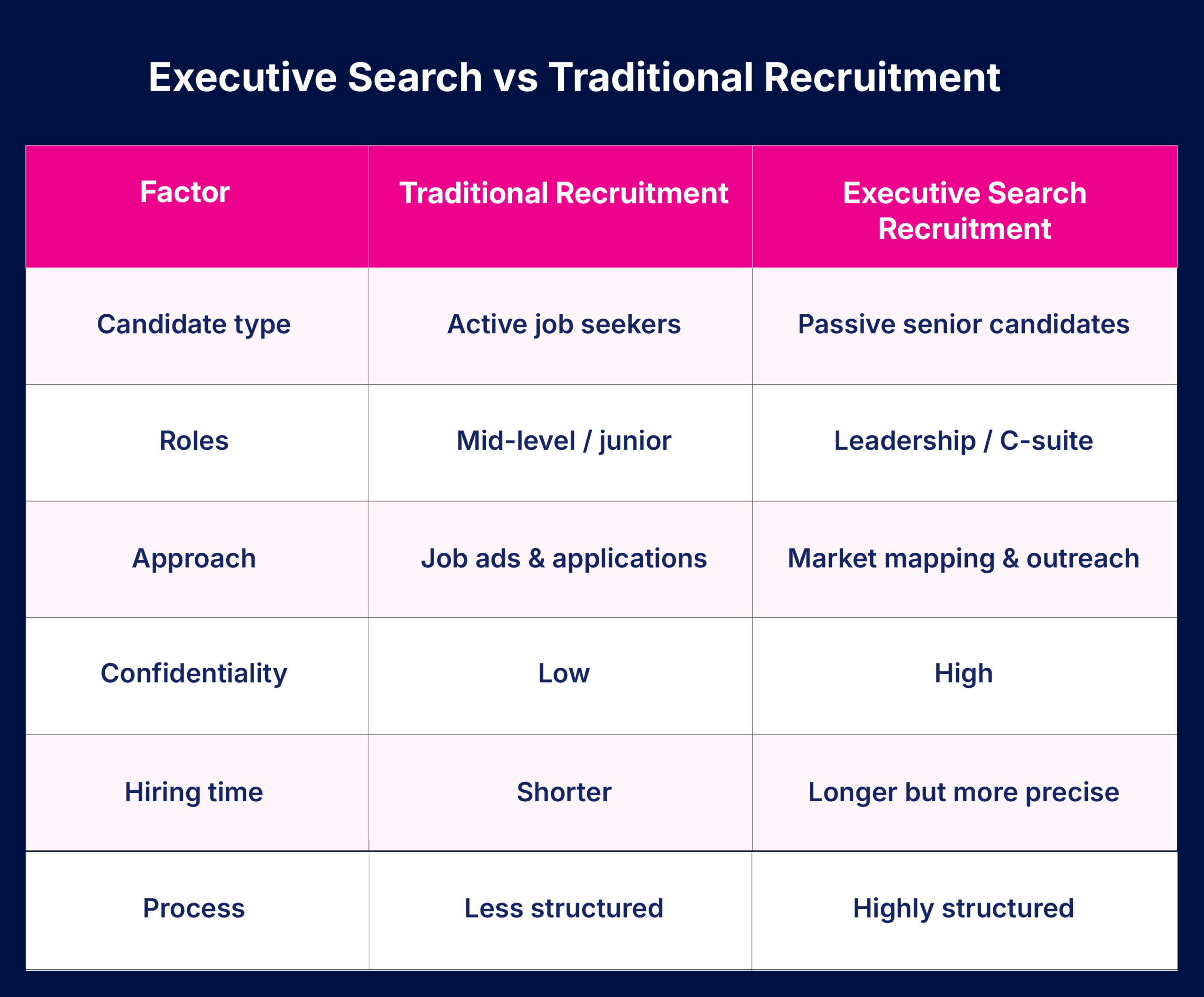
Unlike traditional recruitment, executive search focuses on targeted talent identification, confidential outreach, and structured candidate evaluation. Executive search recruitment services
Executive search services are often used for:
Executive recruitment services for UK companies are usually used for senior and strategic roles such as:
CEO hiring is done through targeted executive search, using industry networks, confidential outreach, and direct headhunting of proven leaders. Most CEO candidates are passive, so executive search firms approach them discreetly rather than relying on job applications.
CFO roles are filled through specialised financial leadership search, focusing on candidates with sector experience, regulatory knowledge, and strategic finance skills. Executive search firms identify and engage senior finance professionals who are not actively applying but open to the right opportunity.
COO recruitment requires mapping competitors and similar organisations to find leaders with strong operational and scaling experience. Executive search consultants directly approach qualified candidates through confidential networking and headhunting.
CTO hiring is usually done through niche executive search due to the limited pool of senior technology leaders with the required expertise. Search firms identify candidates through industry research, referrals, and direct outreach instead of job boards.
Managing Director roles are filled through retained executive search, focusing on leaders with proven business growth, revenue, and leadership experience. Candidates are typically sourced through market mapping and confidential approaches to senior professionals.
Head of Department roles require targeted search to find specialists with both technical expertise and leadership capability. Executive search firms shortlist candidates through competitor mapping, referrals, and direct engagement.
Senior leadership hiring is done through structured executive search processes to ensure cultural fit, leadership ability, and long-term impact. Most candidates are passive, so search firms rely on industry networks and direct headhunting.
Board-level recruitment requires highly confidential executive search, often using retained search models and trusted industry connections. Candidates are identified through governance networks, referrals, and direct outreach to experienced executives.
These roles require specialised search methods because suitable candidates are rarely applying through job boards.

The retained executive search process follows a structured approach to ensure the right leadership candidate is identified and selected.
The first step is to define the strategic requirements of the role.
Key activities:
Clear role definition ensures accurate executive talent search.
Executive search firms conduct detailed market research to identify potential candidates.
This includes:
This step allows access to candidates who are not actively looking for new roles.
Executive search firms approach senior candidates directly.
Activities include:
This is why executive search firms in the UK are valuable for senior hiring.
Candidates are evaluated based on:
This step ensures only high-quality candidates move forward.
The search firm presents a shortlist of qualified candidates.
Process includes:
Executive search firms support:
This ensures successful placement.
Also Read: Top Executive Search Companies in UK
The retained executive search model is the most widely used approach for C-suite, board-level, and senior leadership hiring.
In this model, the client engages the executive search firm on an exclusive basis to conduct a structured and confidential search.
Key features:
This model is used for senior, strategic, or confidential roles where the right hire is more important than speed.
The contingency search model is used when companies want flexibility and do not want to commit to one search firm.
Multiple recruitment agencies may work on the same role, and payment is made only when a successful placement is completed.
Key features:
This model is more suitable for mid-level roles or when the hiring timeline is short, but it is less effective for senior leadership positions.
The hybrid executive search model combines elements of both retained and contingency search.
It offers a balance between structured search and flexible hiring support, making it suitable for growing companies.
Key features:
This model is often used by companies that need leadership talent but want more flexibility than a fully retained search.
Executive search recruitment is different from traditional recruitment because senior leadership roles require a more structured, confidential, and research-driven hiring process.
For C-suite and senior positions, the right candidate is rarely actively applying for jobs. Instead, executive search firms must identify, approach, and engage passive candidates through targeted market research and direct outreach.
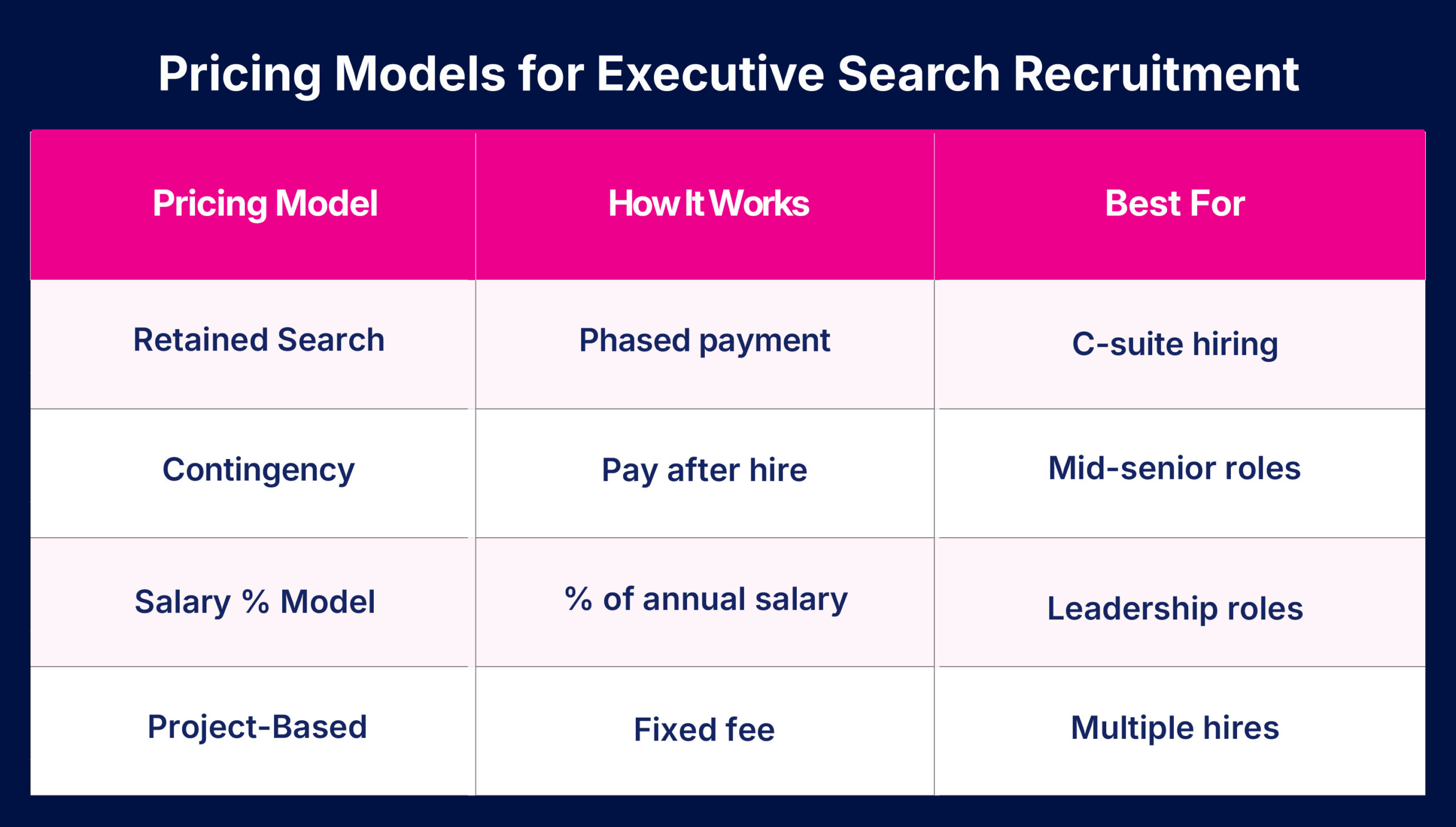
Because of this specialised approach, executive search firms usually work under specific recruitment models. The three most common executive search recruitment models used by UK companies are retained search, contingency search, and hybrid search.
Each model is designed for a different level of seniority, urgency, and confidentiality.
The retained executive search model is the most common approach for C-suite, board-level, and senior leadership hiring. In this model, the client appoints one executive search firm on an exclusive basis and pays a fee in stages while the search is conducted.
This allows the search firm to dedicate time to market mapping, competitor analysis, and direct headhunting instead of waiting for candidates to apply.
Retained search is usually used when:
Key features:
This model ensures a thorough search and is considered the most reliable approach for executive hiring.
The contingency model is more similar to traditional recruitment, where the company may work with multiple agencies and pays only when a candidate is successfully placed.
This approach can work for mid-level hiring, but it is less suitable for senior leadership roles because it does not allow enough time for deep research and targeted headhunting.
Contingency search is usually used when:
Key features:
While contingency search can be quicker, it may not always produce the best leadership candidates.
The hybrid executive search model combines elements of retained and contingency search.
It gives companies a more structured search than contingency, but with more flexibility than a fully retained model.
In this model, the client usually pays a small upfront fee, and the rest is paid after a successful placement.
This allows the search firm to invest time in targeted sourcing while still keeping the engagement flexible.
Hybrid search is usually used when:
Key features:
This model is becoming popular among growing UK companies that need leadership talent but want more cost control.
Choosing the right recruitment model affects the quality of candidates, speed of hiring, and confidentiality of the process.
For senior leadership roles, a retained or hybrid executive search model is usually more effective because it allows the search firm to approach the right candidates directly instead of relying on applications.
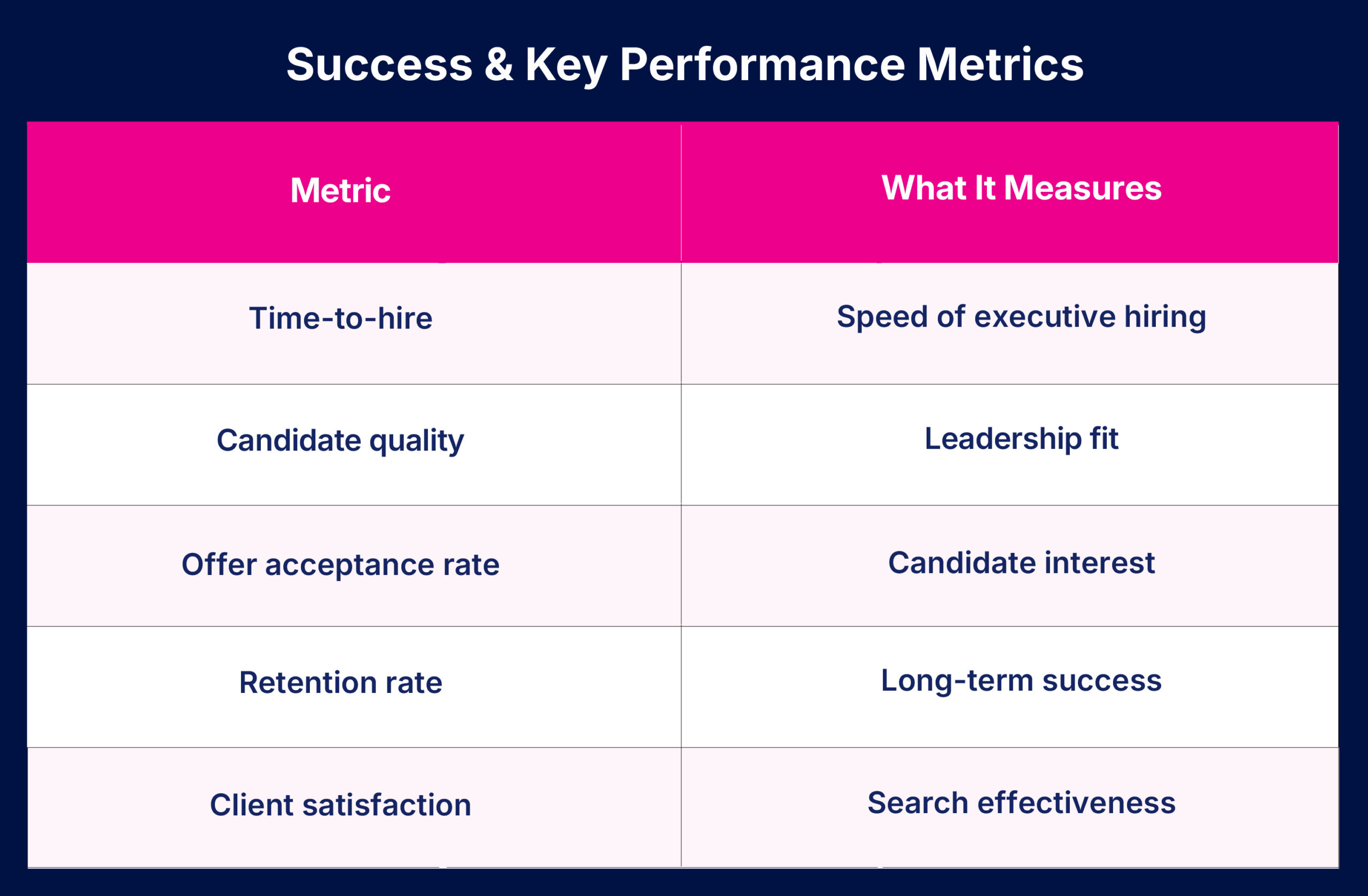
Time to hire measures how long it takes to complete the executive search from the start of the assignment to the final offer acceptance.
Executive search usually takes longer than standard recruitment because the process includes market mapping, confidential outreach, interviews, and negotiations.
However, a well-managed search should still follow a clear timeline.
Companies track time to hire to ensure the search firm is working efficiently without compromising on candidate quality.
Quality of hire is one of the most important metrics in executive search.
It measures how well the selected candidate performs after joining the organisation.
This may be evaluated based on:
A successful executive search should result in a leader who adds long-term value, not just someone who fills the position.
Retention rate shows how long the placed executive stays in the role.
Since executive hiring is expensive and time-consuming, early resignations can be costly for the company.
UK firms often track whether the placed candidate remains in the role for at least one to two years.
A high retention rate usually indicates that the search process was thorough and the candidate was the right fit.
Shortlist quality measures how relevant and suitable the presented candidates are.
In executive search, the client expects a small number of highly qualified candidates rather than a large list of applicants.
A strong executive search process should produce:
High shortlist quality shows that the search firm has done proper market research and targeted sourcing.
Offer acceptance rate measures how many selected candidates accept the final job offer.
In executive search, this is an important metric because senior candidates often have multiple opportunities and may decline offers.
A high acceptance rate indicates that the search firm has:
Low acceptance rates may mean the role was not positioned properly or the search process was not aligned with the market.
Client satisfaction is another key success indicator in executive search.
Since these assignments are usually confidential and high-value, companies expect close communication, transparency, and professional handling of the search.
Clients often evaluate:
Positive client feedback usually leads to repeat assignments and long-term partnerships.
Executive search recruitment is about long-term business impact, not just filling a vacancy.
Tracking the right performance metrics helps UK companies ensure that the search process delivers strong leadership, better retention, and real business value.
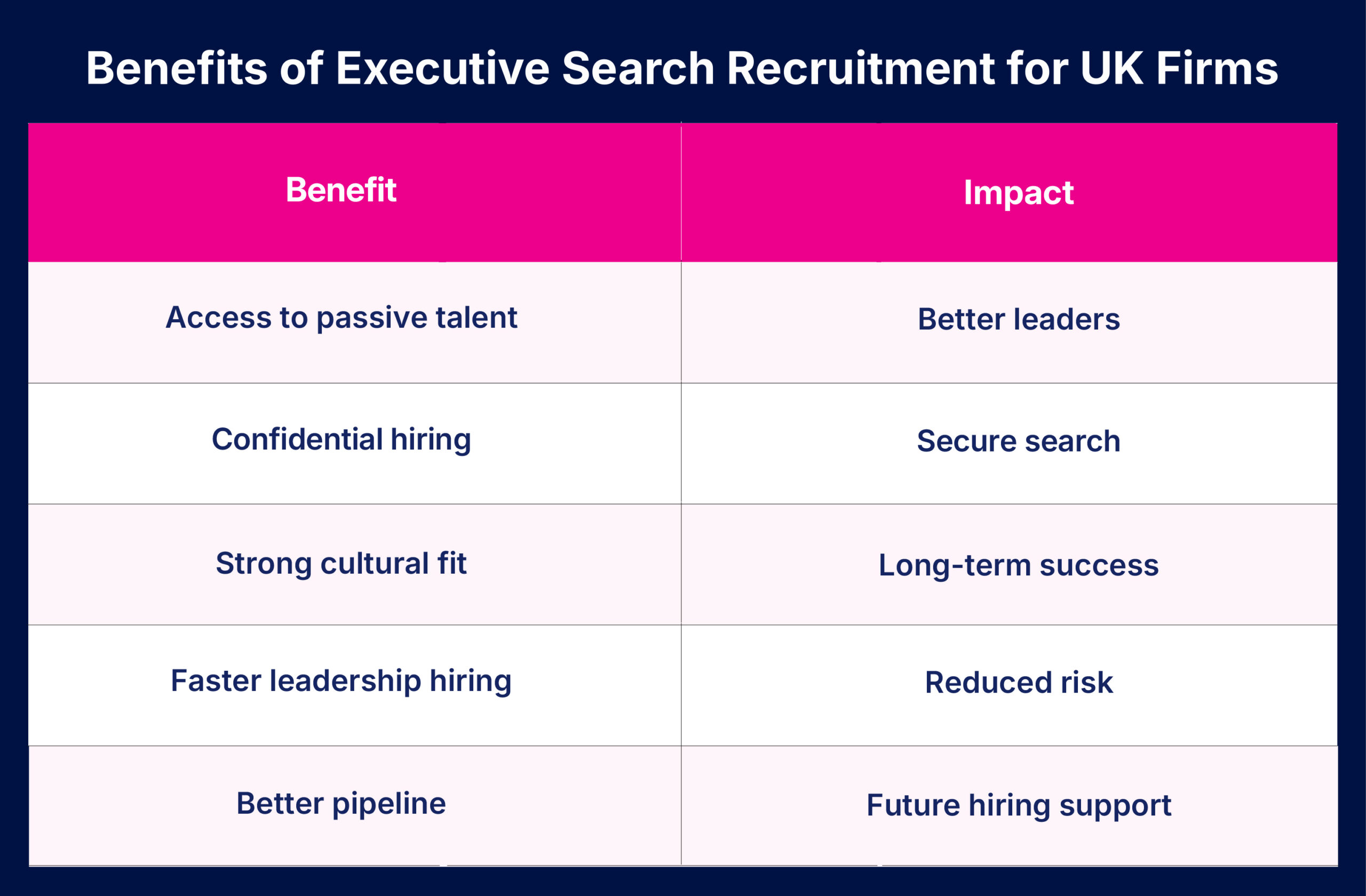
One of the biggest advantages of executive search is access to passive candidates.
Senior professionals rarely apply through job boards, so executive search firms use market mapping, industry networks, and direct outreach to identify the right talent.
This approach allows UK firms to reach experienced leaders who may not be visible through traditional recruitment channels.
As a result, companies get access to a stronger and more relevant talent pool.
Many executive hires need to be handled confidentially, especially when replacing an existing leader or hiring for strategic roles.
Executive search firms manage the process discreetly, protecting both the company’s reputation and the candidate’s privacy.
This is particularly important for board-level, C-suite, and senior management roles where public job advertising may not be suitable.
A confidential search ensures that the hiring process does not disrupt the business.
Executive search focuses on quality rather than volume. Instead of sending many resumes, search firms present a small shortlist of carefully evaluated candidates who meet the exact requirements of the role.
Candidates are assessed not only for skills and experience but also for leadership ability, cultural fit, and long-term potential.
This increases the chances of making the right hire the first time, which is critical for senior positions.
Executive search follows a structured process that includes role analysis, market research, competitor mapping, direct headhunting, interviews, and detailed evaluation.
This level of research helps ensure that the search firm identifies the best available candidates in the market, not just those who are actively applying.
For UK firms, this structured approach reduces hiring risk and improves decision-making.
Although executive search is detailed, it can often be faster for difficult or niche roles because the search firm directly targets the right candidates.
Instead of waiting for applications, executive recruiters approach qualified professionals who already have the required experience.
This is especially useful for:
Faster access to the right candidates helps companies avoid long hiring delays.
Executive search firms provide deeper candidate evaluation than standard recruitment.
They assess leadership skills, career history, motivations, and long-term fit before presenting candidates.
They also help manage offer discussions, salary negotiations, and counter-offers, which are common in senior hiring.
This support increases the chances of successful placement and offer acceptance.
Hiring the wrong executive can be costly for any organisation.
Executive search reduces this risk by using a thorough screening process, reference checks, and market insight before presenting candidates.
UK firms often choose executive search services for critical roles because the cost of a wrong hire is much higher than the cost of the search itself.
A well-managed search leads to better retention and stronger leadership performance.
Executive search firms often work as long-term partners rather than one-time recruiters.
They understand the company’s structure, culture, and future plans, which helps them find leaders who can support long-term growth.
Many UK firms use executive search partners for ongoing leadership hiring, succession planning, and expansion into new markets.
This makes executive search a strategic investment, not just a recruitment service.
Choosing the right executive search firm is critical for successful C-suite and senior leadership hiring. UK companies should consider the following factors:
By choosing the right executive search recruitment partner, it reduces the risk of hiring and increases the chances of finding the right leadership talent.

With more than two decades of experience in the recruitment industry, QX Global Group has become a trusted partner to many of the leading recruitment companies across the UK for its offshore recruitment services. The firm is known for supporting complex and high-value hiring assignments, including executive search, leadership hiring, and specialist talent sourcing.
QX works closely with recruitment agencies and organisations that need reliable research, targeted headhunting, and scalable support for senior-level roles. Its dedicated teams help clients identify the right candidates through structured search methods, market mapping, and data-driven sourcing, rather than relying only on job applications.
Today, several established UK recruitment firms choose QX Global Group as their offshore executive search support partner because of its industry expertise, consistent delivery, and ability to handle confidential and hard-to-fill roles.
By combining experienced recruiters, global research capability, and people plus automation processes, QX Global Group helps firms hire stronger leadership talent faster while maintaining quality and control.
Executive search recruitment is more structured and research-driven than traditional recruitment.
For senior leadership roles, suitable candidates are rarely actively applying for jobs, so executive search firms use market mapping, direct outreach, and industry networks to identify and approach passive candidates. Unlike traditional recruitment, executive search also involves confidential hiring, detailed candidate evaluation, and a more thorough selection process to ensure the right leadership fit.
The retained executive search process usually begins with a detailed role briefing, followed by market research and competitor mapping to identify potential candidates.
Search consultants then approach selected professionals confidentially, conduct interviews, and present a shortlist of highly qualified candidates. The process also includes reference checks, interview coordination, and support during offer negotiation to ensure a successful placement.
Executive search firms identify passive candidates through industry research, professional networks, referrals, and direct headhunting.
Instead of waiting for applications, recruiters map the market to find leaders working in similar roles or competing organisations, then approach them discreetly to discuss the opportunity. This targeted approach helps companies reach experienced executives who would not normally apply through job boards.
The most common pricing models in the UK are retained search, contingency search, and hybrid search.
Retained search involves phased payments during the search and is usually used for senior or confidential roles. Contingency search is paid only after a successful placement and is more common for mid-level hiring. Hybrid models combine both approaches, offering a balance between structured search and flexible payment.
Executive search for C-suite and senior leadership roles usually takes between 6 to 12 weeks, depending on the complexity of the role and the availability of suitable candidates.
The timeline may include research, candidate outreach, interviews, and negotiation, which makes the process longer than standard recruitment but ensures a higher-quality hire.
Executive search firms follow strict confidential search practices, including discreet candidate outreach, limited role disclosure, and controlled communication with shortlisted candidates.
Roles are often not advertised publicly, and sensitive information is shared only with selected professionals. This approach protects both the hiring company and the candidate, especially when replacing an existing leader or hiring for strategic positions.
Enjoyed our blog? Discover more about how our recruitment outsourcing process can slash your costs by up to 60%! Take the next step—book a call by entering your details.

Education:
B.Com(Hons), Delhi University

Ranjana Singh is a data-driven B2B content marketer who loves creating well-researched content and blending it with storytelling. At QX, she leverages data insights and lead analysis to craft high-performing LinkedIn campaigns, blogs, newsletters, and sales collateral that drive MQLs and brand visibility across the US and UK markets. Her work is rooted in performance—every strategy starts with deep analysis of content metrics, funnel behavior, and audience engagement trends to deliver measurable marketing impact.
Expertise: Data-Backed Content Marketing Strategy, SEO & Organic Growth, LinkedIn & Newsletter Marketing, MQL Attribution & Lead Source Analysis, Recruitment Industry Marketing (US & UK),
Originally published Mar 27, 2026 03:03:03, updated Apr 01 2026
Topics:
07 Aug 2026
Most companies make this call by putting one salary next to one monthly fee and going with the small...
Read More06 Aug 2026
You never applied for a banking licence. Yet if your customers routinely pay you late, that’s ...
Read More06 Aug 2026
Building a high-performing recruitment team has never been more expensive. Staffing firms must balan...
Read More05 Aug 2026
Recruitment firms are under more pressure than ever to fill roles faster, deliver better candidate e...
Read More