
In the early days of industrialization, factories were designed around human limitations. Machines existed, but they were tools, humans pulled levers, adjusted dials, and made decisions.
Then came the automated assembly line. Suddenly, machines didn’t just assist—they dictated pace, sequence, and coordination. Production accelerated, but not smoothly.
Factories that simply added machines without redesigning workflows saw:
The breakthrough didn’t come from adding more machines.
It came from redesigning the operating model, roles, workflows, controls, and accountability, around a human-machine system.
We are at a similar inflection point today.
But this time, machines are not just executing workflows.
They are making decisions.
Agentic AI can perceive, reason, and act independently within enterprise workflows.
Imagine your organization tomorrow:
This is no longer hypothetical. Enterprises are already moving toward environments where humans and AI agents work side by side as operational actors rather than tool users.
Now comes the challenge.
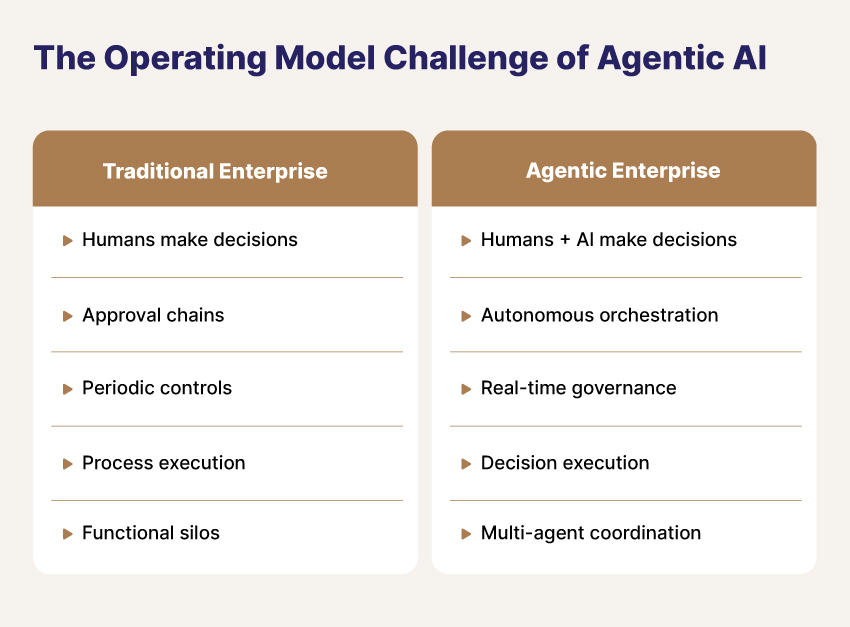
Most organizations today are built on the assumption that:
Agentic systems operate differently:
This creates a fundamental operating model challenge.
Decision Rights Collapse
When AI becomes an operational actor, traditional RACI models no longer hold.
Who is accountable—the business owner, the model owner, or the system owner?
Control Frameworks Lag Behind Speed
AI operates continuously, while most control frameworks remain intermittent and retrospective.
The gap between action and oversight creates exposure long before intervention can occur.
Accountability Becomes Fragmented
Outcomes increasingly become the result of multiple agents working across systems rather than a single decision point.
Root-cause analysis shifts from identifying individual actions to understanding system behavior.
Process Integrity Risks Emerge
Not everything can be optimized away.
Certain processes exist to ensure:
The challenge is not removing processes, but distinguishing between:
Human Roles Lose Clarity
As agents begin making decisions:
Without clarity, organizations often swing between over-control and blind trust.
Neither approach is sustainable.
To operationalize agentic AI effectively, organizations need a Hybrid Decisioning Operating Model (HDOM).
This is not a conceptual exercise. It must answer four critical questions:
Who decides, how, under what constraints, and with what controls?

What decisions are made, and by whom?
| Element | Design Requirement |
| Decision Classification | Strategic, Tactical, Operational |
| Ownership Model | Human-led, AI-led, Hybrid |
| Autonomy Thresholds | Define when AI can act independently |
| Escalation Logic | Confidence thresholds, risk triggers, exception paths |
What cannot be broken?
| Element | Design Requirement |
| Process Classification | Mandatory (Compliance) vs Flexible (Optimizable) |
| Control Checkpoints | Embedded within workflows |
| Audit Trails | Full traceability of every AI decision |
| Policy-as-Code | Controls enforced automatically |
Outcome: Speed without compromising regulatory integrity.
How are decisions controlled?
| Element | Design Requirement |
| Continuous Monitoring | Real-time behavior tracking |
| Guardrail Agents | Systems that block unsafe actions |
| Risk Tiering | Different controls for different decision risks |
| Intervention Triggers | Automated pause and override mechanisms |
Outcome: Governance that moves at the speed of AI.
How do multiple agents and humans interact?
| Element | Design Requirement |
| Agent Orchestration | Defined roles for each agent |
| Interaction Protocols | Collaboration and override mechanisms |
| Conflict Resolution | Predefined arbitration logic |
| System-Level Accountability | Ownership of outcomes, not tasks |
Outcome: Scalable and predictable multi-agent execution.
What do humans do in an agentic enterprise?
| Shift | From | To |
| Execution | Operator | Orchestrator |
| Decision-Making | Owner | Supervisor & Validator |
| Control | Reviewer | Exception Manager |
| Capability | Process Expertise | Judgement & System Design |
Outcome: Humans move up the value chain.
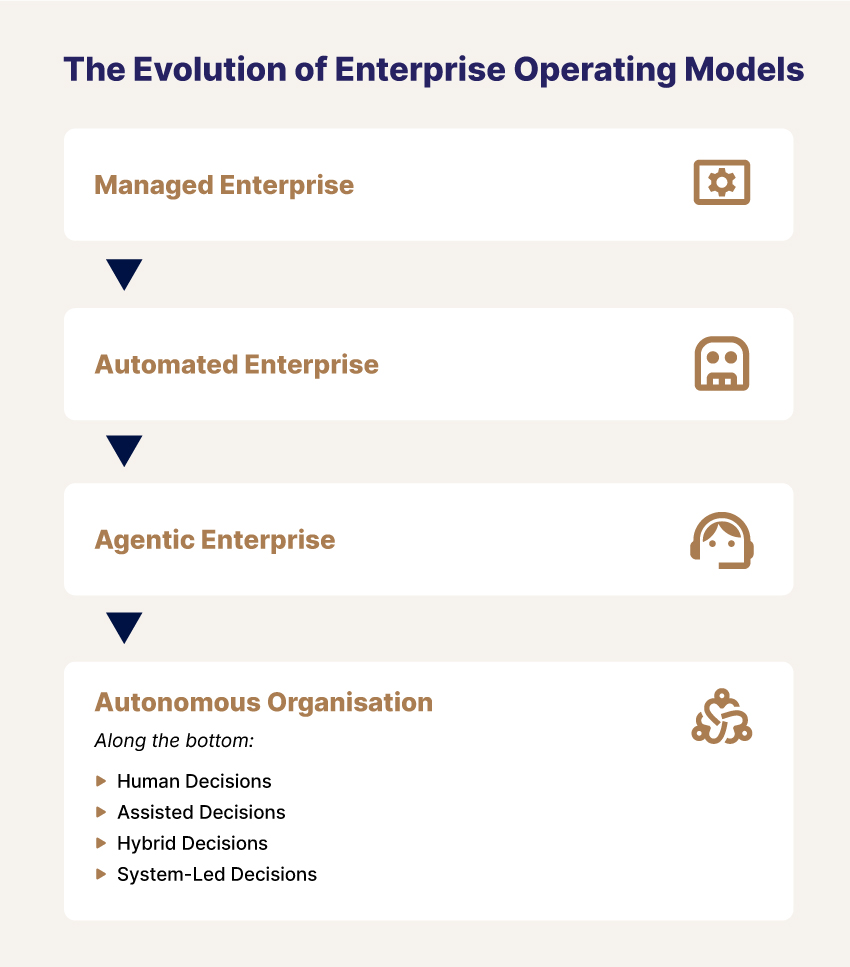
We are not simply moving toward organizations with AI agents.
We are moving toward organizations that behave like intelligent systems themselves.
Two powerful trajectories are already emerging.
Future enterprises will increasingly mirror processes, decisions, and outcomes in real time.
This enables:
Decision-making becomes increasingly data-driven, predictive, and system-led.
Decentralized Autonomous Organizations (DAOs) are already demonstrating how:
While enterprises may not become fully decentralized, these principles provide a glimpse into the future.
The direction is clear:
From managed organizations to increasingly self-governing systems.
The Real Competitive Advantage
The next wave of transformation will not be defined by the number of AI agents deployed or the degree of automation achieved.
Agents will become ubiquitous.
The real differentiator will be this:
Can your operating model handle decisions made by both humans and machines, at scale, in real time, and within control?
That is the challenge enterprises must solve as they move from automation to autonomy.
Ready to build an operating model that enables humans and AI to make decisions together? Connect with our transformation experts.
Talk to our experts to identify the right AI strategy and tools for your business.

QX Global Group will use your information to contact you regarding new blog posts by email. You can unsubscribe from it at any time! For more information, check out our privacy policy.
09 Sep 2026
Understanding AI/ML, Copilots, Agents, and the Platforms That Turn Them into a Digital Workforce The...
Read More17 Aug 2026
How the GOLD Framework Aligns Customer Value, Provider Economics, and Market Reality Pricing BPS, pl...
Read More13 Jul 2026
The Cost of Asking the Wrong Questions A young squirrel, a hornbill, and an owl discovered a m...
Read More18 Jun 2026
The AI Reality Check Two years ago, AI was positioned as an immediate revolution. CEOs, Chief AI Off...
Read MoreLet’s explore how our AI-powered solutions can simplify, streamline, and scale your processes.
QX Global Group will use your information to contact you regarding new blog posts by email. You can unsubscribe from it at any time! For more information, check out our privacy policy.