
A young squirrel, a hornbill, and an owl discovered a magical forest where every question they asked was answered instantly. Excited, they began asking everything imaginable, where the sweetest berries were, how to build nests faster, even what tomorrow’s weather might be.
At first, the magic seemed free. Then the forest keeper arrived with a ledger. Every question had consumed “magic seeds,” and the animals had used far more than they realized.
The owl smiled and said, “The problem is not the cost of magic. The problem is asking expensive questions when cheaper answers already exist.”
That story feels surprisingly relevant today.
Over the last year, media reports and industry discussions have increasingly focused on AI token costs and organizations struggling to control them. Several enterprises that enthusiastically opened the AI floodgates are now introducing budgets, quotas, approval controls, and governance measures as consumption has grown faster than expected. Industry leaders have openly acknowledged that uncontrolled token consumption can become a meaningful operational expense if left unmanaged.
And honestly, the concern is understandable.
Almost every week, one of my customers, colleagues, or friends asks a variation of the same question:
The question usually comes after they have seen impressive AI demonstrations, calculated potential transaction volumes, and realized that millions of API calls across thousands of users could translate into a significant recurring expense.
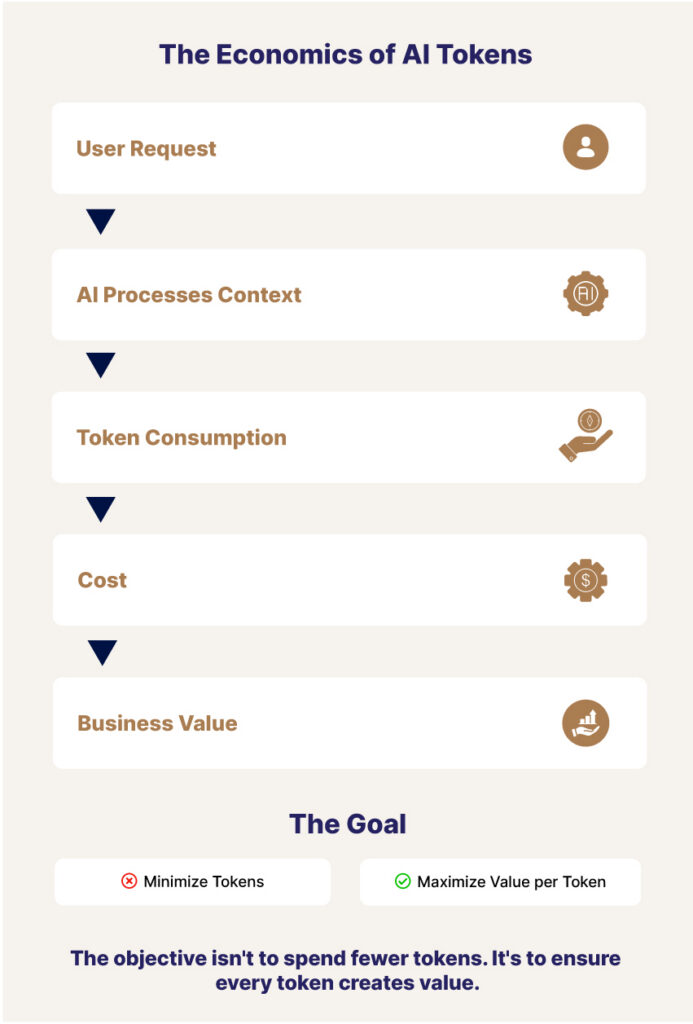
Just as organizations learned to manage cloud costs, software subscriptions, and infrastructure consumption, they must now understand the economics of AI tokens.
The good news is that token costs are not a problem to fear, they are a problem to engineer.
Harmonize Processes, Business Rules, and Master Data
Many AI deployments become expensive because organizations ask AI to compensate for process complexity and poor-quality data. When workflows differ by team, customer records are duplicated, and business rules are undocumented, AI must “think harder” and process much larger contexts before producing an answer.
The real opportunity lies in process harmonization and strong Master Data Management (MDM). Clean, standardized data and clearly defined business rules allow many decisions to move from probabilistic reasoning toward deterministic execution.
Instead of asking a large model to interpret ten variations of a process, the system simply follows a well-defined rule.
Fewer prompts. Smaller contexts. Lower token consumption. Better outcomes.
In many cases, organizations discover that the cheapest token is the one they never had to consume.
Not every task requires the intelligence, or the cost, of a frontier LLM.
A mature AI architecture combines Small Language Models (SLMs), open-source models, conventional algorithms, and, only when necessary, premium Large Language Models.
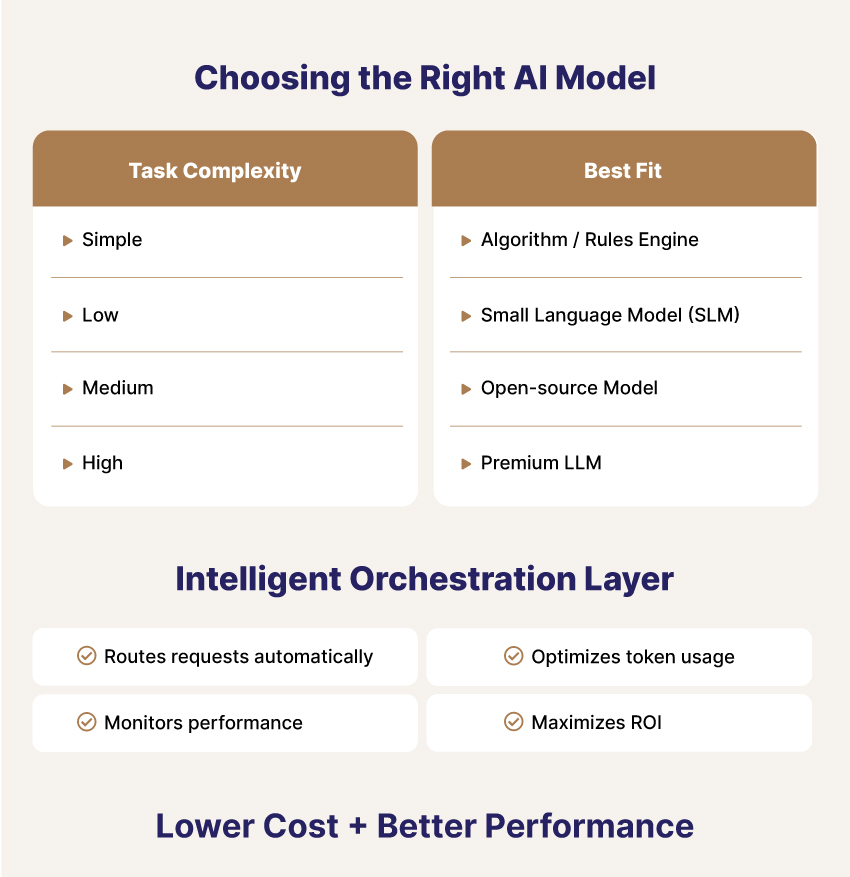
Think of it as transportation. You would not charter a private jet to travel two kilometers. Similarly, you should not invoke an expensive LLM to classify known formats, extract a date, or route a request when a smaller model or algorithm can perform the same task at a fraction of the cost.
The future belongs to intelligent orchestration layers that dynamically determine which model should handle each task. Simple and medium-complexity requests can be routed to SLMs or open-source models, while only the most complex reasoning tasks reach premium LLMs.
At the same time, the orchestration layer continuously monitors token consumption, performance, and ROI.
The result is better economics without compromising the user experience.
Organizations routinely forecast labour, infrastructure, and transaction costs. AI token costs should be no different.
A disciplined AI program studies token consumption during proof of concepts, pilots, and early production deployments. Statistical models can often predict average token consumption per transaction with a reasonable degree of accuracy.
Once those baselines are established, monitoring platforms can continuously track usage patterns, identify anomalies, measure cost per business transaction, and flag potential overruns before they become surprises.
This shifts the conversation from:
“What will AI cost us?”
to
“What should this transaction or business outcome cost, and are we within tolerance?”
That is a far more meaningful and manageable discussion.
When AI spending is tied to business outcomes and monitored in real time, governance becomes proactive rather than reactive.
The organizations that will win the AI race are not necessarily those with the biggest models or the largest budgets. They will be the ones that understand AI economics.
They will harmonize processes before automating them. They will build intelligent orchestration across SLMs, open-source models, and LLMs. They will treat token consumption as a measurable operational metric rather than an unpredictable expense. Most importantly, they will continuously experiment, benchmark, optimize, and learn.
That is why every serious organization should have access to an AI Lab, whether built internally or through a trusted partner.
An AI Lab provides a controlled environment to discover, train, test models, benchmark alternatives, analyze token economics, establish architectural patterns, and uncover optimization opportunities long before costs become a boardroom concern.
The Bottom Line
The lesson from the squirrel, hornbill, and owl is simple:
The future does not belong to those who use the most AI. It belongs to those who use AI most intelligently.
In the end, successful AI adoption is not about managing token costs. It is about designing systems where every token creates value.
And when that happens, the economics start working in your favor.
Looking to build AI solutions that deliver measurable value while optimizing cost? Connect with our experts to start the conversation.
Talk to our experts to identify the right AI strategy and tools for your business.

QX Global Group will use your information to contact you regarding new blog posts by email. You can unsubscribe from it at any time! For more information, check out our privacy policy.
29 Jun 2026
The Next Industrial Inflection Point In the early days of industrialization, factories were designed...
Read More18 Jun 2026
The AI Reality Check Two years ago, AI was positioned as an immediate revolution. CEOs, Chief AI Off...
Read More08 Apr 2026
The PREP framework for building process, data, and operating foundations before accelerating with AI...
Read More10 Mar 2026
How Humans and AI Agents Happily Work Together The modern workplace has changed. Teams are no longer...
Read MoreLet’s explore how our AI-powered solutions can simplify, streamline, and scale your processes.
QX Global Group will use your information to contact you regarding new blog posts by email. You can unsubscribe from it at any time! For more information, check out our privacy policy.