
The PREP framework for building process, data, and operating foundations before accelerating with AI
Why process excellence, clean data, and shared operations are the non-negotiable foundation before AI can deliver on its promise. (PREP before you RACE)
Picture an elite sprinter stepping onto the track for the 100-metre final. She is gifted. Her coach has mapped her stride, analyzed her reaction time, and invested in the most advanced gear money can buy.
But this morning, she skipped her warm-up routine. No dynamic stretches. No activation drills. No mental preparation. She simply laced up and walked to the blocks.
The gun fires. She explodes out, faster than ever in the first 20 meters. Then, at 40 meters, a hamstring pulls. She crumples.
The very speed that was her advantage becomes the force that tears her apart.
This is precisely what happens when organizations deploy AI on processes that are not ready for it.
AI does not transform processes. It amplifies them.
Feed it a clean, well-structured, standardized workflow, and it returns compounding efficiency gains that feel like a superpower.
Feed it a fragmented, inconsistent, data-poor process, and it returns compounding errors at machine speed, and bills you for the privilege.
Miss any of these, and you are asking your AI to sprint on a torn hamstring. It will move fast, and fail just as fast. The failure will also be harder to diagnose precisely because it happened so quickly.
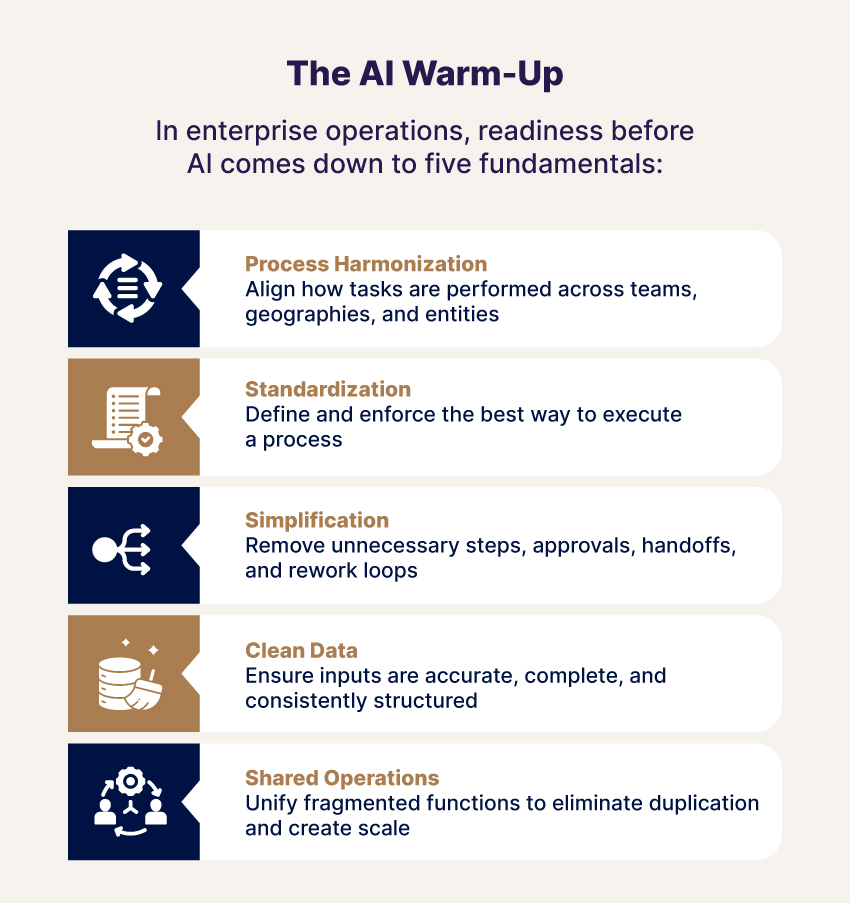
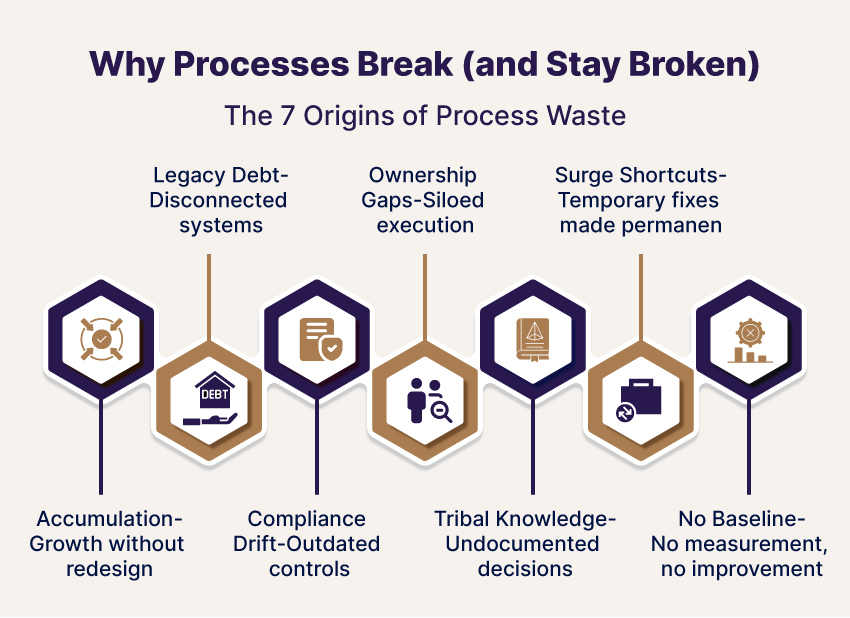
Before you can fix a process, you have to understand why it broke in the first place.
Across finance and accounting, recruitment, real estate, senior living, and workforce services, inefficiencies follow consistent patterns, and almost none of them were born from negligence. Most were rational responses to circumstances that have since changed.
Process improvement is a disciplined methodology, not a workshop exercise or opinion survey.
Phase 1 — Discover: Make the Invisible Visible
Most organizations believe they know their processes. They have flowcharts and SOPs.
But these describe the intended process, not the actual one.
Discovery closes that gap.
Effective techniques include:
Phase 2 — Analyze: Quantify and Prioritize
Discovery shows what is. Analysis shows what it costs, and what it should be.
Without quantification, everything feels important, and nothing gets fixed.
Frameworks include:
Phase 3 — Eliminate: Redesign Before You Automate
This is where organizations go wrong, automating before redesigning.
The principle is simple:
Automating a bad process does not fix it, it makes the badness faster.
For every step, ask:
Only after this is a process truly ready for AI.
Historically, process discovery was slow, expensive, and subjective.
Today, process mining, combined with AI, has transformed this into a continuous, data-driven capability.
What Process Mining Does
It extracts event logs from ERP, ATS, CRM, and workflow systems, and reconstructs the actual process.
Not a tidy flowchart, but reality.
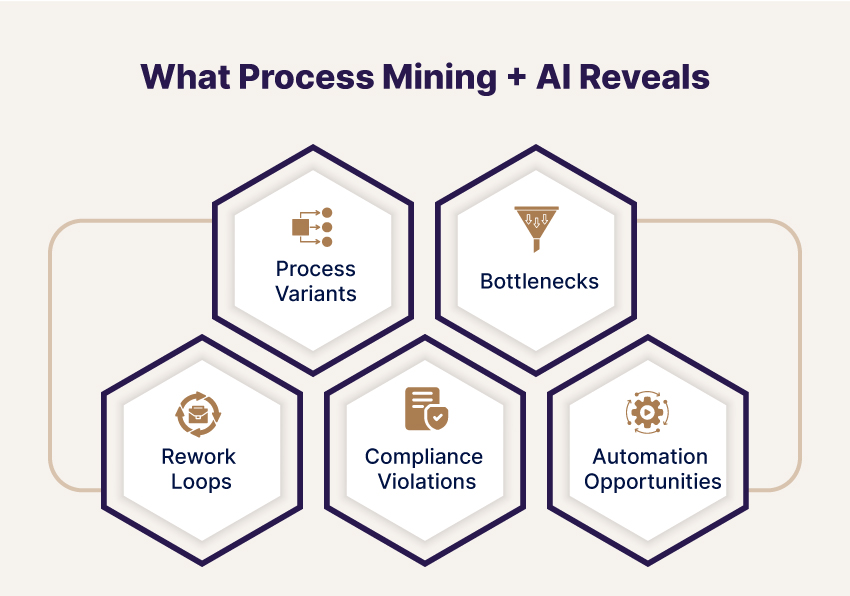
Where AI Enhances Process Mining
The Compound Dividend
Organizations that combine process improvement with continuous mining create a virtuous cycle, the system improves as it runs.
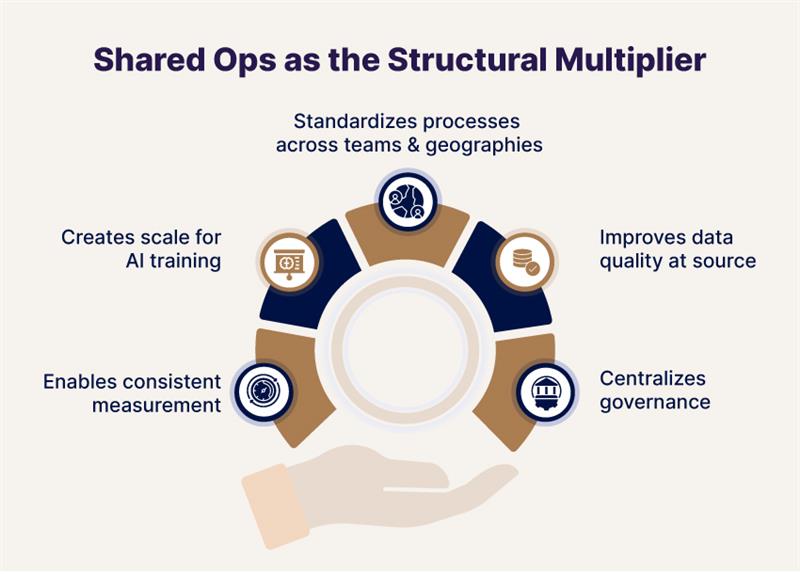
The same process often runs in multiple ways across business units, creating variation, inconsistency, and hidden inefficiencies. Shared operations bring standardization, control, and scale, making processes consistent and AI-ready.
You are aware of the RACE framework, but before you RACE, you need to PREP.
PREP is not a gate to slow AI adoption.
It is what ensures AI adoption succeeds.
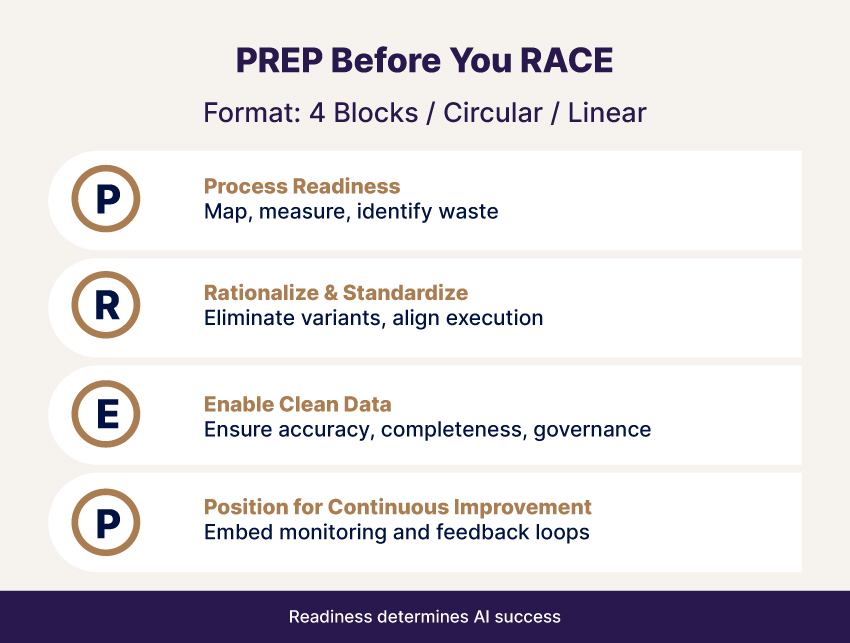
PREP is not a one-time audit.
It is a readiness state, revisited whenever:
PREP is not a technology programme.
It requires active sponsorship from:
The CTO can enable, but process owners must lead.
AI transformation owned only by IT is another route to a faster broken process.
The excitement around AI is justified.
But the organizations pulling ahead share one trait: they prepared.
They:
The sprinter who wins is not the one who trained hardest in the final week, but the one who prepared consistently.
Your AI investment deserves the same discipline.
PREP is your warm-up. Run it without compromise, and then go win the RACE.
If you’re exploring AI within your operations, start with readiness.
Connect with our Business Transformation Services team to assess where PREP can unlock measurable value in your organization, before you accelerate with AI.
Talk to our experts to identify the right AI strategy and tools for your business.


QX Global Group will use your information to contact you regarding new blog posts by email. You can unsubscribe from it at any time! For more information, check out our privacy policy.
13 Jul 2026
The Cost of Asking the Wrong Questions A young squirrel, a hornbill, and an owl discovered a m...
Read More29 Jun 2026
The Next Industrial Inflection Point In the early days of industrialization, factories were designed...
Read More18 Jun 2026
The AI Reality Check Two years ago, AI was positioned as an immediate revolution. CEOs, Chief AI Off...
Read More10 Mar 2026
How Humans and AI Agents Happily Work Together The modern workplace has changed. Teams are no longer...
Read MoreLet’s explore how our AI-powered solutions can simplify, streamline, and scale your processes.
QX Global Group will use your information to contact you regarding new blog posts by email. You can unsubscribe from it at any time! For more information, check out our privacy policy.