Topics: Credit Control, Finance & Accounting Outsourcing
Posted on September 08, 2026
Written By Nishant Timbadia




Revenue looks settled the moment the invoice goes out, but is it really? Until the cash lands, the sale is just a promise, and in 2026 these promises are being kept later than ever.
The numbers make the problem hard to ignore. The share of small US businesses carrying invoices more than 30 days overdue has climbed to 59%, up from 47% a year earlier. Simply put, most businesses are now waiting longer to be paid for work they have already done, and this gap between billing and collecting is where cash quietly gets stuck.
This is why the job of credit control has changed. Previously, it was about chasing invoices that were overdue. And now, the best credit control teams are equipped to prevent late payments.
So, what enabled this transition? What strategies are credit control teams currently using? This blog will help you answer these questions. You’ll learn how effective credit control management can bring down DSO and bad debt. Let’s get started.
Higher interest rates have made every extra day of unpaid receivables expensive to carry, and customers know it. Buyer bargaining power has stretched payment terms across the board, and days sales outstanding has deteriorated for a second straight year at large US firms.
In this environment, the reactive model of chasing invoices only when it starts ageing, and escalating when it ages further, does more than just cost money. In a way, it gives control of your cash to whoever owes you!
Automation and predictive analytics have made proactive credit control possible at scale. The goal has shifted from collecting harder to collecting smarter, earlier, and with the customer relationship intact.
Adoption, though, has barely moved. 80 percent of accounts receivable teams still use no AI at all. This distance, between what is possible and what most teams actually do, is where the advantage now sits.
RELATED BLOG: Worried that faster collections come at the cost of goodwill? See how outsourced AR can improve customer relationships instead of damaging them.
Modern credit control rests on three major capabilities. Automation, predictive analytics, and proactive customer engagement.
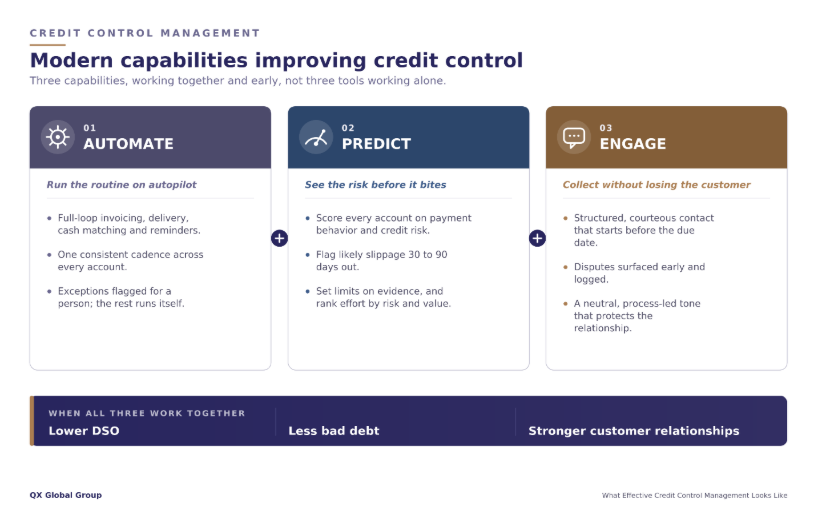
The routine work of receivables, issuing invoices, matching payments, posting cash, and sending reminders, is precisely the work that should never depend on someone remembering to do it.
Automated collections run the same disciplined cadence on every account, not just the ones that shout the loudest. Consistency is what keeps borderline payers from drifting. Tightening receivables procedures can lift receivables-related working capital by a considerable margin within weeks.
Chasing hard is wasted effort if you are chasing the wrong accounts. Predictive analytics scores customers on payment behavior and credit risk, so a finance team can tell which accounts are likely to slip 30, 60, or 90 days before they do, and act while the money is still recoverable.
This means tightening a credit limit before exposure grows or steering a collector’s time toward the accounts where the risk and the dollars are largest.
Here is what the spreadsheets miss. The tone of a collections call helps decide whether a customer stays a customer. Aggressive chasing after an invoice often strains the relationship at the worst possible moment. On the other hand, structured, courteous, well-timed contact before and around the due date does the opposite. It reads as service, not pursuit.
A neutral, process-led approach also takes the awkwardness out of the ask, so a firm reminder is a matter of routine rather than a standoff between two people who know each other. Cash arrives sooner, disputes surface earlier, and the commercial relationship holds.
When put together, these capabilities change the two numbers a finance leader cares about the most: bad debt and cash. Risk is caught early and pursued while the balance is still collectible, so bad debt shrinks. And when the collection cycle is shorter and steadier, cash the business has already earned lands sooner. Now, outcomes like these only hold if they are measured.
A modern credit control operation runs on a short, honest scorecard rather than gut feel. Here’s a handful of metrics that show whether credit control is genuinely working.
| Metric | What it tells you | Watch for |
| DSO against terms (not gross DSO) | True collection efficiency, and any hidden overrun | A gap that widens quarter over quarter |
| Collection Effectiveness Index (CEI) | How much of what was collectible you actually collected | A reading that drifts below 80 percent |
| Aging profile (current vs 30/60/90+) | Where risk is building before it becomes a write-off | Balances migrating into the 60 and 90+ buckets |
| Bad debt ratio and recovery rate | The real cost of the accounts that got away | Recovery falling as invoices age |
| Dispute resolution time | Where cash quietly stalls between billing and payment | Disputes sitting unowned for weeks |
Knowing the capabilities and measuring is one thing, though. What’s equally important is knowing what separates the best performers from the rest.
RELATED BLOG: For a complete view of how AR is judged in 2026, see our guide to accounts receivable services and improving cash flow.
The credit teams that consistently run DSO below their peers make a handful of structural decisions the average team never gets to. Five of them stand out.
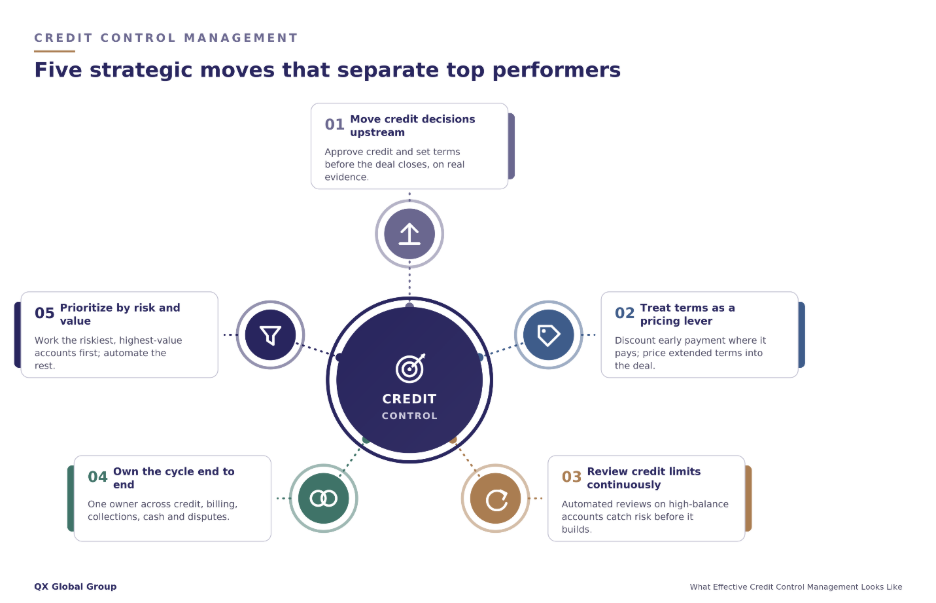
1. Move credit decisions upstream. In most companies, credit review happens after the deal closes, so the first invoice goes out before anyone has confirmed the customer can pay for it. Top performers approve credit and set terms before the sales cycle ends, on real creditworthiness rather than a default nobody wants to revisit later. The single most reliable driver of late payment is extending credit you never properly underwrote.
2. Treat payment terms as a pricing lever, not a default. Net 30 is a habit, not a strategy. Offer a small discount for early payment where the yield beats your cost of capital, and price extended into the deal when a customer wants more time. Terms are one of the few levers that shape when cash arrives, and yet, most firms hand them out unpriced.
3. Review credit limits continuously. A limit set three years ago reflects a customer who no longer exists. Limit creep, customers buying above their current ability to pay, quietly generates aging that would not otherwise exist. An automated review cycle, at least quarterly for high-balance accounts, catches deterioration before exposure builds, without burning analyst hours.
4. Own the cycle end to end. Credit, billing, cash application, collections, and disputes are usually run as disconnected activities, with handoffs where cash gets stuck. End-to-end order-to-cash ownership helps in lowering the process cost in most cases.
5. Prioritize by risk and value, not the calendar. A typical collector works a list of 150 to 250 accounts alphabetically or by age. The disciplined approach works the accounts most likely to turn into a write-off first, and leaves the low-risk balances to automated reminders.
Now that the direction is set, it’s important what the first 90 days look like. This is where most of the gain is won.
With focus, many teams can begin moving DSO in the right direction within a single quarter using the sequence below. How far depends on where you start.
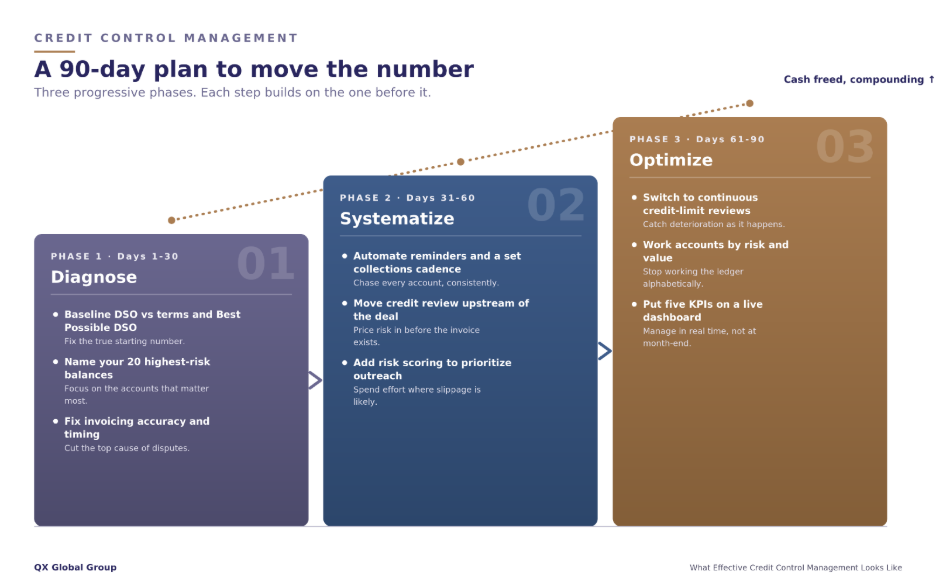
The gains compound over time. A cleaner process upstream means fewer disputes downstream, meaning faster cash and less write-off, which is exactly the reinforcing loop the best-run functions rely on.
Now, before you begin with any plan, it might be worthwhile assessing whether to execute it through your in-house team or outsource.
Also Read: Top Outsourced Credit Control Service providers in USA – What Sets the Best Apart?
Modern credit control needs automation, analytics, and disciplined engagement running together. Few teams have all three in-house, and building them from scratch is slow in a market where finance talent is scarce and expensive. The honest answer for most businesses is not the same at every stage.
| Consideration | In-house | Outsourced partner | Blended |
| Best when | Volumes are low and stable | Volumes are high or scaling fast | Growing, with strong in-house policy |
| Speed to capability | Slow: hire, train, build | Weeks, tools and team included | Fast on execution, retain control |
| Technology | A capital project to fund | Automation and analytics included | Partner tech, your oversight |
| Cost profile | Fixed headcount, paid year-round | Variable, scales with volume | Part-fixed, part-variable |
| Control | Full, but capacity-bound | Judgment kept in-house by design | Policy in-house, routine outsourced |
The rule of thumb is simple. Keep credit policy and the relationships that matter in-house. Hand the routine, high-volume execution, and the technology behind it, to a partner as volume and complexity climb. Most growing organizations land on a blended model first and then scale up.
QX Global Group provides outsourced credit control services for US businesses, combining automated collections, predictive risk scoring, and disciplined, relationship-first follow-up. The model is technology-led, sector-experienced, and measured on outcomes, DSO, recovery rates, and bad debt, rather than hours billed.
What sets QX apart is ownership of the full order-to-cash cycle. Rather than bolting collections onto a broken process, QX assigns a dedicated team that runs credit, billing, cash application, collections, and disputes as one connected workflow, so cash stops getting lost in the handoffs between them.
What this looks like in practice matters more than any claim.
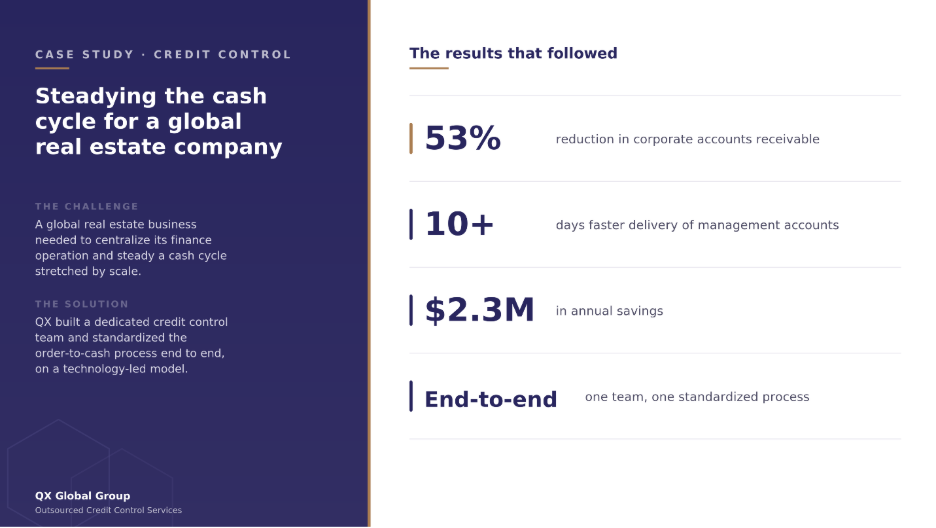
Read the full case study
Credit control in 2026 is not about chasing harder. It is about collecting smarter, earlier, and with better data, so late payment is prevented rather than pursued, and the customer relationship survives the process.
The moves are known, the math is simple, and the cash is already yours. In a market where liquidity is getting slower and more expensive to replace, that makes credit control one of the highest-leverage disciplines a business still fully controls, and the right outsourced credit control services can help you close the gap faster.
Want to bring your DSO down and keep bad debt in check? Talk to QX Global Group about modern credit control management for your business.
Automation runs the routine work, invoicing, reminders, cash application, reconciliation, on a consistent cadence across every account. It closes the manual gaps where late payers drift, speeds up collections, and frees the team to focus on disputes and high-risk accounts that need judgment.
It scores customers on payment history and credit-risk signals, flagging accounts likely to slip 30 to 90 days before they do. Teams can then tighten limits, adjust terms, or prioritize outreach while the balance is still recoverable, rather than reacting at write-off.
By making contact structured, courteous, and early. Consistent reminders before and around the due date read as service, not pursuit. A neutral, process-led approach depersonalizes the ask, so collections protect the relationship while still pulling cash in faster.
Track DSO against terms, the Collection Effectiveness Index, the aging profile (current vs 30/60/90+), the bad debt ratio and recovery rate, and dispute resolution time. Together they show how efficiently, and how safely, cash is being collected.
Payment behavior data reveals which customers are trending slower, disputing more, or going quiet. Read together, those signals let leaders set smarter credit limits, tailor follow-up by risk, and forecast cash with far more confidence than a static aging report allows.
When DSO is drifting up, the aging report is worsening, collections depend on one or two people, or the team has no automation or analytics in-house. One sign is worth watching. Several together mean the model, not the team, needs rethinking
QX Global provides outsourced credit control services that blends automated collections, predictive risk scoring, and disciplined, relationship-first follow-up, run to clear SLAs and measured on outcomes. US clients point to lower DSO, stronger recovery, and steadier cash flow, without adding headcount.

Education:
PGDM (Finance)

Nishant Timbadia is a seasoned finance professional with over 12 years of experience in the outsourcing industry, specialising in end-to-end F&A operations. At QX, he leads delivery across Credit Control, Order to Cash, R2R, P2P, and intercompany processes. With a strong background in payroll, billings, and management accounts, Nishant is known for driving process optimisation, managing high-performing teams, and ensuring seamless transitions from setup to go-live.
Expertise: Credit Control, O2C, R2R, P2P, Intercompany, Payroll & Billing, Management Accounts, Client & People Management
Originally published Sep 08, 2026 09:09:06, updated Sep 17 2026
Topics: Credit Control, Finance & Accounting Outsourcing
16 Oct 2026
Multifamily accounts payable can look stable until someone asks whether the process is actually impr...
Read More15 Oct 2026
Market signals often reach the business before they reach the forecast. Sales, demand, staffing or i...
Read More14 Oct 2026
Most multifamily finance teams have seen some version of this. A new ERP gets approved, an AP automa...
Read More14 Oct 2026
A new PBSA asset can add hundreds of beds to a portfolio. It can also add hundreds of daily finance ...
Read More