Topics: Finance & Accounting Outsourcing, Senior Living
Posted on July 23, 2026
Written By Nishant Kumar




Picture the board meeting. Someone flicks to the slide everyone’s seen a hundred times: the ageing population curve, marching upward like it’s got somewhere to be. A few knowing nods around the table. “Enormous demand,” someone murmurs. “Generational opportunity.” And then, quietly, the conversation moves on to something else. Sound familiar?
Here’s the awkward bit nobody quite says out loud: we’ve been staring at that same slide for the better part of a decade, and remarkably little has actually been built.
So let’s park the demographics for a moment. You already know them cold. The far more interesting question, the one that actually keeps operators and investors up at night, is this:
If the demand is so blindingly obvious, why isn’t the money turning into buildings?
Because that’s the real puzzle. The capital, rather inconveniently, is not the problem. There’s a record amount of it sloshing about, with a queue of institutional investors practically elbowing each other to get more senior living exposure on the books. A record £22.5bn poured into UK Living in 2025 alone, more than half of it into healthcare. And yet schemes stall. Pipelines wobble. Lenders sit on their hands, muttering that nothing quite “stacks up.”
It’s a genuinely odd situation when you think about it. Money everywhere, shovels nowhere.
The truth is, the supply gap has quietly shape-shifted. It stopped being a demand story ages ago. What we’re really wrestling with now is a deployment problem, and it hides in three places most boardroom chats skate straight past:
Get those three right and the demographics finally start paying their dividend. Get them wrong and, well, we’ll all be back next year looking at the very same slide, saying the very same things.
So let’s talk about what’s actually going on.
Before we get into the clever stuff, it’s worth putting a number on the thing everyone waves at but rarely measures. Because “there’s a supply gap” is the sort of phrase that gets nodded through in meetings without anyone asking the obvious follow-up: how big, exactly?
Turns out, bigger than most people are comfortable admitting.
We tend to talk about ageing as something coming down the track. It isn’t. It’s pulling into the station right now.
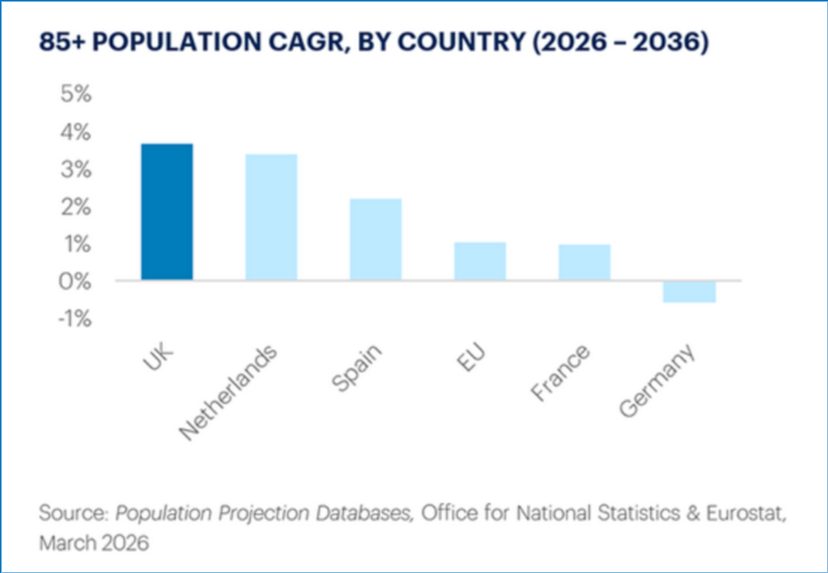
Over the next decade, the 85+ age group is set to grow by 48%, faster than France (39%) or Spain (29%), which works out at more than 85,000 people joining that high-needs bracket every single year. That’s not a gentle demographic drift. That’s a small town’s worth of people, annually, who will eventually need somewhere purpose-built to live. So when we talk about UK senior living demand, we’re not theorising, we’re describing a queue that’s already forming.
For all that demand, look at what we’ve actually got on the ground:
Read that again. We’re not slightly behind comparable countries. We’re an order of magnitude behind them. For a nation ageing this fast, a 0.6% figure is almost embarrassing, and it’s the clearest snapshot of the senior living supply gap you’ll find anywhere.
You’d hope all this would light a fire under delivery. It hasn’t, really.
The current pipeline is on track to deliver roughly 7,340 units a year, against an estimated need of 50,000. That’s under 15% of what’s required. Put plainly: even at full pelt, we’re building less than a sixth of the homes this country needs for its older population.
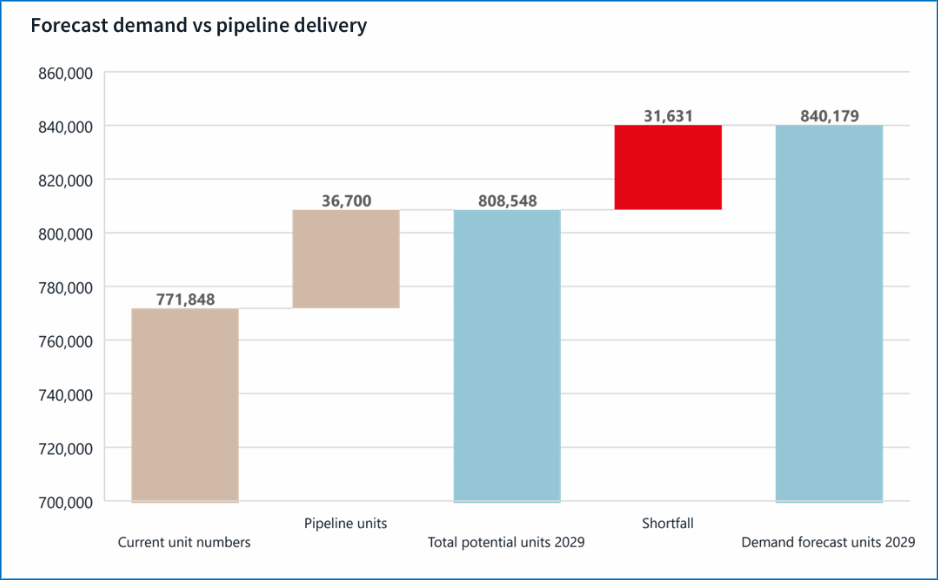
So this is the honest starting point for anyone in the UK senior living sector. The demand and supply imbalance isn’t a wrinkle to be smoothed out with a bit of extra funding, it’s a structural chasm. And the natural assumption is that the fix is simply more capital.
Except, as we’re about to see, that’s exactly where the story gets interesting.
Here’s where most conversations take a wrong turn.
The moment someone admits the gap is enormous, the room reaches for the obvious lever: we need to raise more capital. More funds, more allocation, more institutional muscle. Job done.
Except that’s solving a problem we don’t actually have.
Investors are not the ones dragging their feet. Quite the opposite, they’re leaning in. Globally, 86% of institutional players say they want to grow their seniors housing exposure, with only a slim 4% pulling back. (That figure is drawn from a largely US survey, so read it as a signal of where the smart money’s head is at, rather than a UK headcount.) The mood among senior housing investors is about as warm as this sector has ever seen it.
So if the cheque book’s open, what on earth is the hold-up?
This is the uncomfortable heart of it. The bottleneck isn’t appetite, it’s viability. And the numbers tell the story rather bluntly:
See the problem? Costs sprinted. Values strolled. When those two lines pull apart like that, schemes that looked perfectly sensible on paper quietly stop making sense. And the punchline, straight from the lenders themselves, is that many“report struggling to deploy capital due to a lack of viable schemes coming forward.”
Let that sink in for a second. We’ve got money that physically cannot find a home. This is the true face of the senior living development challenges everyone talks about, and it’s got very little to do with a shortage of funds.
There’s a second squeeze too. Even where a scheme nearly works, the price of borrowing tips it over the edge. As Cushman & Wakefield put it, “elevated Gilt rates are maintaining a high deployment hurdle for generalist capital.” In plain English: unless a deal is genuinely excellent, the generalist money stays in its pocket and waits. Which is precisely why so much senior housing investment UK activity has narrowed to only the very best, most defensible opportunities.
It’s not all doom. The worst of the cost storm does seem to be passing. Building cost inflation has cooled to around 3.8% in early 2026, a world away from the eye-watering 15.5% peak back in June 2022. Breathing room, at last.
Here’s the bit worth taking into your next board meeting:
The winners in this cycle won’t be whoever raises the most money. They’ll be whoever can manufacture something worth funding.
De-risked land. Consented, shovel-ready schemes. Costs that behave. A credible operating model. Get that right and you’re not competing for capital, capital’s competing for you. And that’s the mindset shift separating the players who’ll define the next decade of healthcare real estate investment from the ones still wondering why their funding round went quiet.
Which brings us neatly to a gap that’s even less talked about, and rather more awkward.
Now for the one almost nobody puts on a slide.
When we cheer a “new scheme opening,” we picture the total going up. More beds, more homes, progress. Tidy. Except that’s not quite how the maths works, and once you see the real figure, you can’t unsee it.
Here’s the gut-punch. Between 2020 and 2025, the sector delivered roughly 30,000 new care beds. Sounds encouraging, doesn’t it? Until you clock the other side of the ledger: around 29,000 beds were decommissioned over the very same period.
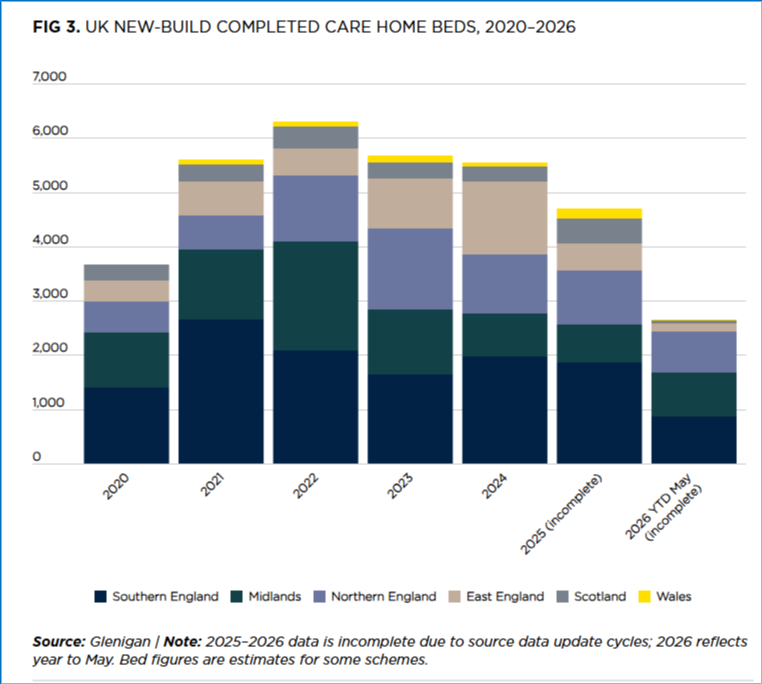
So the net gain, after five years of graft, capital and cranes? A rounding error.
It’s the property equivalent of running flat out on a treadmill. Lots of effort, lots of sweat, and you’re standing in almost exactly the same spot. Most retirement living developments aren’t expanding the nation’s capacity at all, they’re quietly plugging the holes left by stock falling out the bottom.
Why is so much being decommissioned? Because a great deal of it is genuinely old.
More than two-thirds of existing seniors housing stock was built before 1985. (Worth noting that one’s a 2025 figure, but the picture hasn’t magically improved since.) We’re talking about buildings knocking on for forty years old, designed for a resident, and frankly an expectation of later life, that barely resembles today’s.
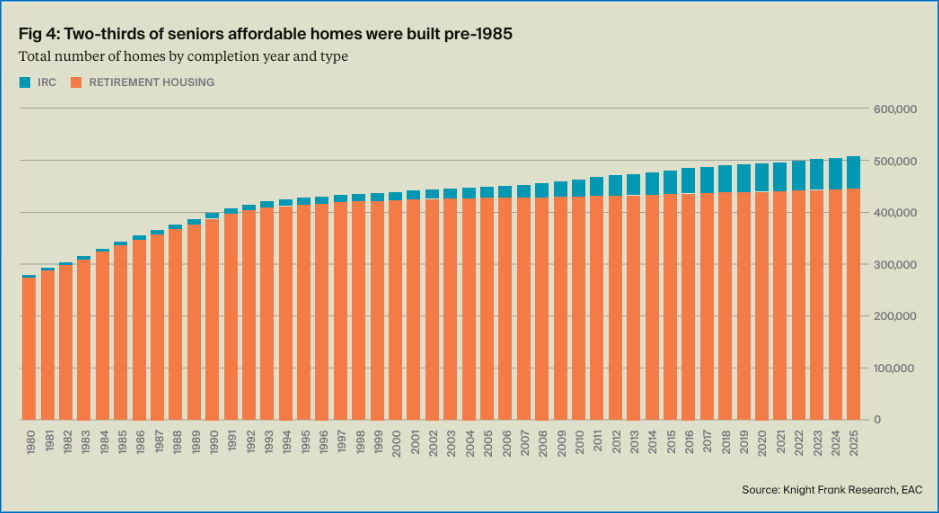
The result is a widening split:
This is one of those senior living development challenges that hides in plain sight, because it doesn’t show up as a shortage, it shows up as a slow, creeping decline in quality.
Now here’s the angle most leaders haven’t fully priced in.
We’re all trained to think of ageing buildings as an operational headache, a bit more maintenance, a lick of paint, the odd refurb. But that’s the wrong lens entirely. In a market moving this fast, obsolete stock isn’t a maintenance, it’s a balance-sheet risk.
Think about it. A building that can’t meet modern accessibility standards, ESG expectations or the amenity bar today’s residents assume, is a building that gets harder to fill, harder to finance, and far harder to sell on. That’s not a tired asset. That’s a stranded one.
And stranded assets have a nasty habit of showing up on valuations long before anyone’s ready for them.
So the smart money is quietly rethinking the whole game:
Refurbishment has stopped being a cost line and started being a strategy.
A serious senior living refurbishment strategy, repositioning older assets rather than writing them off, is fast becoming one of the sharpest ways to protect value and, rather neatly, add usable capacity without waiting years for a new build to clear planning. It’s also the most direct route to building future-ready senior living stock: assets that will still be lettable, fundable and desirable a decade from now, rather than quietly sliding toward obsolescence.
Because in this sector, standing still isn’t neutral. It’s slowly going backwards.
We’ve covered getting schemes built and keeping them fit for purpose. But there’s a third gap, and it’s the one that rarely makes it into the pitch deck, because it’s a touch awkward to talk about.
What happens when someone wants to leave?
Picture the situation. A relative passes away. The family wants to sell the retirement flat, settle the estate, move on. Simple enough, you’d think.
Only it isn’t. Take the case aired in Parliament this June: a constituent’s estate had been stuck since 2023, “incurring £15,000 in service charges,” with the grim kicker that “even if they find a buyer, those charges plus the exit fees will effectively wipe out any value from the sale.”
Read that again. The asset didn’t just fail to appreciate. It actively ate itself while sitting empty.
And here’s the thing, this isn’t some rare horror story. It’s common enough that MPs are now raising it on the floor of the Commons. When a problem graduates from private grumble to parliamentary debate, you know it’s reached a tipping point.
Credit where it’s due, the sector isn’t sitting on its hands. Some operators have twigged that this friction is toxic and are tearing it out at the root.
The standout example: Churchill Living became the first major UK retirement provider to permanently scrap all exit fees. No small gesture, that. It’s a direct admission that the old model, quietly clipping a percentage on the way out, had become a liability rather than a nice little earner.
Expect others to follow. Once one big name moves, the rest tend not to dawdle.
Here’s the reframe, and it’s the bit most people miss entirely.
It’s tempting to file exit fees under “consumer fairness”, a regulatory and reputational matter, someone else’s department. That would be a mistake. Because a clogged exit isn’t just bad for residents. It’s quietly poisonous for the investment case.
Follow the logic:
In other words, that £15,000 of service charges swallowing a family’s inheritance and an investor’s frustration at sluggish capital velocity are the same problem, viewed from opposite ends. One’s a kitchen-table tragedy, the other’s a spreadsheet headache, but the root cause is identical.
There’s a silver lining, mind. The incoming regulation of event fees, far from being a threat, could actually unlock investment, giving residents, operators and senior housing investors alike the confidence that the rules of the game are clear and fair. Clarity, it turns out, is rather good for capital.
So the operators who fix their exit story won’t just be doing right by families. They’ll be quietly building far more investable senior housing assets, the kind where money can flow in and back out again without friction. And in a market this hungry for deployable, dependable opportunities, that’s no small advantage.
Right, here’s a puzzle to chew on.
We’ve established the money’s keen and the need is enormous. So logic says they should meet in the middle and everyone goes home happy. Except they don’t. And the reason why is one of the most overlooked stories in the whole sector.
The capital and the demand are both real. They’re just standing in entirely different places, looking straight past one another.
Let’s start with where the capital actually goes. And the honest answer is: wherever it feels safest.
New development has clustered, almost stubbornly, in the affluent, private-pay corners of the market, the postcodes where residents can comfortably self-fund and margins look reassuring. As Savills rather pointedly observed, “new supply remains concentrated in more affluent private-pay markets, which highlights the significant untapped demand potential in lower-fee and local authority-reliant regions.”
You can hardly blame anyone for it. Faced with wobbly viability and dear borrowing, investors and operators have gravitated to the deals that stack up most easily. Prime location, prime buyer, prime returns. It’s a perfectly rational instinct.
But rational instincts, repeated across an entire industry, have a way of creating a rather large blind spot. Everyone chasing the same safe corner means one thing: the rest of the map goes begging.
Here’s the part that ought to make a few leaders sit up.
The people who most want this housing aren’t all clustered in leafy, high-value catchments. They’re spread right across the country, and crucially, they’re often nowhere near the shiny new schemes. Fresh research from ARCO lays it bare: 53% of interested homeowners say there simply aren’t enough suitable homes in their local area.
Let that number settle for a moment. Over half the willing buyers are effectively saying, “I’d move tomorrow, if only there were somewhere near me to move to.”
That’s not weak demand. That’s stranded demand. It exists, it’s motivated, it’s got its coat on ready to go, and yet the product simply isn’t turning up where these people actually live. The supply and the appetite are like two friends who keep just missing each other at the station.
So here’s the angle most boardrooms haven’t quite named yet.
The obsession with prime has left a thumping great hole in the middle of the market, and that hole is starting to look less like a problem and more like the next opportunity. The so-called “missing middle”: mid-market, more affordable, need-led provision in the regions everyone else has skirted around.
And this isn’t wishful thinking. The institutional mood is already shifting. JLL reckons “affordable and mid-market strategies set to rise from investors focused on social impact.” Translation? The clever capital is beginning to sniff out the very ground the herd has ignored.
There’s a lovely irony here, and it’s worth savouring:
The safest-looking bets have become the most crowded. And the “riskier” middle, the underserved regions, the mid-market buyer, may well be where the real, durable returns are hiding.
For a leader plotting a genuine senior living expansion strategy, that’s the reframe that matters. The winning move over the next decade probably isn’t fighting for another trophy asset in the same three postcodes as everyone else. It’s having the nerve to build a serious senior housing investment UK thesis around the middle of the market, and the middle of the map, while it’s still going cheap.
Because the biggest mismatch in this sector isn’t between demand and supply. It’s between where the money wants to go, and where it’s actually needed. And whoever bridges that gap first won’t just plug part of the senior living supply gap, they’ll have found the bit of the market everyone else forgot to price in.
That’s also, rather neatly, how you help rebalance the broader demand and supply imbalance, by widening the lens beyond prime and letting capital do its work where it counts.
Ask most operators who they’re up against and they’ll reel off the usual suspects, the rival brand down the road, the new scheme two towns over. All wrong.
The real competition doesn’t have a sales suite or a glossy brochure. It’s a three-bedroom house with a garden the owner no longer uses and a spare room that’s now “the study.”
This sector isn’t a niche housing play tucked away in the corner of the market. It’s a release valve for the entire housing crisis.
The takeaway? Stop competing with the house on features. Start competing with it on friction, make moving simpler, cheaper and less frightening, and you don’t just win a resident. You set off a chain reaction the entire country badly needs.
By now the pattern’s clear. Money’s available, need is enormous, yet only some operators seem to get funded while others watch their pipeline go quiet. So what’s the actual dividing line?
It’s rarely the pitch. It’s rarely even the location. More often, it comes down to a single, unglamorous quality: legibility. Can an investor look under the bonnet and instantly trust what they see?
Because the game has quietly changed. As Cushman & Wakefield noted, deals are increasingly clearing on operational metrics rather than yield benchmarking, in other words, capital is backing businesses that can prove how they run, not ones that merely tell a good story. That single shift explains most of the gap between the haves and the have-nots.
| Metric | Operators who attract capital | Operators who don’t |
| Financial visibility | Clean, real-time reporting; investors see cash position at a glance | Fragmented spreadsheets, month-end that drags on for weeks |
| Cash conversion | Predictable, well-forecast, few surprises | Lumpy, reactive, forever firefighting |
| Asset quality | Building future-ready senior living stock that stays lettable and fundable | Ageing assets sliding quietly toward obsolescence |
| Approach to old stock | A deliberate senior living refurbishment strategy that protects value | Deferred maintenance until the asset becomes a liability |
| Growth posture | A clear senior living expansion strategy investors can underwrite | Opportunistic, deal-by-deal, hard to back with conviction |
| Investment appeal | Genuinely investable senior housing assets, money flows in and out cleanly | Capital gets in, then gets stuck |
Look down that right-hand column and you’ll spot the common thread: it’s almost never a property problem. It’s an operational one.
In this cycle, the most valuable thing you can build isn’t another scheme. It’s a business that’s easy to say yes to.
Get the operational plumbing right and you stop chasing capital. You become the sort of proposition that serious healthcare real estate investment actively seeks out, because you’ve made the “yes” almost effortless.
With a rather liberating thought, actually. For years the sector has behaved as though its destiny hinged on forces beyond its control, demographics, interest rates, planning committees. Yet the three gaps we’ve walked through, startability, obsolescence and exit, share one quiet trait: they’re all, at heart, operational problems. And operational problems can be fixed.
That’s the advantage hiding in plain sight. The operators who’ll thrive aren’t waiting for the market to rescue them. They’re getting their own house in order, sharpening the forecasting, tightening the numbers, making their business the kind capital can read at a glance and back without hesitation.
And this is where a specialist partner quietly earns its keep. QX Global Group works with senior living operators to strengthen exactly the machinery investors scrutinise, the sort of senior housing accounting services that turn a good operator into a genuinely fundable one:
None of this is glamorous. It rarely makes the pitch deck. But it’s precisely the unglamorous discipline that separates the operators who get funded from the ones left wondering why the room went quiet. Get it right, and “investable” stops being an aspiration and starts being how the market sees you.
Also Read: Top Finance and Accounting Outsourcing Companies
Fancy a proper look under your own bonnet? Book a consultation with QX Global Group, and let’s explore what genuinely investable could look like for your business.
Because the money isn’t the missing piece, the viable schemes are. There’s record capital keen on the sector, yet rising build costs and dear borrowing mean fewer deals stack up. The senior living supply gap now hinges less on demand and more on whether capital can actually be deployed into something buildable.
Strong UK senior living demand is real, but much of it sits trapped, buyers waiting on a house sale, or homes simply not being built where people live. Demand that can’t move behaves like no demand at all, which is why the demand and supply imbalance persists despite the obvious need.
Increasingly on operational credibility, not just yield. Senior housing investors want clean numbers, predictable cash conversion and a clear senior living expansion strategy they can underwrite. Well-run, investable senior housing assets, where capital flows in and out cleanly, win the day.
A bigger one than most assume. With much stock ageing, a deliberate senior living refurbishment strategy protects value, prevents obsolescence, and adds usable capacity far faster than waiting years for new-build to clear planning, all while building future-ready senior living stock.
Viability, cost discipline and finance maturity. Construction costs, borrowing rates and reporting quality now decide which retirement living developments get funded. The UK senior living sector’s future belongs to operators who treat operational rigour as a growth lever, not back-office admin.
By becoming easy to say yes to. Sharper forecasting, tighter working capital and investor-grade reporting turn a good operator into a fundable one, and make senior housing investment UK partners far keener to back both expansion and acquisition.
Because specialist senior housing accounting services strengthen exactly what investors scrutinise, clean reporting, cash flow visibility and scalable finance support, without piling on headcount. It’s how operators sharpen their appeal for healthcare real estate investment and free their teams to focus on growth.

Education:

Nishant Kumar is a senior commercial leader with 20+ years of experience supporting hospitality and accommodation businesses through technology-enabled outsourcing and operational transformation. At QX Global Group, he works with property owners, asset managers, and hospitality leaders across the UK and Europe to improve profitability, modernise back-office operations, and build scalable operating models. His expertise spans finance and accounting, payroll, and digital enablement for multi-property and franchise-led hospitality organisations, with a strong focus on cost optimisation, standardisation, and automation-led efficiencies.
Expertise: Hospitality and accommodation outsourcing, Multi-entity finance transformation, Shared services and global delivery models, Automation-led cost optimisation, Strategic commercial advisory
Originally published Jul 23, 2026 09:07:46, updated Jul 24 2026
Topics: Finance & Accounting Outsourcing, Senior Living
15 Sep 2026
Every compliance obligation a finance team meets requires data. Be it tax filings, statutory reporti...
Read More14 Sep 2026
A control failure doesn’t announce itself. It hides in the one routine a single trusted person own...
Read More11 Sep 2026
Picture a 90-unit association collecting around $290 a month per home. The books live in a spreadshe...
Read More09 Sep 2026
In July 2026, one of Britain’s biggest housebuilders had a rough morning. Vistry Group warned ...
Read More