Topics: Finance & Accounting Outsourcing, Finance and Accounting Transformation
Posted on June 23, 2026
Written By Siddharth Sujan




For a long time, finance and accounting outsourcing was a cost conversation. Same work, lower cost. Fewer internal hires. More capacity during busy periods.
That still has value, but it is no longer enough.
CFOs are under pressure to close faster, report cleaner numbers and keep control as the business becomes more complex. A cheaper finance function does not help much if the month-end pack is late, reconciliations are still manual or leadership does not fully trust the numbers.
That is why the conversation around outsourced finance and accounting is changing. Cost saving may open the door, but control is what makes the model work. The real question for CFOs is no longer just, “How much can we save?”
It is, “Can this help finance run with better visibility, governance and confidence?”
Cost reduction can be a good reason to explore F&A outsourcing services but it should not be the whole business case.
Many finance teams are not struggling only because they are expensive. They are struggling because the work is too fragmented. AP has one version of the numbers. AR has another. Reporting depends on spreadsheets. Close tasks sit with a few experienced people. Controls vary by team, entity or region.
Outsourcing does not automatically fix that.
If the process is unclear, the handoffs are weak and ownership is loose, the same problems simply move to a different team. Finance may cost less, but the CFO still carries the risk.
That is why finance governance and control matter more in modern outsourcing decisions. The stronger models bring standard processes, clear review layers, defined SLAs, audit trails and better reporting discipline.
Once cost is no longer the only measure, the outsourcing brief changes. CFOs should not be asking only whether a provider can process invoices, post journals or clear reconciliations. They should be asking whether the model will make finance easier to run.
That shows up in the day-to-day details.
Are close tasks tracked without constant chasing? Are reconciliations reviewed before they become month-end blockers? Are AP, AR and R2R teams working to the same calendar? Are reporting packs produced in a consistent format? Are exceptions visible early enough for someone to act?
This is where finance and accounting outsourcing becomes more than capacity support. It gives finance a more disciplined way to manage recurring work across functions, teams and entities. Good F&A outsourcing services should help create:
The value is practical: fewer surprises, less dependency on individual memory and more confidence that the numbers moving through finance have been checked, reviewed and explained. For CFOs, that is where finance and accounting services start to support the wider operating model, not just the workload.
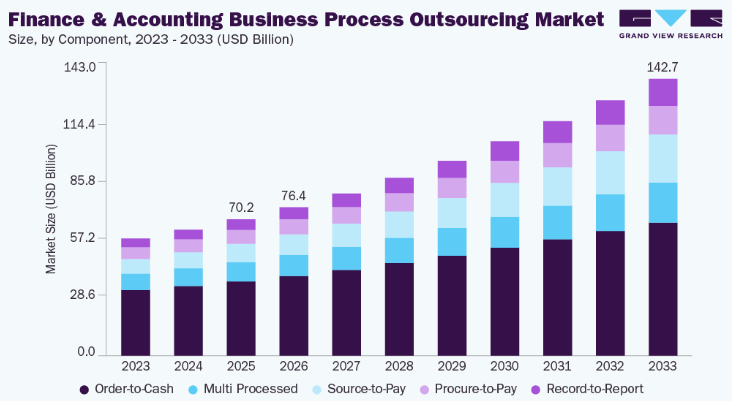
Control is often misunderstood in outsourcing. It does not mean keeping every task in-house. It also does not mean checking every journal, invoice or reconciliation personally. That is not control. That is dependency.
In outsourced finance and accounting, control means the CFO can see how work is moving, where issues are stuck and whether the output can be trusted. That requires structure around the work:
These details matter because finance risk often sits in handoffs. A reconciliation query waits too long. A journal is posted without enough support. A reporting pack changes because one entity submitted late. A vendor issue keeps coming back because no one owns the root cause.
None of these issues always look serious on their own. Together, they weaken finance governance and control. A strong outsourcing model makes those gaps visible and gives CFOs a clearer view of process health. That is the difference between outsourcing work and building a stronger finance transformation strategy. The best models make CFO financial governance easier to maintain as the business grows.
RELATED BLOG: Planning to outsource finance? Read the blog to learn what should move outside the business and what must stay in the CFO’s control.
Slow reporting has always been frustrating. In the current environment, it is more than an inconvenience. If the close takes too long, leadership is working with old information. If reporting packs keep changing, decisions get delayed. If every number needs extra explanation, the CFO spends more time defending the data than using it.
That is why reporting speed and visibility have become central to the outsourcing conversation. A strong finance and accounting outsourcing model should help finance shorten the time between activity happening in the business and leadership seeing the impact clearly. That depends on cleaner handoffs, better close discipline and fewer manual workarounds.
For example:
This is where finance process standardisation matters. When teams follow different methods, reporting slows down. When the process is consistent, finance can close faster without sacrificing review quality.
Outsourcing underperforms when it is treated like a staffing shortcut. If a business takes a broken process and hands it to a lower-cost team, the work may become cheaper but not better. The same delays, gaps and control issues keep showing up, only with more distance between the problem and the people responsible for fixing it.
This usually happens when companies outsource finance and accounting without first being clear on the operating model. Common issues include:
That is why finance and accounting (F&A) outsourcing needs proper governance from the start. The provider should not only complete assigned tasks. They should help improve how the work flows, how exceptions are managed and how reporting quality is maintained.
RELATED CASE STUDY: QX helped a UK holiday park business reduce AP backlogs, improve reconciliations and bring more control to finance operations. Read the case study here.
Savings are easy to see on paper. The harder question is whether the finance function is actually becoming easier to run. That is what CFOs should look for when assessing finance and accounting outsourcing. Is the team only doing the work at a lower cost, or is the model improving control across finance? The signs are usually practical:
A lower-cost model can still leave the CFO dealing with missed deadlines, unresolved exceptions, weak controls and poor visibility.
Good F&A outsourcing services should reduce that noise. They should help finance run with more discipline across payables, receivables, record-to-report, payroll, compliance support and management reporting.
A mature outsourcing model does not feel like work has simply been moved to another team. It feels like finance has become better organised.
The provider understands the process, not just the task. They know what good output looks like, where errors usually appear, which exceptions need attention and when something should be escalated. A high-maturity finance and accounting (F&A) outsourcing model usually includes:
For CFOs, that is the difference between outsourcing as a cost lever and outsourcing as part of a broader finance transformation strategy. The first reduces pressure on the team. The second helps build a finance function that can handle complexity with more control.
QX Global Group helps businesses move beyond cost-led finance and accounting outsourcing by building delivery models around control, consistency and visibility.
We combine trained finance teams, standard workflows, AI-led automation and governance-led delivery to help businesses:
For CFOs, this creates a stronger base for decision-making confidence. Work is completed with clearer ownership, issues are surfaced earlier and finance leaders get better visibility into the health of the process, not just the status of tasks. Looking to move from cost-focused outsourcing to stronger finance control? Talk to our F&A experts today.
Cost savings still matter, but they do not solve weak process ownership, slow reporting or poor data confidence. CFOs are now using finance and accounting outsourcing to strengthen finance governance and control, standardise workflows and reduce the operational risk that comes from fragmented finance processes.
Strong F&A outsourcing services bring structure to close calendars, reconciliations, reporting packs and review workflows. This improves reporting speed and visibility because finance leaders can see where work stands, what has been reviewed and which exceptions still need attention. That is what builds stronger decision-making confidence.
Organisations should look at process maturity, governance cadence, review layers, automation capability, reporting quality and experience across AP, AR, R2R, payroll and compliance support. A strong outsourced finance and accounting partner should improve control and scalability, not just reduce delivery cost.
During uncertainty, finance teams need faster information, tighter controls and the ability to scale without adding complexity. Finance and accounting (F&A) outsourcing supports resilience by standardising processes, improving visibility across finance operations and giving CFOs more reliable data for planning, reporting and cash decisions.
CFOs choose QX Global Group because its finance and accounting services combine skilled finance teams, AI-led workflows, process standardisation and governance-led delivery. QX supports AP, AR, R2R, payroll, reporting and compliance activities, helping businesses improve control, visibility and operating confidence as they scale.

Education:
B.A. - Mass Communication

Expertise: Finance & Accounting Thought Leadership, Transformation & Operating Model Storytelling, CFO & Executive-Level Content Strategy, Outsourcing, Shared Services & Global Delivery Narratives
Originally published Jun 23, 2026 11:06:06, updated Jun 23 2026
Topics: Finance & Accounting Outsourcing, Finance and Accounting Transformation
22 Jun 2026
UK CFOs are watching cash more closely. Costs remain under pressure, borrowing is expensive, and the...
Read More04 Jun 2026
The best hospitality accounting outsourcing companies in the UK are no longer judged only ...
Read More02 Jun 2026
For many finance leaders, accounts receivable outsourcing still carries an old fear: faster collecti...
Read More02 Jun 2026
In Build to Rent, revenue leakage rarely starts with rent pricing. It usually starts much later, whe...
Read More