Topics: Finance & Accounting Outsourcing, Record to Report Process
Posted on October 26, 2026
Written By Ampil Jain




Finance teams know when a close has been difficult. The signs show up after the calendar says it is finished, for example, a balance still needs support, a late entry changes the result, or management sends the pack back for another explanation.
Days to close captures none of that. It does record when the period was released, but says little about the condition of the numbers at release. A five-day close that depends on old reconciling items and post-review journals is not stronger than a six-day close that produces stable, supported reporting.
The difference is becoming more important as controllership expands beyond transaction control into reporting and analysis. Controllers are increasingly expected to deliver not only accurate numbers but reporting that stands up to scrutiny and helps the business understand what has changed. This raises an important question… how should finance measure the quality of the close itself?
This article looks at close quality through five practical signals: reconciliation aging, late journals, recurring adjustments, unexplained variances, and management rework. Together, they show whether record-to-report services are making the close more dependable instead of simply moving the deadline forward.
The close is complete when material balances are supported, significant movements are understood, required adjustments are posted, and open items have a clear disposition. The reporting pack should be ready for use, not waiting for another round of accounting repair.
Three conditions separate a completed calendar from a completed close:
A period may fall short on one condition without being unreliable. The issue is whether the same dependency returns each month and sits outside the reported close date.
The recurring weak points are visible in five signals that most close calendars do not measure.
The signals below cover evidence, ledger stability, repeat failure, analytical clarity and report usability. They should be read together; none is a complete quality measure on its own.
Count open items by age, value, account risk and reason. A recent timing difference with documented support is not equivalent to a ninety-day balance still under investigation. The close issue is the aged, material or unsupported item, not the existence of an exception.
The useful trend is the reduction in repeatedly carried items. Completion percentages can improve while the same exceptions continue into the next period.
Separate entries posted after the formal cutoff, after account review and after the first management pack. Each point has a different effect. An entry before consolidation may slow the schedule; an entry after management review can change the story already presented.
Classify the cause: new information, avoidable delay, reviewer correction, accounting judgment or interface failure. That shows which entries need a process fix and which reflect legitimate close activity.
Recurring accruals can be part of a controlled close. Repeated corrections are different. They often point to source-data gaps, incomplete subledger processing, mapping issues or an accounting treatment that never became part of the standard process.
Finance should not mix approved recurring entries and recurring repair. The latter needs a remediation owner, not a faster journal template.
Commentary does not explain a variance merely because it restates the amount. Finance needs the accounting or operating driver, the size of its effect and a view on whether the movement changes the outlook or requires action.
Track material variances without an agreed driver at the point of release. This exposes whether the delay sits in operations, source detail or ledger cleanup.
Record requests that force finance to revise numbers, schedules, mappings, or commentary after the pack reaches management. Separate deeper analysis from correction. More analysis can be useful; reconciling two versions or repairing a classification issue is rework.
This is the user test of the close. A balanced ledger carries little weight if the first management discussion sends finance back into the books.
Now, these signals can be combined into a consolidated management view, provided the score remains grounded in evidence rather than perception.
RELATED BLOG: Explore Record-to-Report Services ROI for US Companies to see how businesses evaluate R2R performance beyond cost reduction and close speed.
The index should answer a straightforward question… did the latest close produce numbers that are easier to support, explain, and use?
| Component | Illustrative Weight | Measure | Improvement |
| Reconciliation aging | 25% | Age, value and risk of open items | Old or unsupported balances fall |
| Late journals | 20% | Entries after cutoff, review or initial pack | Avoidable post-review changes decline |
| Recurring adjustments | 20% | Repeated corrections and true-ups | Repairs are removed at source |
| Unexplained variances | 20% | Material movements without agreed drivers | Reports explain the movement before release |
| Management rework | 15% | Corrections or rebuilds after pack delivery | Accounting rework falls |
The weights are illustrative. A regulated business may put more emphasis on reconciliations and journals. Similarly, a decentralized business may care more about variance explanation and reporting rework. Agree the weighting with controllership and the people who use the reports.
Use reconciliation systems, journal timestamps, adjustment analysis, variance logs, and reporting revision history. A close that felt smoother may still have carried more unresolved work.
Plot quality against the close timetable. A shorter close with a weaker score often means work was carried forward. A longer close with a stronger score may be acceptable during remediation, integration or system change.
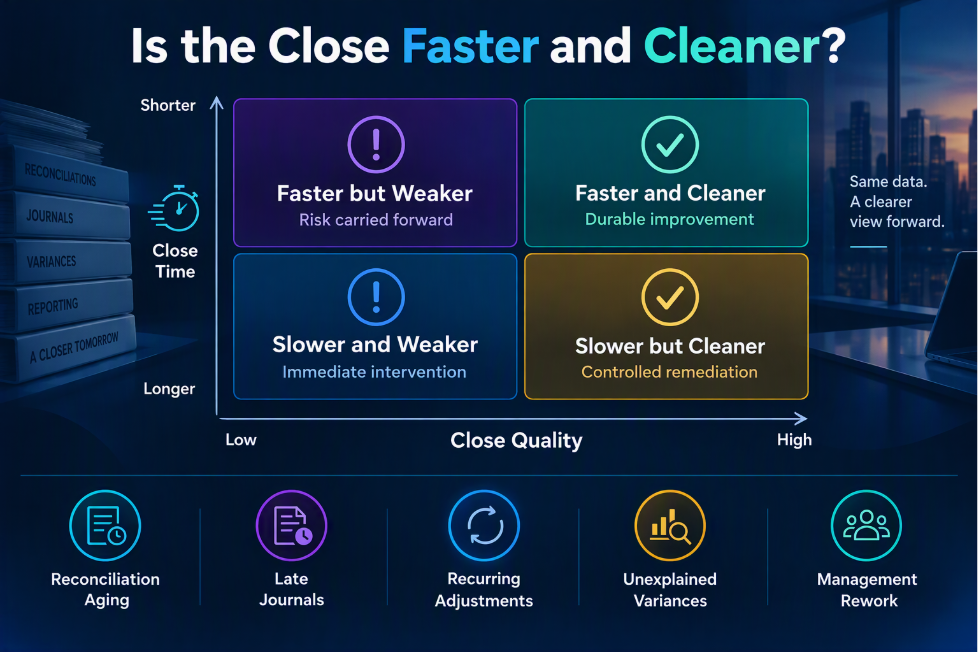
The top-right quadrant is durable improvement: faster and cleaner. The other three require context. “Faster but weaker” is the most deceptive because the calendar improves while reporting risk moves into reconciliations, late journals, or the next period.
Quarter-end, acquisitions, system changes, and audit requests can distort a single month. A three-period view keeps one unusual close from resetting the judgment on performance.
The index identifies where confidence is being lost. The next step is to move more of the quality work out of the final close window.
The final days of close cannot repair every issue created during the period. The accounts and handoffs carrying the greatest risk need attention before day one.
Here’s a practical sequence:
a. Pre-reconcile high-risk accounts. Bank, cash, intercompany, payroll, tax, suspense and clearing accounts should be matched during the month where timing allows. The close then focuses on final movement and genuine exceptions.
b. Set journal cutoffs around review. The timetable must cover preparation, evidence, approval and downstream assessment. A journal posted on time but too late for review still weakens the close.
c. Give every open item a disposition. Clear it, support it as a timing difference, reserve it, escalate it or accept it under policy. “Carry forward” is not a useful disposition.
d. Link variance commentary to accounting evidence. Commentary should trace back to reconciliations, journals, accruals and operating drivers. Shared definitions reduce the need to rebuild the explanation after pack delivery.
This is where record-to-report process outsourcing can add capacity, provided the scope includes evidence quality, exception ownership, and remediation rather than task completion alone.
A useful R2R scope is built around the points where close quality is most likely to weaken. These include unsupported balances, journals that arrive after review has begun, recurring corrections and reporting schedules that need to be rebuilt each month.
The outsourced team should have enough ownership to move these issues towards resolution. That means preparing and reviewing reconciliations, maintaining standard journals, coordinating intercompany balances, supporting fixed-asset and accrual schedules, administering the close calendar and preparing consistent reporting evidence. Simply marking tasks as complete will not improve the close if unresolved items continue into the next period.
Accounting judgment needs a different treatment. Policies, material estimates, reserves, impairments and unusual transactions require knowledge of the business and responsibility for the reported outcome. These decisions should remain with the controller and internal accounting leadership, along with final journal approval and sign-off on the financial statements.
The boundary becomes clearer when R2R activities are grouped by the type of decision involved:
| I. Rules-based accounting work | II. Exception-led investigation | III. Material accounting decisions |
| Repeatable activities such as standard journals, reconciliations, intercompany matching, fixed-asset schedules and close-calendar coordination can be documented and transferred with defined evidence and review requirements. | Unsupported balances, unusual movements and broken interfaces may be worked by the outsourced team, but escalation rules should identify when the issue requires accounting judgment, business input or a policy decision. | Estimates, reserves, impairment assessments, unusual transactions, policy interpretations and final reporting approval remain with internal leadership. |
This division prevents two common scope failures. The first occurs when a provider completes tasks but returns every difficult exception to the client. The second occurs when internal teams expect the provider to make decisions that require commercial knowledge or formal accounting authority.
Service levels should reflect the same distinction. Timeliness measures whether the work was delivered when expected. Quality measures whether balances were supported, adjustments were properly evidenced and reports remained stable after review. Both are needed. A reconciliation submitted on time with unexplained items is no more complete than a management pack that changes after leadership has begun using it.
With the operating boundary established, the provider can be assessed on a more meaningful outcome: whether the close becomes easier to support, explain and rely on.
RELATED BLOG: Explore Record-to-Report Solutions Features to understand the capabilities high-performing finance teams look for when modernizing the close.
Keep days to close on the scorecard, but add measures that explain whether the reported improvement will hold.
Report by entity, process and account risk. A group average can conceal one recently acquired entity carrying old reconciliations or one business unit generating most post-review journals.
QX Global Group supports general-ledger accounting, reconciliations, journals, intercompany activity, fixed assets, close coordination, reporting schedules and audit preparation through a governed R2R model. The client retains accounting policy, material judgments and final sign-off.
The objective is not simply to shorten the close. It is to reduce the amount of unresolved work that remains hidden behind the close date, whether that appears as aging reconciliations, recurring adjustments, late journals or repeated reporting revisions.
In practice, improving close quality starts with visibility. Finance teams need a clear view of which accounts generate recurring exceptions, where reporting revisions originate and why journals continue to arrive after review has begun. Once these patterns become visible, efforts can shift from processing around the problem to removing its cause. The result is a close that becomes easier to support, explain and rely on over time.
A trusted close does not ask management to wait for another reconciliation, journal or version of the report. Material balances are supported, significant movements are understood and the pack is ready for use.
Measure the five signals over three periods. Find the accounts, entities and handoffs creating old reconciliations, post-review journals, recurring corrections, unexplained variances or management rework. Fix those causes earlier in the month.
Record-to-report services create value when they make close quality visible and repeatable. The aim is not a shorter calendar at any cost. It is a close the controller can sign, management can use and the business does not need to reopen.
Ready to build a close the business can trust? Explore QX Global Group’s record-to-report process outsourcing services or talk to our team about a close model built around supported balances, disciplined journals and decision-ready reporting.
Record-to-Report services improve close quality by standardizing reconciliations, journals, reviews and reporting evidence. They add capacity and governance across repeatable close work while internal management retains accounting policy, material judgments and final approval.
Reconciliation aging reduces confidence when material balances remain unexplained or unsupported across reporting periods. Aging by value, risk and reason helps management distinguish understood timing differences from unresolved items that may affect reporting accuracy or audit readiness.
Late journals and recurring adjustments destabilize numbers after review has started and often reveal unresolved source-process issues. Tracking timing, cause and repeat occurrence helps finance reduce post-review changes instead of learning to repair the same failure faster.
A high-quality close reduces rework by delivering supported balances, stable numbers and explanations tied to business drivers. Management can use the reporting pack without asking finance to reconcile versions, correct classifications or rebuild commentary after delivery.
A business should consider R2R outsourcing when close work depends on key people, reconciliations age, journals arrive late or reporting capacity limits review. Outsourcing is most useful when the scope includes evidence quality, exceptions and remediation.
QX provides governed R2R delivery across general-ledger support, reconciliations, journals, close coordination, reporting schedules and audit preparation. Clients retain accounting policy, judgment and final sign-off while QX adds repeatable execution and scalable finance capacity.
Choose a provider that combines close-process expertise with reconciliation, journal and reporting controls. The provider should document dependencies, support automation where rules are stable and keep accounting judgment, materiality and final approval with the client.
Look for R2R providers that connect reconciled ledger data with controlled mappings, evidence and review sign-offs. Reporting support should preserve stakeholder definitions, disclosure requirements and audit trails rather than produce a generic management pack.
Strong providers use preparer-reviewer controls, documented policies, version histories, approval evidence and exception logs. Ask how the provider proves reconciliation quality, journal support and report changes, not only whether tasks were completed on time.
Dedicated-team providers assign named finance professionals who learn the client’s systems, accounting rules and close calendar. Confirm exclusivity, cross-trained backups, transition coverage and knowledge-retention requirements in the contract before moving R2R work.
A capable R2R partner should baseline close speed and quality before transition. Useful measures include reconciliation aging, late journals, recurring adjustments, unexplained variances, management rework, pack revisions and audit-support effort.
Select partners that provide task status, exception ownership, aging, journal timing and close-quality trends at entity and process level. Dashboards are useful only when the underlying definitions, evidence and escalation rules are governed.

Education:
PGDBA (Finance), SCDL Pune

Ampil Jain is a results-driven finance leader with over 18 years of experience in Record to Report (R2R), Procure to Pay (P2P), and intercompany processes. At QX, he specialises in financial reporting, client and people management, and driving transformation across large cross-functional teams. His deep understanding of compliance and operations enables him to deliver accuracy, efficiency, and strategic value across global finance functions.
Expertise: R2R, P2P, Intercompany, Financial Reporting, Client Management, People Leadership, Process Transformation
Originally published Oct 26, 2026 05:10:48, updated Oct 26 2026
Topics: Finance & Accounting Outsourcing, Record to Report Process
16 Oct 2026
Multifamily accounts payable can look stable until someone asks whether the process is actually impr...
Read More15 Oct 2026
Market signals often reach the business before they reach the forecast. Sales, demand, staffing or i...
Read More14 Oct 2026
Most multifamily finance teams have seen some version of this. A new ERP gets approved, an AP automa...
Read More14 Oct 2026
A new PBSA asset can add hundreds of beds to a portfolio. It can also add hundreds of daily finance ...
Read More