Topics: Finance & Accounting Outsourcing, Student accommodation
Posted on October 14, 2026
Written By Nishant Kumar




A new PBSA asset can add hundreds of beds to a portfolio. It can also add hundreds of daily finance decisions before the first full rent cycle has settled.
Growth is usually visible in the physical portfolio: acquisitions complete, developments open, university agreements expand, and new students arrive. Finance capacity is less visible. The pressure appears later, in unreconciled rent, deposits moving between systems, capital expenditure coded inconsistently, and property reports that reach management after the decision they were meant to support.
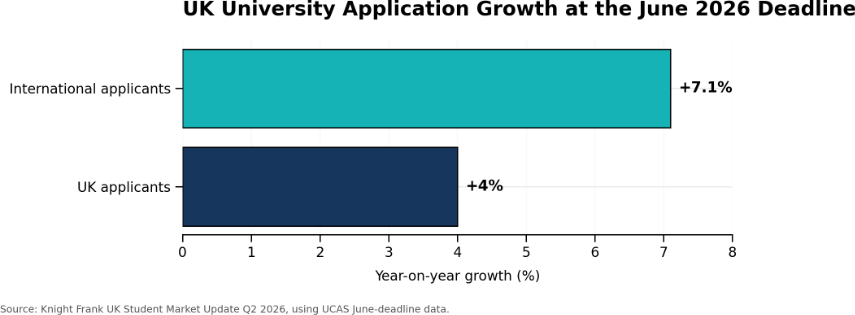
This is the gap operators need to watch. Knight Frank recorded 695,740 UK university applicants at the June 2026 deadline, 4% more than a year earlier, including a 7.1% rise in international undergraduate applicants.
Demand remains an opportunity, but every additional bed, tenancy and payment adds accounting work that does not scale automatically with the estate. The real constraint is therefore not transaction volume alone. It is the amount of interpretation, correction and coordination required to turn property activity into a trusted portfolio view.
This article follows the pressure from asset onboarding through rent, deposits, capex, university agreements, and reporting, then considers where student accommodation accounting services can add capacity without moving commercial authority away from the operator.
The pressure first becomes visible when a new asset enters the portfolio, and its operational data has to become finance-ready.
Portfolio growth first tests finance when a new asset enters the group with its own data, controls and reporting habits. Onboarding, income and deposits belong in the same discussion because the quality of the opening position determines how much manual work carries into every close that follows.
Legal completion, operational handover and student move-in do not make an asset finance-ready. Finance needs agreed opening balances, verified supplier records, active bank controls, mapped reporting dimensions and a clear cut-off for outstanding items. If these arrive in stages, the first close becomes a reconstruction exercise and temporary journals become part of the inherited process.
A repeatable onboarding playbook should settle five points before the first close:
PBSA income is operationally dense. Instalment plans, guarantor payments, bursaries, concessions, room changes, cancellations, arrears and refunds can all affect the same reporting period. The challenge is matching them consistently across the property system, bank, ledger and deposit records.
At scale, small breaks absorb judgement. A receipt without a tenancy reference needs investigation. A room move changes the expected charge. A refund may depend on deductions approved outside finance. The control model should automate clean matches, then make every exception visible by cause, value, age, and owner.
Operators using PBSA finance and accounting services can standardise these onboarding and reconciliation routines across assets while retaining control over tenancy policy, commercial decisions, and cash release.
Once income is controlled, the next question is whether finance can distinguish genuine portfolio investment from operating complexity that has accumulated without challenge.
Capex programmes and university agreements create different commercial obligations, but both increase the amount of interpretation finance must turn into repeatable accounting rules. The strain appears when commitments, invoices, occupancy evidence and contractual deductions do not meet in the same reporting process.
PBSA assets absorb capital through development completion, room upgrades, building-safety works, energy improvements, amenities, and lifecycle replacements. If purchase commitments, project approvals, invoices, capitalisation policy and fixed-asset records are disconnected, the portfolio can remain within its total budget while individual schemes or workstreams overrun unnoticed.
A useful capex view combines approved budget, commitments, incurred spend, capitalised value, forecast to complete and changes in approval. It also distinguishes growth investment from repair and maintenance. That gives management time to act while the programme is still open, rather than explaining the variance after completion.
Nomination agreements, headleases, minimum guarantees, void-sharing arrangements, and service commitments can produce several monthly calculations across occupancy, deductions and settlement. Problems arise when operations, finance and the university apply different interpretations to the same clause.
Each arrangement needs a concise schedule covering the revenue basis, occupancy evidence, deductions, settlement timetable, reporting requirements and owner of disputes. The contract remains the legal record; the schedule makes it operable throughout the academic cycle.
These controls protect individual assets and agreements. The harder task is converting them into one portfolio view that leaders can compare and trust.
A property dashboard should do more than reproduce a management account. It should connect operating activity with the financial consequence, then show which exceptions need intervention. Public PBSA software examples commonly bring occupancy, income, arrears and resident lifecycle activity into one view; finance should extend that logic to cash, capex and contractual obligations.
| Dashboard Lens | Measures to Connect | Decision It Should Support |
| Demand and income | Occupancy, bookings, billed rent, concessions and bad-debt movement | Is occupancy converting into collectible income? |
| Cash and tenant balances | Rent collected, unmatched receipts, deposits, refunds and aged arrears | Where is cash held up or incorrectly allocated? |
| Cost and margin | Payroll, utilities, maintenance and controllable spend | Which property variances need operational action? |
| Capital | Budget, commitments, spend, capitalised value and forecast to complete | Is investment on scope, on time and correctly classified? |
| Partnership obligations | University settlements, guarantees, deductions and covenant measures | Are contractual outcomes aligned with the accounting treatment? |
| Forward risk | Expected occupancy, collection exposure and known commitments | What will affect the next close and cash position? |
If this view still depends on manual interpretation, late reconciliations, and property-specific definitions, the reporting problem has become a capacity problem. The maturity map below shows how far the operating model has progressed and what should change next.
The maturity map brings the earlier issues into one view. It shows whether the operating model still relies on asset-level workarounds, has established control, connects portfolio reporting or can absorb growth without rebuilding finance each time. Different processes may sit at different stages.
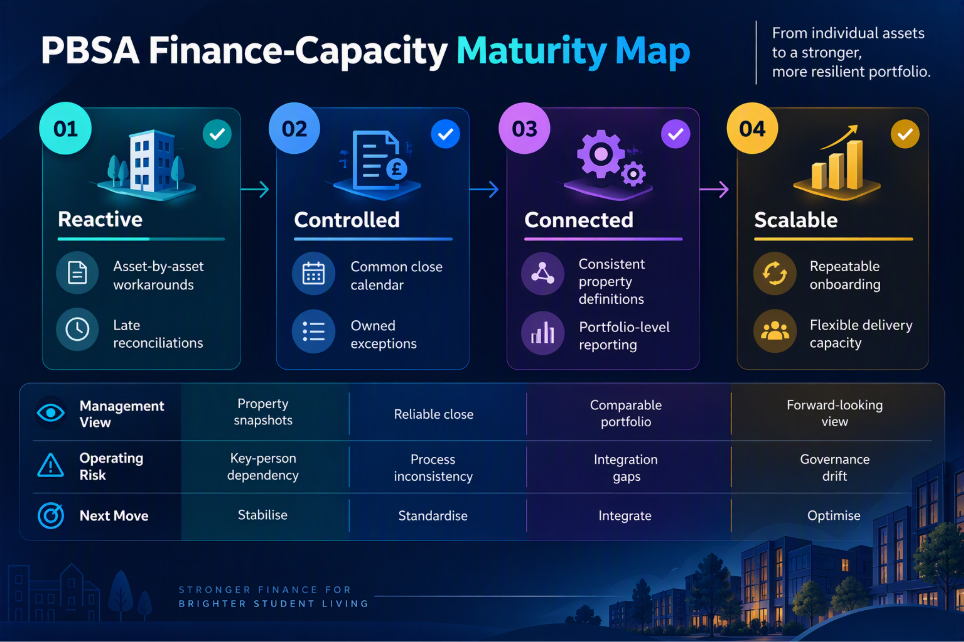
Use the map to set the next priority. Stabilise reactive processes, standardise controlled ones, integrate connected reporting, and maintain governance where the model is already scalable. The remaining question is whether the internal team has enough capacity to make this shift while keeping day-to-day finance under control.
External support becomes relevant when recurring processing and portfolio change compete for the same internal attention. The signal is a pattern: onboarding disrupts close, reconciliations remain open, reporting depends on key individuals, or improvement work repeatedly loses to daily processing.
The objective should be to standardise the operating flow, not move fragmented work elsewhere. A clear division looks like this:
The performance model should follow the same logic as the capacity diagnosis: close timeliness, reconciliation ageing, first-time-right reporting, onboarding readiness, and reduction in repeat exceptions. Cost matters, but cost without control simply moves pressure out of sight.
This operating boundary provides a more useful way to judge a partner than a list of available accounting tasks.
QX Global Group provides PBSA finance and accounting services for operators across property-level accounting, rent and deposit reconciliation, accounts payable, balance-sheet control, month-end preparation, reporting and asset onboarding. Delivery works within the operator’s systems and policies, with commercial decisions and financial authority retained by the client.
The aim is to replace asset-by-asset workarounds with documented processes, common reporting definitions and finance capacity that can flex as the portfolio changes. Physical growth should not require finance to rebuild its operating model each time a property is added.
A UK student accommodation engagement shows how this approach supports portfolio visibility. Following a major merger and acquisition, the client needed consistent accounting and reporting across a large multi-site portfolio.
QX Global introduced standardised budget templates, consolidated reporting processes and common budget assumptions, while automating the conversion of data from two software systems into the required reporting format. The resulting template gave leadership a transparent group view and drill-down reporting by region, site, bed count, occupancy, and other shared parameters.
PBSA demand can support expansion, but it does not guarantee that finance will scale with the estate. Every new asset adds income flows, deposits, supplier activity, capital commitments, partnership calculations and reporting obligations. Fragmented processes convert that variety into permanent manual effort.
Start where management confidence is weakest. It may be the first close after onboarding, an ageing rent reconciliation, capex forecasts that arrive too late, or property packs that cannot be compared. Establish one definition, one owner and one timetable, then extend the method across the portfolio.
The strongest finance functions do not try to predict every pressure that growth will create. They build an operating model that can absorb change, handle exceptions early, and preserve a trusted view of performance. This is how finance capacity meets PBSA ambition.
Growing portfolios need finance capacity that arrives before reporting quality begins to slip. Talk to QX Global Group about a scalable PBSA accounting model.
Growth adds assets, tenancies, reconciliations, capex commitments and reporting obligations faster than fragmented processes and key-person-dependent finance teams can absorb them consistently.
They should cover transaction processing, rent and deposit reconciliations, supplier accounting, month-end support, balance-sheet control, asset onboarding and consistent property-level reporting.
Consistent property packs connect occupancy, income, arrears, costs, capex, cash and contractual obligations, helping leaders compare assets and identify exceptions before decisions are delayed.
Each asset adds local systems, definitions and workarounds. Finance then spends more time reconciling differences, correcting entries and rebuilding reports instead of analysing portfolio performance.
Operators should consider outsourcing when onboarding disrupts close, reconciliations remain unresolved, reporting depends on key individuals or routine processing repeatedly delays finance improvement.
QX combines property-level accounting capacity, documented workflows, reconciliations, month-end support and reporting while operators retain commercial policy, financial judgement and final approval authority.
Look for providers with sector-specific accounting experience, property-level reporting capability, strong reconciliation controls and a delivery model that keeps commercial authority with the operator.
Choose a provider that connects occupancy, income, arrears, cash, costs and capex using consistent property definitions, clear exception ownership and agreed reporting timetables.
Yes. Transaction processing, reconciliations, journals, balance-sheet substantiation and reporting preparation can be outsourced, while management judgement and final approval remain in-house.
Yes. Standardising definitions, controls, data ownership and escalation routes avoids transferring asset-level workarounds into a larger outsourced model and makes performance easier to govern.

Education:

Nishant Kumar is a senior commercial leader with 20+ years of experience supporting hospitality and accommodation businesses through technology-enabled outsourcing and operational transformation. At QX Global Group, he works with property owners, asset managers, and hospitality leaders across the UK and Europe to improve profitability, modernise back-office operations, and build scalable operating models. His expertise spans finance and accounting, payroll, and digital enablement for multi-property and franchise-led hospitality organisations, with a strong focus on cost optimisation, standardisation, and automation-led efficiencies.
Expertise: Hospitality and accommodation outsourcing, Multi-entity finance transformation, Shared services and global delivery models, Automation-led cost optimisation, Strategic commercial advisory
Originally published Oct 14, 2026 08:10:26, updated Oct 14 2026
Topics: Finance & Accounting Outsourcing, Student accommodation
14 Oct 2026
Most multifamily finance teams have seen some version of this. A new ERP gets approved, an AP automa...
Read More13 Oct 2026
A structured invoice can travel from one system to another in seconds. The approval, dispute, and pa...
Read More13 Oct 2026
Most property accounting software now claims some form of AI. In the demo, invoices are coded automa...
Read More12 Oct 2026
When a student housing portfolio gets underwritten, almost everything is modeled down to the bed. Re...
Read More