
Pricing BPS, platforms, AI, SaaS, and BPaaS from a customer’s perspective
| The right price is neither the highest amount a provider can charge nor the lowest amount a customer can negotiate. It is the price that creates a sustainable business case for everyone. |
Imagine that we are a mining company sitting on an enormous gold reserve. The richest deposits, however, lie beyond the reach of conventional equipment.
A technology provider offers a breakthrough platform capable of reaching that gold. How should we price it?
As the customer, we look at the additional wealth the platform can help us recover. The provider considers the research, expertise, infrastructure, and operating costs required to build and support it. The market compares the solution with alternative technologies and the value each can unlock.
An agreement becomes possible only when one price makes sense from all three perspectives. That price turns buried potential into shared value.
The lesson is straightforward: the best outcome is not the lowest price, but the best competitive price for the value delivered, supported by a strong customer business case and sustainable provider economics.
This principle is especially relevant to software platforms, AI solutions, SaaS, and BPaaS, where the cost of the underlying technology may have little relationship to the value it creates.
Most pricing methods begin from one dominant point of view:
Each method answers only part of the pricing question. Sustainable platform pricing must support three independent business cases: the customer, the provider, and the market. The objective is to find where all three converge.
Every platform should begin with a formal price book. It creates a consistent starting point for proposals, reduces arbitrary pricing, and shows customers how an offering can expand as their needs evolve.
Pricing should be structured in two dimensions.
Individual capabilities such as core processing, AI, analytics, and integrations should have independent list prices. This allows customers to adopt selectively and add capabilities as their requirements grow.
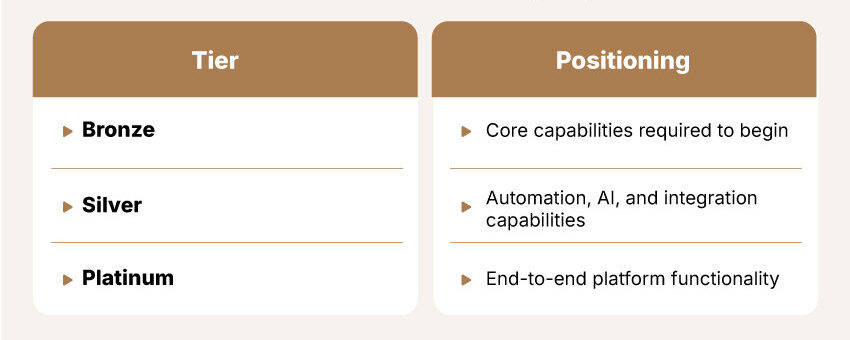
A price book provides commercial consistency, but it should not determine the final price for every customer. Two customers can derive significantly different value from the same platform. The list price must therefore be tested and refined through the GOLD Pricing Framework.
GOLD combines customer value, provider economics, and market benchmarking to establish a defensible decision price.
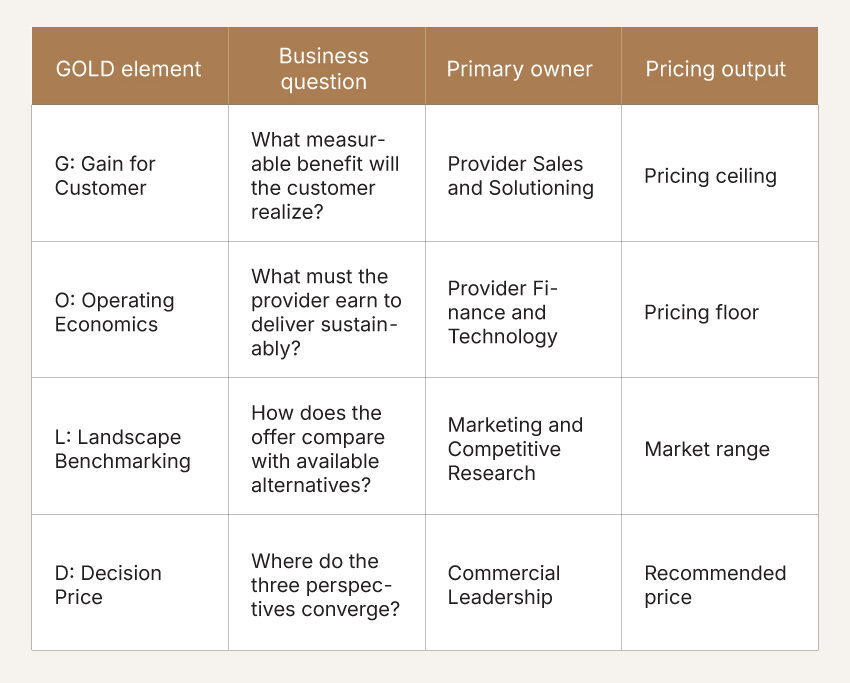
Cross-functional ownership is essential. Sales represents the customer opportunity. Finance and Technology protect delivery viability. Marketing provides an independent market view. Commercial Leadership brings the evidence together. No single function should determine the price in isolation.
A valid proposal begins with the customer business case.
What is the platform worth to the customer’s organization?
The assessment must quantify realistic outcomes rather than simply list product features. These may include:
The customer compares these gains with implementation costs, subscription fees, change effort, and ongoing operating expenses. The price must leave enough value to meet the required return on investment and payback period.
This establishes the pricing ceiling: the maximum price that the customer’s business case can economically justify.
A strong customer business case cannot depend on an unsustainable provider business case.
What must the provider charge to build, implement, operate, support, and continuously improve the platform profitably?
Relevant costs may include:
These inputs establish the pricing floor. A price below this level may look attractive at contract signature, but it can later weaken service quality, provider viability, and the ability to fund future innovation.
Technology defines delivery economics, while Finance validates cost recovery and margin expectations. Together, they ensure sustainable pricing without funding inefficiency.
Customers will always compare an offer with the available alternatives.
How does this platform compare with the customer’s other choices?
The goal is not merely to identify the lowest headline price. It is to establish the best competitive price for each unit of value delivered. The comparison should consider:
A less expensive competitor may provide fewer capabilities, require greater implementation effort, or generate lower business value. Landscape benchmarking establishes the market-acceptable range and validates any premium supported by superior functionality, faster implementation, or stronger outcomes.
The Decision Price is the overlap between customer value, provider economics, and market acceptability. It is not a number selected halfway between the customer’s target and the provider’s opening position. It is the price at which each perspective independently supports the transaction.
| Customer value | Provider economics | Market reality |
| Benefits exceed total costs and deliver an attractive ROI and payback period. | Revenue covers development, implementation, operations, innovation, and profit. | Price and value compare credibly with available alternatives. |
When these conditions are satisfied, the price becomes defensible rather than merely negotiable.
GOLD changes the commercial conversation. Instead of asking, “What is the most the provider can charge?” or “How low can the customer negotiate?”, it asks:
What price can every stakeholder independently justify?
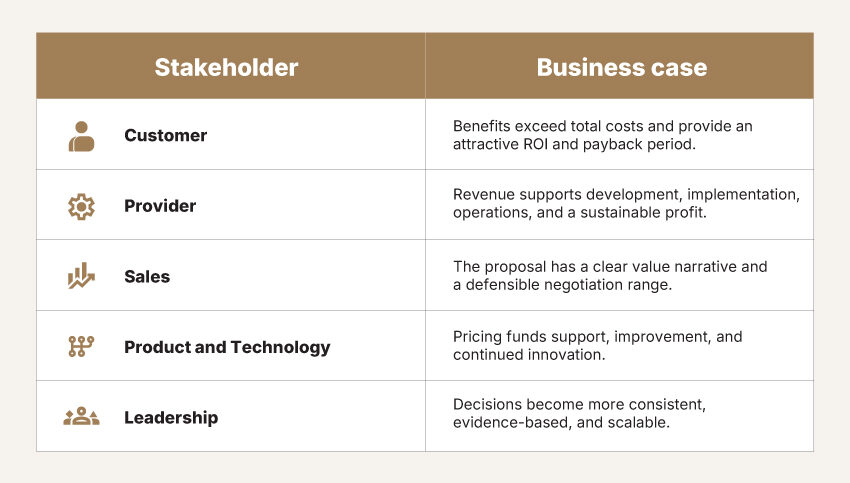
Win-win does not mean dividing the benefits equally. It means the customer receives more value than it pays for, while the provider earns more than it costs to deliver. Market benchmarking ensures that neither side’s assumptions are detached from reality.
When pricing is developed through GOLD, the price itself becomes the business case. It demonstrates that customer gains justify the investment, provider economics support sustainable delivery and innovation, and the offering remains competitive in the market.
The goal of procurement is not to secure the lowest price, but the highest value at a fair and sustainable price. A price that is too high weakens the customer business case; a price that is too low can undermine delivery and innovation. GOLD helps identify the point that protects both outcomes.
The result is a commercially sound decision in which price is not merely the outcome of negotiation, but evidence that the partnership can create and sustain value for everyone involved. The best price is the one that every stakeholder can independently justify.
As AI-powered platforms, SaaS solutions, and BPaaS models continue to reshape business services, organizations need pricing approaches that balance customer outcomes, provider sustainability, and market competitiveness. The GOLD Framework provides a practical way to achieve that balance.
| Evaluating AI-enabled business services, automation platforms, or outcome-based operating models? Our specialists help organizations assess business cases, identify value drivers, and design commercially sustainable solutions that deliver measurable outcomes. Talk to Our Experts |
Talk to our experts to identify the right AI strategy and tools for your business.

QX Global Group will use your information to contact you regarding new blog posts by email. You can unsubscribe from it at any time! For more information, check out our privacy policy.
09 Sep 2026
Understanding AI/ML, Copilots, Agents, and the Platforms That Turn Them into a Digital Workforce The...
Read More13 Jul 2026
The Cost of Asking the Wrong Questions A young squirrel, a hornbill, and an owl discovered a m...
Read More29 Jun 2026
The Next Industrial Inflection Point In the early days of industrialization, factories were designed...
Read More18 Jun 2026
The AI Reality Check Two years ago, AI was positioned as an immediate revolution. CEOs, Chief AI Off...
Read MoreLet’s explore how our AI-powered solutions can simplify, streamline, and scale your processes.
QX Global Group will use your information to contact you regarding new blog posts by email. You can unsubscribe from it at any time! For more information, check out our privacy policy.