
Two years ago, AI was positioned as an immediate revolution. CEOs, Chief AI Officers, and transformation leaders were promised autonomous operations, dramatic productivity gains, rapid cost compression, and enterprise-wide disruption. The expectation was simple: deploy AI, and transformation would follow.
Today, the reality is more nuanced. AI has delivered meaningful impact, but largely through augmentation rather than replacement, co-pilots rather than autonomy, and targeted improvements rather than enterprise-wide transformation. Value is emerging in pockets, often constrained by data readiness, process inconsistencies, traditional function-centric operating models, integration challenges, and resistance to change.
The technology worked. The assumptions didn’t.
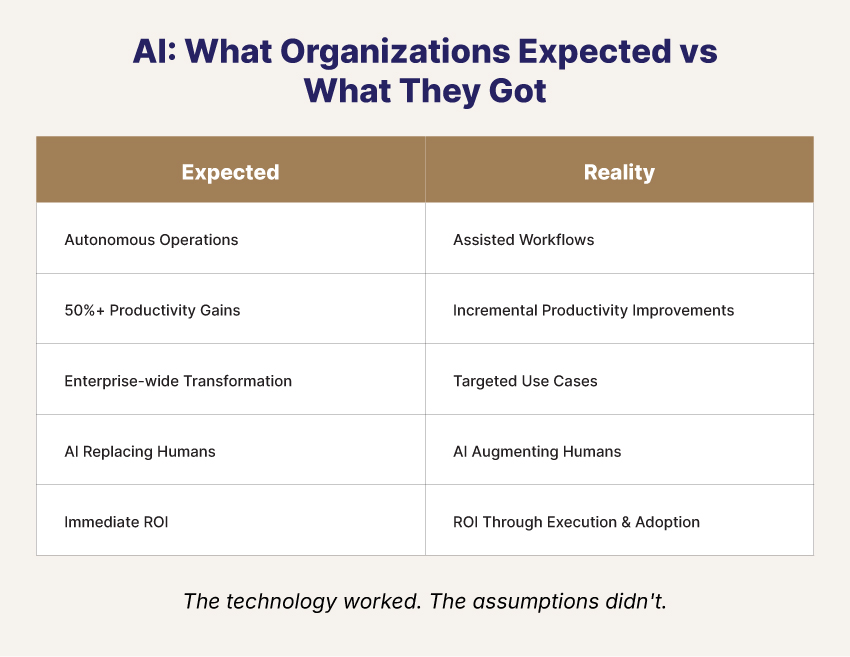
A simple metaphor captures this gap. Organizations thought they had bought a fully self-driving car, something capable of operating end-to-end without intervention. What they actually received was an advanced driver-assist system: powerful, intelligent, but dependent on human judgment, structured use, and disciplined control.
Some organizations are still waiting for the car to drive itself. Others have learned how to drive it properly, and are already moving ahead.
The difference is not AI capability. It is organizational readiness and execution maturity.
This is where the narrative shifts, from technology adoption to operational discipline.
Successful AI programs today are anchored in fundamentals. The right use cases, high-volume, repeatable, and data-stable, deliver disproportionate value. The right tools, aligned to enterprise architecture, make scalability possible. Most importantly, preparation across data, processes, and people determines whether AI initiatives succeed or stall.
This is also where many organizations miscalculate.
AI is not a plug-and-play capability; its effectiveness is directly proportional to the quality of the underlying processes, data, and operating model. Without this foundation, even the most advanced models and platforms underperform.
This is precisely where external expertise can become critical, bringing structured thinking, reducing experimentation cycles, and accelerating the path to measurable outcomes.
A more fundamental challenge has emerged across the ecosystem: the gap between strategy and accountability.
Many organizations continue to rely on advisory-led models where consultants assess, recommend, and exit. While valuable in shaping direction, these models often do not carry accountability for outcomes. As a result, efficiency projections can sometimes be optimistic, detached from the realities and constraints of execution.
The moment accountability is introduced, the equation changes.
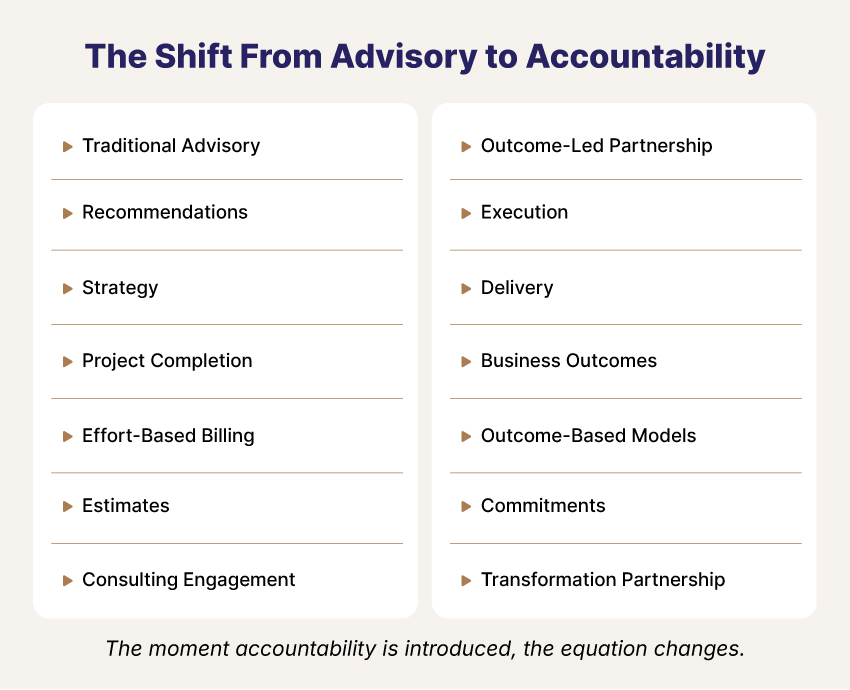
When a partner is required to deliver the estimated outcomes, whether in terms of productivity, cost reduction, or efficiency gains, assumptions get stress-tested. Risks are incorporated. Dependencies are addressed upfront. The focus shifts from what is theoretically possible to what is practically deliverable at scale.
Increasingly, accountability is being reinforced through commercial models.
BPS providers that offer transaction-based pricing and commit to reducing Cost Per Transaction (CPT) over time directly align their success with client outcomes. This shifts the conversation from effort-based billing to outcome-based delivery.
It signals confidence in execution, enforces implementation discipline, and ensures that efficiency gains are not merely projected, but realized and sustained.
In many ways, this is the clearest indicator of a partner willing to stand behind its commitments.
This is where execution-led partners differentiate themselves. Their credibility comes not from bold projections, but from the ability to commit to and deliver measurable outcomes.
In a world where AI investments are increasingly scrutinized through the lens of ROI, the shift from advisory to accountability is becoming a defining factor for success.
Recognizing these realities, QX has designed its Transformation and AI Consulting approach as an integrated, end-to-end transformation lifecycle, ensuring that strategy, preparation, execution, and outcomes remain tightly connected.
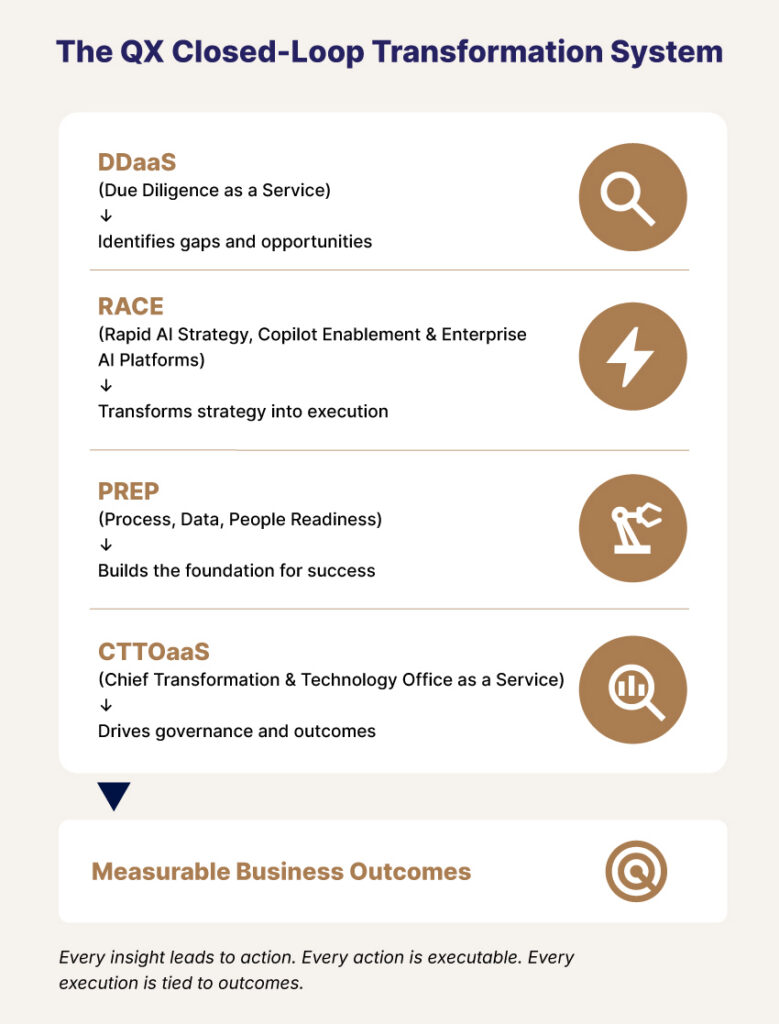
DDaaS: Due Diligence as a Service
DDaaS goes beyond diagnostic assessments to identify gaps across all transformation levers, process, data, people, and technology, and define a structured roadmap of downstream initiatives.
Every DDaaS engagement is designed to translate directly into a pipeline of actionable BPS and AI opportunities.
RACE: Rapid AI Strategy, Copilot Enablement and Enterprise AI Platforms
RACE converts AI ambition into a clear execution path.
It identifies high-impact use cases, enables quick wins through co-pilots, and extends into enterprise-wide implementation of AI platforms. These platforms integrate with systems of record and embed intelligence directly into core operations rather than creating isolated AI initiatives.
Each deployment also creates reusable IP, agents, accelerators, and platform capabilities that compound value over time.
PREP: Process, Data, People Readiness
PREP addresses one of the most underestimated barriers to AI success: foundational readiness.
By standardizing processes, improving data quality, and building organizational readiness, PREP removes execution friction and significantly improves deployment success.
CTTOaaS: Chief Transformation & Technology Office as a Service
CTTOaaS ensures that strategy translates into outcomes at scale.
Through a structured PMO/TMO framework, it drives governance, prioritization, execution discipline, and outcome tracking, ensuring initiatives are not isolated experiments, but part of an enterprise-wide transformation journey.
Individually, each offering solves a critical part of the problem.
Together, they form a closed-loop transformation system where:
This creates a direct connection between strategy, readiness, execution, and realized value.
This is the shift leaders must internalize.
AI transformation is no longer a technology challenge, it is an execution challenge.
Organizations that view AI as a standalone deployment will continue to struggle to realize value. Those that approach it as a structured, accountable, end-to-end transformation journey will be best positioned to scale outcomes.
The self-driving car did not arrive exactly as expected.
But for organizations that have learned how to drive it well, the destination is already coming into view.
Ready to move beyond AI experimentation and focus on measurable business outcomes? Let’s start the conversation.
Talk to our experts to identify the right AI strategy and tools for your business.

QX Global Group will use your information to contact you regarding new blog posts by email. You can unsubscribe from it at any time! For more information, check out our privacy policy.
13 Jul 2026
The Cost of Asking the Wrong Questions A young squirrel, a hornbill, and an owl discovered a m...
Read More29 Jun 2026
The Next Industrial Inflection Point In the early days of industrialization, factories were designed...
Read More08 Apr 2026
The PREP framework for building process, data, and operating foundations before accelerating with AI...
Read More10 Mar 2026
How Humans and AI Agents Happily Work Together The modern workplace has changed. Teams are no longer...
Read MoreLet’s explore how our AI-powered solutions can simplify, streamline, and scale your processes.
QX Global Group will use your information to contact you regarding new blog posts by email. You can unsubscribe from it at any time! For more information, check out our privacy policy.