Topics: Accounts Payable Optimisation, Finance & Accounting Outsourcing
Posted on July 03, 2026
Written By Mehboob Rad




Duplicate payments rarely happen because of one careless mistake. More often, they are a sign of a deeper control problem inside the procure to pay (P2P) process.
An invoice is received twice through different channels. A vendor exists under two slightly different names. A purchase order is missing. An approval is handled over email. A credit note is not visible to the processor. A payment file is released before the exception is fully resolved.
Individually, these issues may look operational. Collectively, they create financial leakage.
For CFOs and finance leaders, duplicate payments are more than an accounts payable error. They tie up working capital, distort cash visibility, weaken supplier trust, and create uncomfortable questions during audits. In high-volume businesses, even a small duplicate payment rate can turn into a material control risk.
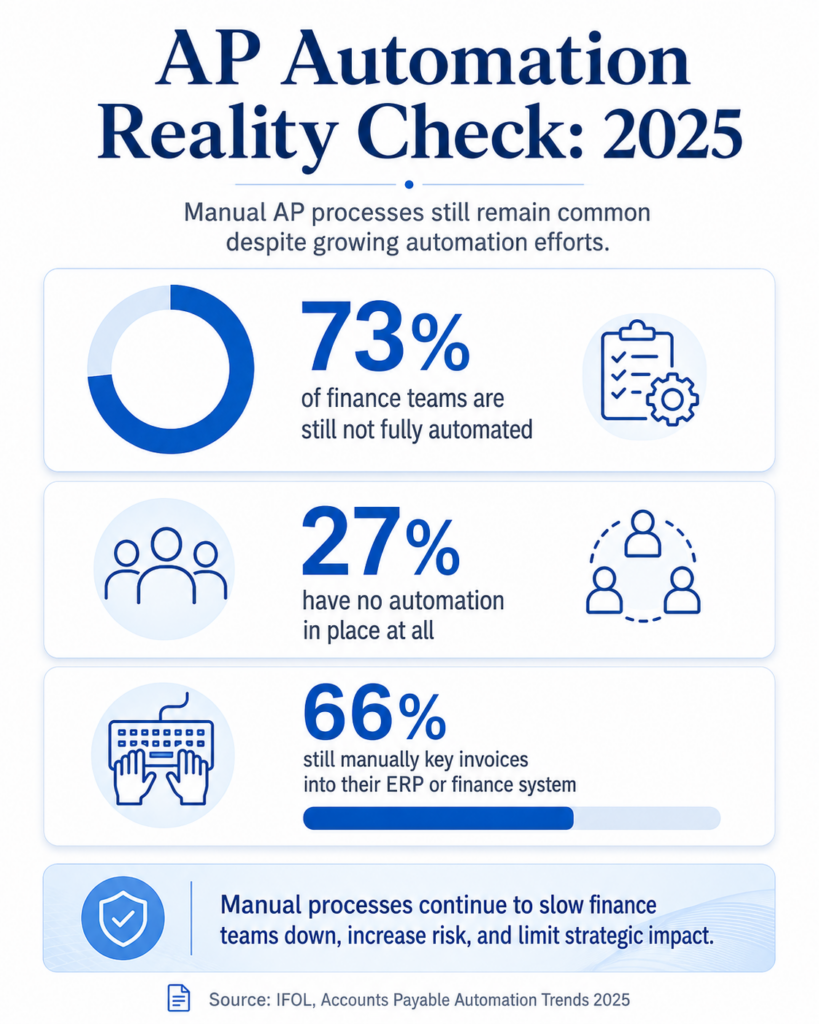
Duplicate payments usually happen because of gaps in data, workflow, and control. The most common causes include:
That is where duplicate payments slip through: not because AP teams are careless, but because the process lacks centralized visibility and stronger automated controls.
Duplicate payments may seem recoverable, but recovery is rarely simple. Vendors may apply the excess amount as a credit instead of issuing a refund, while AP teams spend weeks reconciling the issue. In some cases, the overpayment is only discovered during vendor statement reviews, audits, or cash flow variance checks.
The impact also shows up in reporting. Duplicate payments can overstate expenses, distort vendor balances, affect accrual accuracy, and create noise in cash forecasting. For CFOs, this weakens confidence in the numbers. For controllers and AP leaders, it adds reconciliation pressure and unnecessary exception handling.
Related Blog: Your Ultimate AP Automation Guide to Streamlining Finance
Strong procure to pay automation reduces duplicate payments by controlling the invoice earlier in the process, before it reaches approval or payment release. Instead of relying on month-end reviews or post-payment audits, modern accounts payable automation solutions build preventive checks into invoice capture, validation, matching, workflow routing, and payment controls.
The 2025 AFP Payments Fraud and Control Survey found that 79% of organizations experienced attempted or actual payments fraud in 2024, while 63% reported business email compromise. For AP leaders, this reinforces why invoice approvals, vendor changes, and payment releases need stronger audit trails and automated controls.

Automated invoice processing controls create a cleaner, more reliable audit trail by documenting every key step in the invoice lifecycle, including:
This gives finance leaders stronger evidence around segregation of duties, approval discipline, vendor master governance, and payment control. It also improves internal review. Instead of relying only on after-the-fact samples, finance teams can monitor duplicate alerts, recurring mismatch categories, approver delays, vendor exceptions, and control breaches in near real time.
That changes the AP conversation from “what went wrong?” to “where is risk building, and how do we stop it earlier?”
For many enterprises, the challenge is not simply choosing an AP automation tool. It is implementing automation in a way that fits the operating model, ERP environment, approval hierarchy, vendor base, and control expectations.
This is where QX’s ProAP adds value.
QX ProAP is an AP automation solution designed to strengthen invoice processing, reduce manual effort, and improve control across the procure to pay (P2P) process. It supports finance teams by bringing structure, validation, and workflow discipline into high-volume AP environments.
ProAP helps with:
The value is not automation for automation’s sake. The value lies in combining technology with process knowledge.
QX Global Group brings experience across AP operations, finance transformation, and procure to pay outsourcing, helping organizations redesign workflows before automating them. That matters because weak processes do not become strong simply because software is added. If vendor master data is poor, approval matrices are unclear, or exception ownership is undefined, automation will only expose the gaps faster.
With ProAP, QX helps finance teams build a more controlled AP environment where duplicate payment prevention is part of the workflow, not a manual check performed at the end. Book a consultation now!
Related Blog: QX ProAP: The Go-To AP Automation Software for Forward-Thinking Businesses
For C-suite leaders, accounts payable (AP) automation should not be seen only as a back-office productivity project.
A mature AP function gives leadership better visibility into committed spend, vendor behavior, cash timing, policy compliance, and working capital exposure. It also helps finance teams move away from firefighting and toward higher-value analysis.
When AP is automated and connected to the wider P2P ecosystem, finance leaders can answer sharper questions:
This is the strategic side of procure to pay automation. It gives CFOs a clearer view of risk before it becomes leakage.
Duplicate payments are usually not isolated mistakes. They are signals of fragmented data, weak workflows, inconsistent controls, and limited visibility across the P2P cycle.
For finance leaders, the priority is not simply to recover duplicate payments faster. The priority is to prevent them from happening in the first place.
P2P accounts payable automation does this by strengthening invoice capture, standardizing validation, enabling three-way matching, centralizing workflows, and embedding payment controls before funds leave the business.
With the right combination of automation, process redesign, governance, and expert delivery support, AP becomes more than a transactional function. It becomes a stronger control layer for cash, compliance, vendor trust, and financial accuracy.
That is where solutions like QX ProAP, combined with QX’s finance operations expertise, can help organizations build a smarter, cleaner, and more resilient AP function.
Three-way invoice matching compares the invoice against the purchase order and goods receipt before payment approval. This helps confirm that the vendor, quantity, amount, and terms are valid, reducing the chance of duplicate, incorrect, or unauthorized invoices moving into the payment run.
Why do fragmented AP workflows increase financial leakage exposure?
Fragmented AP workflows create gaps in visibility. When invoices, approvals, purchase orders, vendor communication, and payment files sit across different systems or inboxes, teams may not know whether an invoice has already been received, approved, rejected, or paid. That lack of control increases the risk of duplicate payments and financial leakage.
How can organizations improve vendor master data quality for AP automation?
Organizations can improve vendor master data quality by standardizing vendor names, tax IDs, bank details, entity codes, and payment terms. Regular vendor data cleansing, duplicate record checks, approval controls for vendor changes, and clear ownership of vendor master governance are also essential for stronger AP automation.
How can CFOs measure the effectiveness of duplicate payment prevention controls?
CFOs can track metrics such as duplicate invoices flagged before payment, duplicate payments recovered, vendor master duplicate rates, invoice exception rates, match accuracy, approval cycle time, and payment run exceptions. A falling error rate, stronger audit trails, and fewer post-payment recoveries indicate that controls are working.
What risks emerge when invoice validation remains heavily manual?
Manual invoice validation increases the risk of data entry errors, missed duplicates, inconsistent approvals, delayed exception handling, and weak audit evidence. It also makes it harder for finance teams to spot recurring vendor issues, control gaps, or payment risks before cash leaves the business.
How does procure to pay outsourcing strengthen payment control and audit readiness?
Procure to pay outsourcing strengthens payment control by combining standardized AP processes, trained finance teams, automation, and stronger workflow discipline. It helps ensure invoices are captured, validated, matched, approved, and documented consistently, giving finance leaders cleaner audit trails and better control over payment risk.

Education:
B.Com, PGDCA

Mehboob Rad brings over 12 years of experience in Finance & Accounting, with proven expertise across Record to Report (R2R), Procure to Pay (P2P), and Order to Cash (O2C) processes. At QX, he leads operations spanning UK payroll, billing, and finance for recruitment firms, combining process depth with a sharp eye for financial accuracy and compliance. His leadership style is rooted in empowering teams and driving measurable outcomes for clients across the F&A spectrum.
Expertise: R2R, P2P, O2C, UK Payroll, Pay & Bill for Recruitment, Financial Reporting & Compliance, F&A Team Leadership
Originally published Jul 03, 2026 09:07:57, updated Jul 21 2026
Topics: Accounts Payable Optimisation, Finance & Accounting Outsourcing
12 Oct 2026
When a student housing portfolio gets underwritten, almost everything is modeled down to the bed. Re...
Read More08 Oct 2026
What happens when occupancy improves, demand strengthens, and finance teams still feel under pressur...
Read More01 Oct 2026
Run a tender for procure-to-pay outsourcing and the meetings blur together. Multiple providers, mult...
Read More30 Sep 2026
Ask a high-volume AP team what is wrong and you will get a list, not a diagnosis. Invoices arrive th...
Read More