Topics: Accounts Payable Automation, Accounts Payable Process
Posted on February 18, 2026
Written By Rushabh Shah




Supplier relationships are no longer just an operational concern. In 2026, they are directly tied to cash flow stability, compliance risk, and business continuity. Late payments, unresolved invoice disputes, and poor visibility into payment status erode trust quickly and put pressure on both finance and operations.
This is why accounts payable vendor management is becoming a strategic priority for finance leaders. Increasingly, teams are turning to automation to bring consistency, transparency, and predictability into how vendors are managed.
This blog explains what effective AP vendor management looks like today, why it matters more than ever, and how automation is reshaping supplier relationships without compromising control.
Accounts payable vendor management refers to how organizations manage supplier onboarding, invoice processing, payments, and ongoing communication across the AP lifecycle.
At its core, strong accounts payable management ensures that vendor data is reliable, invoices are processed correctly, payments follow agreed terms, and issues are resolved without friction. When executed well, it supports healthier cash flow, reduces disputes, and strengthens vendor relationship management by giving suppliers confidence in how finance operates.
In 2026, effective vendor management is less about manual follow-ups and more about structured workflows, clear ownership, and automation-backed visibility.

Vendor management has moved up the finance agenda because the cost of getting it wrong has increased. Suppliers today are less tolerant of delayed payments, inconsistent communication, and unclear approval status. What was once handled through manual follow-ups now shows up as strained relationships, escalations, and lost leverage.
At the same time, finance teams are operating under tighter working capital constraints. Cash flow decisions need to be deliberate, not reactive. Poor visibility into vendor liabilities makes it harder to plan payments, negotiate terms, or prioritize critical suppliers. This is where a structured vendor management system becomes essential.
There is also a growing compliance dimension. Audit expectations around vendor data accuracy, approval controls, and payment traceability continue to rise. Finance leaders are increasingly accountable not just for whether vendors are paid, but how consistently and transparently the process is managed. In this environment, strong vendor relationship management depends as much on process discipline as it does on intent.
Effective accounts payable vendor management is built on a few core components that work together as a single system, not isolated tasks.
Accurate vendor master data is the foundation. Errors in bank details, tax information, or payment terms create downstream issues that are costly to fix later. Centralized ownership and controlled updates reduce risk before invoices even enter the workflow.
Timely, accurate invoice handling prevents disputes before they start. Validation rules, matching logic, and exception handling are critical to keeping the vendor accounts payable workflow moving without constant manual intervention.
Predictable payments matter as much as speed. Clear scheduling aligned with agreed terms improves trust and allows finance teams to manage cash flow without last-minute adjustments.
Vendors want clarity, not follow-ups. When invoice status, approvals, and payment timelines are visible, disputes are resolved faster and escalation volumes drop.
End-to-end traceability across approvals, changes, and payments is essential. Strong controls within the vendor accounting process automation framework ensure consistency without slowing execution.
AP automation is changing vendor management by removing uncertainty from the process, not by adding speed for its own sake. When core AP steps are automated, finance teams stop reacting to issues and start controlling outcomes.
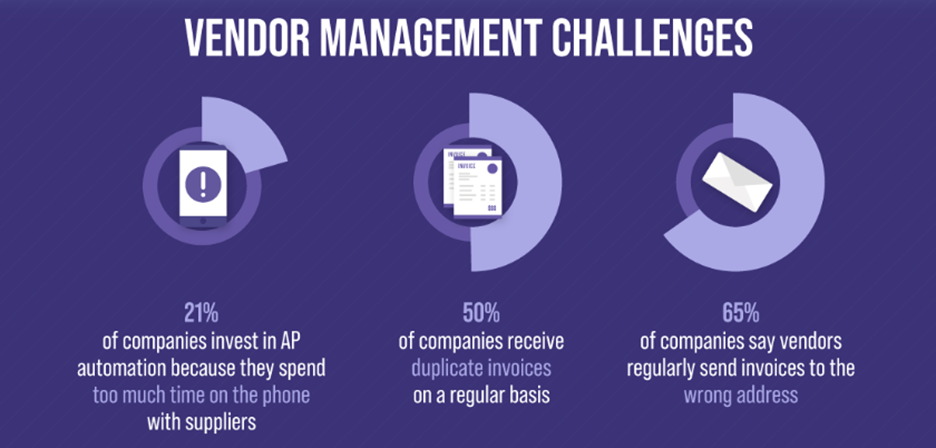
Automation standardizes how invoices enter the system. OCR and rules-based checks reduce manual keying errors, flag mismatches early, and prevent incomplete invoices from moving forward. This is where AP management automation delivers its first real win: fewer downstream corrections and cleaner vendor records.
Automated routing ensures invoices follow the same approval logic every time, regardless of volume or timing. This consistency removes variability across properties, teams, and vendors. As a result, AP automation vendor management shifts from individual follow-ups to system-led execution.
Automation creates a single source of truth for invoice and payment progress. Finance teams can see where items are held, why they are delayed, and what is scheduled next. Vendors no longer need to chase updates because the process itself provides clarity.
Instead of spending time reconciling errors or answering status queries, teams focus on exceptions that genuinely require judgement. Errors decline, rework shrinks, and compliance improves without adding extra layers of review.
Also Read: Accounts Payable Automation: Everything You Should Know
Supplier relationships improve when finance operations become reliable. AP automation strengthens trust not through promises, but through repeatable outcomes.
Automated workflows reduce approval delays and eliminate avoidable holds. Vendors are paid when expected, not when issues are chased down. Over time, AP automation for supplier payments becomes a credibility signal rather than just an efficiency gain.
Validation rules, matching logic, and audit trails reduce errors before payments are released. Fewer incorrect amounts, duplicate payments, or missing approvals mean fewer disputes. This is where vendor payment accuracy and transparency materially improve the supplier experience.
Automation replaces inbox-based updates with real-time status tracking. Vendors know whether an invoice is received, approved, or scheduled. This transparency removes friction and cuts down follow-ups that strain both sides.
Standardized workflows ensure suppliers are treated the same way, regardless of property, region, or invoice volume. Over time, this consistency is what allows invoice automation to improve vendor relations at scale.
Strong accounts payable vendor management is less about adding controls and more about designing AP to behave predictably under pressure. The following practices separate stable vendor ecosystems from constantly escalated ones.
Vendor master data, invoice intake, approvals, and payment status should sit within a single, governed workflow. Fragmented spreadsheets and email-based tracking create inconsistency and increase dispute risk. Centralization is the foundation for scalable vendor relationship management.
Manual intervention should be the exception, not the process. AP management automation removes repetitive handling from invoice capture, validation, and routing, reducing both errors and dependency on individuals. Fewer handoffs mean fewer breakdowns.
Predictability matters more to vendors than speed alone. Clearly defined payment cycles, automated acknowledgements, and visible approval status reduce follow-ups and friction. This is where vendor payment accuracy and transparency directly influence supplier trust.
Metrics such as invoice exception rates, approval cycle times, dispute frequency, and on-time payment performance should be reviewed regularly. These indicators reveal where vendor accounting processes are weakening before issues escalate.
Vendor management cannot operate independently of working capital priorities. Payment scheduling, discount capture, and approval logic should align with broader cash flow planning, not contradict it. Well-designed accounts payable management supports liquidity without damaging supplier relationships.
Not all automation improves outcomes. The right approach strengthens control, visibility, and consistency across the vendor lifecycle.
The right approach turns vendor management into a controlled system rather than a recurring source of exceptions.
Also Read: Top Accounts Payable Outsourcing Companies in USA – What Sets Them Apart
Vendor relationship management in accounts payable is moving away from transactional firefighting and toward structured, system-led collaboration. In 2026, suppliers increasingly expect the same level of transparency and predictability they experience in other parts of the business.
Three shifts are already taking shape.
The future is not faster AP at any cost. It is calmer AP that vendors can rely on.
QX Global Group helps finance teams redesign AP operations to strengthen both control and supplier relationships. Our accounts payable services combine AP management automation with structured execution models that remove friction from vendor-facing processes without compromising governance.
We work with organizations to:
By aligning accounts payable management with automation and process clarity, we help finance teams move from reactive vendor handling to stable, system-led execution.
If vendor escalations, payment disputes, or visibility gaps are still consuming AP time, it may be time to rethink how vendor management is designed. Speak with our AP specialists to explore how automation can improve supplier relationships while giving finance teams tighter control in 2026.
Effective accounts payable vendor management starts with predictability. That means clean vendor data, standardized invoice workflows, clear approval ownership, and payment schedules that align with agreed terms. When these basics are supported by AP management automation, finance teams reduce errors, shorten cycle times, and give vendors confidence in how payments are handled.
The vendor management process covers supplier onboarding, invoice receipt and validation, approvals, payment execution, and ongoing communication. Strong vendor relationship management ensures each step is consistent, traceable, and visible. In mature environments, this process is supported by a centralized vendor management system that reduces manual touchpoints and improves control.
Poor accounts payable vendor management creates uncertainty. Late payments, frequent invoice disputes, and unclear status updates force vendors into follow-ups and escalations. Over time, this erodes trust, weakens negotiating leverage, and can disrupt supply continuity. What begins as an AP issue often turns into a broader operational risk.
AP automation for supplier payments reduces disputes by standardizing invoice capture, validation, and approval routing. Errors are flagged early, approvals follow defined rules, and payment status is visible in real time. This improves vendor payment accuracy and transparency, which directly cuts down disputes, emails, and manual follow-ups.
Finance teams should track invoice exception rates, approval cycle times, on-time payment performance, dispute frequency, and average resolution time. Together, these KPIs show whether the vendor accounts payable workflow is predictable and controlled. When supported by vendor accounting process automation, these metrics also highlight where process design needs improvement.
External support becomes relevant when vendor escalations increase, disputes consume AP capacity, or visibility into invoice and payment status remains poor despite internal effort. Organizations scaling vendor volumes or implementing AP automation vendor management often benefit from external expertise to redesign workflows, strengthen controls, and stabilize supplier relationships without adding headcount.
CFOs usually need more than a savings estimate. They need a business case that can hold up with the CEO, board, and finance leadership team. The right vendors are the ones that can help with:
The strongest partners help CFOs decide what to outsource, what to automate, what to keep in-house, and whether the investment is worth the risk.

Education:
CA, B.Com

Rushabh Shah is a Chartered Accountant with over 7 years of experience in audits, financial analysis, and process optimisation. At QX, he specialises in CAPEX reviews, treasury management, P2P processes, and tax and statutory compliance. With a strong foundation in financial reporting, Rushabh brings cross-sector expertise and a sharp analytical approach to managing complex finance operations.
Expertise: CAPEX Reviews, Treasury Management, P2P Processes, Tax & Statutory Compliance, Financial Reporting, Audit & Financial Analysis
Originally published Feb 18, 2026 02:02:36, updated Jun 01 2026
Topics: Accounts Payable Automation, Accounts Payable Process
30 Jul 2026
Accounts payable outsourcing helps recruitment agencies gain greater control over cash flow, improve...
Read More22 Jul 2026
From the top, accounts payable usually looks like one of the easier to manage parts of finance. Invo...
Read More21 Jul 2026
Most finance leaders know their biggest customers inside out. They know which products are performin...
Read More17 Jun 2026
Turn season is usually discussed through an operations lens: move-outs, inspections, make-ready work...
Read More