Topics: Finance & Accounting, Senior Living
Posted on May 01, 2026
Written By Nishant Kumar




In senior living, financial complexity is expected. Multiple services, rising costs, and regulatory oversight are all part of the operating environment. Yet, for many operators, the real challenge is not complexity itself, but maintaining clarity within it.
The scale of the sector’s growth challenge is significant. The Older People’s Housing Taskforce estimates that the UK needs 30,000–50,000 new later living homes each year, while only around 5,000–7,000 are currently being built annually. It also notes that only 0.6% of over-65s live in Housing with Care in the UK. As the sector expands, financial clarity will become harder to maintain across increasingly complex operating models.
With growth, senior housing financial management becomes harder to standardise. Financial data remains available, but increasingly difficult to interpret in a consistent way. This is where healthcare financial reporting complexity begins to show — not as a single issue, but as a result of multiple financial layers interacting with each other.
The result is a gradual loss of visibility. And once clarity begins to slip, control becomes harder to maintain.
One of the core reasons financial clarity is difficult to maintain in senior living is structural. These organisations are not built around a single, clean financial model.
Instead, they operate across multiple layers at the same time:
Each of these behaves differently from a financial perspective.
Care services are driven by staffing levels, acuity of residents, and operational intensity. Accommodation income follows a more stable, property-based model. Service revenues often sit somewhere in between, with variable demand and inconsistent timing.
Individually, these streams can be managed.
The difficulty begins when they are brought together.
This is where areas such as care cost allocation and rent and service charge accounting become more than accounting exercises. They become critical to understanding how the business is actually performing.
The challenge is not recording these streams. It is ensuring they can be interpreted together in a meaningful way.
At scale, that becomes increasingly difficult.
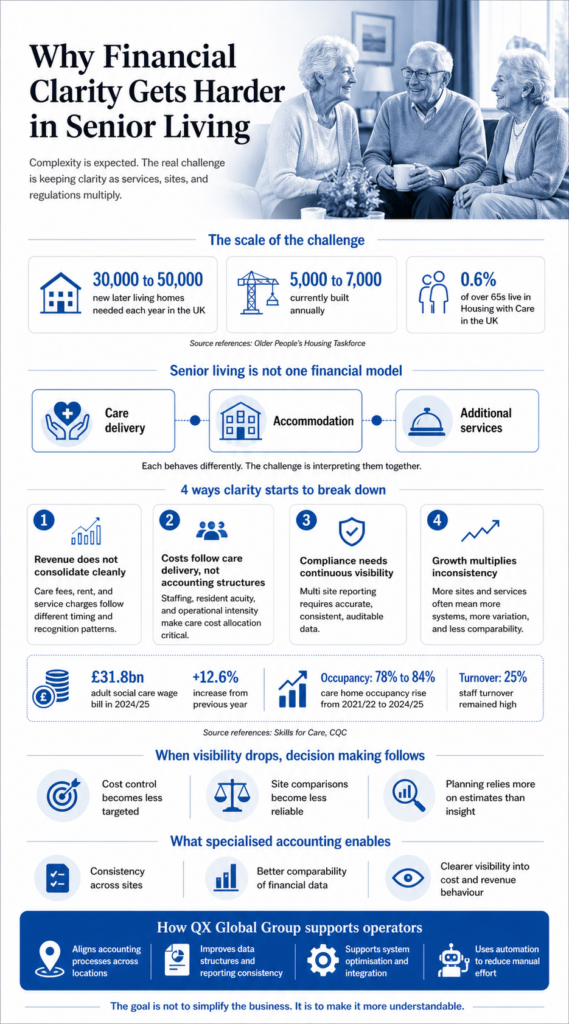
The pressure on financial clarity does not appear in one place. It builds gradually, across revenue, costs, compliance, and growth.
Most operators recognise these issues individually. What makes them difficult is how they interact.
Senior living revenue is inherently layered. Care fees, rental income, and service charges all contribute to the overall financial picture, but they do not behave in the same way.
Differences in timing, recognition, and variability mean that consolidation is rarely straightforward. What appears accurate at a site level may not align cleanly when viewed across the portfolio.
This is where rent and service charge accounting begins to create friction. Not because the underlying numbers are incorrect, but because they are not easily comparable.
Over time, this affects how revenue is interpreted. The business continues to generate income, but understanding where that income is coming from — and how it is evolving — becomes less clear.
If revenue creates one layer of complexity, costs create another.
In senior living, costs are driven primarily by care delivery. Staffing levels, resident needs, and operational intensity shape how costs behave on a day-to-day basis.
Workforce cost pressure makes this especially important. Skills for Care estimates that the adult social care sector wage bill reached £31.8 billion in 2024/25, a 12.6% increase from the previous year. When such a large and fast-rising cost base is driven by staffing, care intensity, and operational demand, clear care cost allocation becomes central to understanding true performance.
This does not always align neatly with accounting structures.
Costs may be captured accurately, but not always allocated in a way that reflects how the business operates. This is where care cost allocation becomes critical.
Without clear allocation, margins begin to blur. It becomes harder to distinguish between:
At a single-site level, this may be manageable. Across multiple locations, the lack of clarity becomes more visible.
Regulatory oversight in senior living is both necessary and demanding. Requirements under care home financial regulations UK and broader regulatory compliance reporting frameworks require operators to maintain consistent, auditable financial records.
At a single-site level, compliance is often well managed.
The challenge emerges when these requirements need to be applied across multiple locations and operating models.
Compliance is no longer a periodic exercise. It becomes a continuous requirement, dependent on the accuracy and consistency of financial data across the organisation.
Gaps are not always obvious. They tend to surface during audits, reviews, or reporting cycles, often when correction becomes more complex.
The issue is not understanding compliance. It is maintaining it consistently at scale.
CQC’s 2024/25 State of Care report shows why visibility matters. Care home occupancy rose from 78% in 2021/22 to 84% in 2024/25, while staff turnover remained at 25%. For operators, this creates a difficult combination: higher utilisation, continued workforce movement, and the need for consistent financial and operational reporting across sites.
Growth in senior living typically comes through expansion across sites, services, or acquisitions.
Each addition introduces variation.
Different systems, different processes, and different reporting practices begin to coexist within the same organisation. What worked well in one location may not align with another.
Over time, this leads to a familiar pattern:
This is where healthcare financial reporting complexity becomes more pronounced.
Growth does not always improve visibility.
In many cases, it reduces it.
When financial clarity begins to decline, the impact is rarely immediate. Operations continue, reports are produced, and the business moves forward.
The change is more subtle.
Decisions become harder to make with confidence. Financial insights take longer to interpret. Margins are understood in broader terms rather than with precision.
For leadership teams, this creates a shift from proactive to reactive management.
Control is still present within the organisation. The challenge is that it is no longer supported by consistent visibility.
Over time, this affects both operational efficiency and strategic decision-making.
Most traditional accounting approaches are designed for businesses with relatively linear financial models. Revenue streams are predictable, cost structures are aligned, and reporting follows consistent patterns.
Senior living does not operate in that way.
The interaction between care delivery, property management, and regulatory requirements creates a level of complexity that generic models are not designed to handle.
This is where specialised accounting for healthcare providers becomes relevant.
It is not about adding more accounting processes. It is about adapting those processes to reflect how the business actually operates.
Without this alignment, even well-structured accounting frameworks begin to fall short.
When accounting is aligned with the operational reality of senior living, the impact is immediate.
Financial data becomes more interpretable. Reporting becomes more consistent. Decision-making becomes more informed.
This is where senior living accounting services and care home accounting services play a meaningful role within the organisation.
Rather than focusing only on compliance or reporting output, the emphasis shifts to:
This supports stronger senior housing financial management, particularly in environments where scale and complexity are increasing.
The objective is not to simplify the business.
It is to make it more understandable.
For senior living operators managing complex, multi-site environments, achieving financial clarity requires a combination of structured processes, system alignment, and specialised expertise.
QX Global Group supports this by helping organisations bring consistency into their finance operations.
This includes:
A key advantage is the ability to improve financial visibility and control without increasing headcount in proportion to growth. By combining process discipline, technology, and experienced talent, organisations can scale more efficiently while maintaining clarity across their operations.
Senior living is inherently complex. That complexity is not the problem.
The challenge lies in maintaining financial clarity as that complexity grows.
As revenue models, cost structures, and regulatory requirements interact across multiple sites, visibility becomes harder to sustain. Without that visibility, control begins to weaken.
At scale, the question is no longer whether financial data exists.
It is whether it can be understood clearly enough to support confident decision-making.
Specialised accounting for healthcare providers is important because senior living combines multiple financial models, including care services, accommodation, and operational services. Standard accounting approaches often fail to capture this complexity effectively.
Layered revenue streams make consolidation and reporting more difficult. Without structured rent and service charge accounting and clear allocation methods, financial clarity reduces over time.
Strong accounting processes support regulatory compliance reporting by ensuring accurate, consistent financial data across sites, helping organisations meet care home financial regulations UK.
Improving financial transparency requires standardising reporting structures, aligning systems, and implementing consistent cost allocation frameworks across the organisation.
Clear care cost allocation and improved visibility into operational costs help finance teams identify inefficiencies and make more informed decisions around resource allocation and profitability.

Education:

Nishant Kumar is a senior commercial leader with 20+ years of experience supporting hospitality and accommodation businesses through technology-enabled outsourcing and operational transformation. At QX Global Group, he works with property owners, asset managers, and hospitality leaders across the UK and Europe to improve profitability, modernise back-office operations, and build scalable operating models. His expertise spans finance and accounting, payroll, and digital enablement for multi-property and franchise-led hospitality organisations, with a strong focus on cost optimisation, standardisation, and automation-led efficiencies.
Expertise: Hospitality and accommodation outsourcing, Multi-entity finance transformation, Shared services and global delivery models, Automation-led cost optimisation, Strategic commercial advisory
Originally published May 01, 2026 05:05:36, updated May 01 2026
Topics: Finance & Accounting, Senior Living
01 May 2026
In many real estate businesses, real estate accounts receivable tends to stay in the background unti...
Read More29 Apr 2026
For a long stretch, multifamily performance had a familiar formula. Push rents, protect occupancy, k...
Read More24 Apr 2026
Senior living has a demand story the industry can feel good about. Occupancy is rising, the age wave...
Read More22 Apr 2026
Introduction For many finance leaders, the value of record to report has traditionally been measured...
Read More