Topics: Finance & Accounting Outsourcing, Property Management
Posted on November 12, 2026
Written By Nishant Kumar




Repairs data usually begins life as an operational record: a leak, a failed pump, a broken entry system or a contractor call-out. By month-end, the same job may appear as a purchase order, an invoice, an accrual and a short line in a property variance report. The connection between these records is often lost.
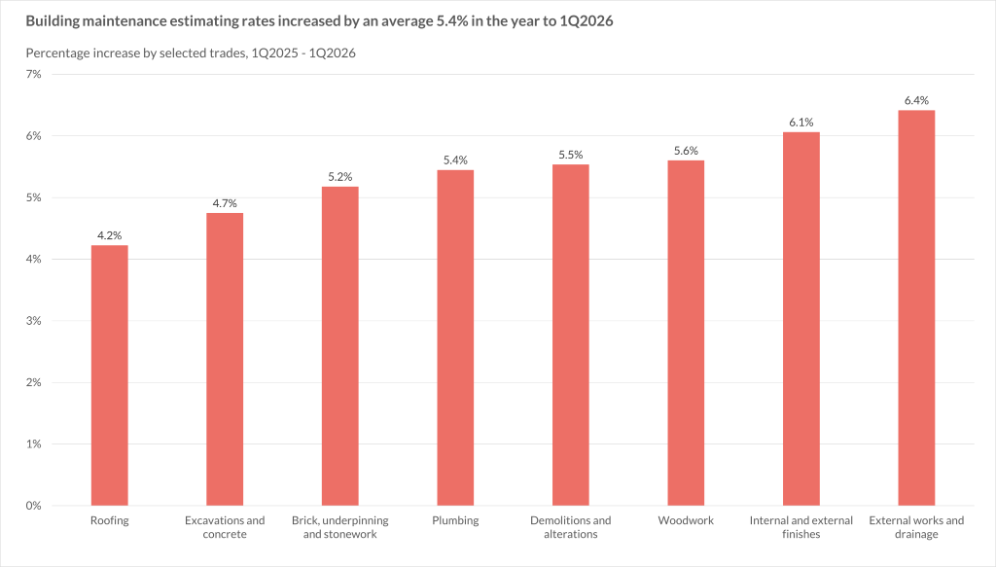
The loss becomes more significant as maintenance costs rise. BCIS reported that estimating rates in its maintenance database rose by an average of 5.4% in the year to Q1 2026, with movement ranging from 4.2% for roofing work to 6.4% for external works and drainage. These rates indicate cost movement in the database rather than the actual repair spend experienced by every operator.
Finance cannot manage this pressure through a larger repairs budget alone. It needs to know which assets, components, and failure types are driving the increase.
Repairs become useful portfolio evidence when the job, contractor, asset, and financial record use the same structure. This article explains how property management accounting services can connect these records and turn day-to-day maintenance activity into clearer accruals, contractor oversight, and lifecycle decisions.
A property team may close a job when the work is complete. Finance closes it when the invoice, accrual and coding are settled. Asset management may keep it open until the cause is understood and the lifecycle plan is updated. Those points often fall in different reporting periods.
The data usually breaks at one of four hand-offs:
1. Job to asset: The request identifies the property but not the component, unit, system or asset code affected.
2. Work to cost: The contractor record explains what was done, while the invoice uses a broad description or consolidated call-out charge.
3. Cost to period: Work is completed before month-end, yet the invoice arrives later and no reliable accrual is raised.
4. History to decision: Repeated jobs are visible individually but never brought together by cause, component or contractor.
Each hand-off can be reconciled manually, but across a portfolio this removes context needed for benchmarking and asset planning.
Fixing those hand-offs starts with agreeing which repair data operations and finance need to share.
The matrix shows the minimum information that should carry through from the original request to portfolio reporting. It is a control map, not another form for site teams.
| Shared Data | Minimum Record | Management Use |
| Asset identity | Property, unit, component and asset code | Links repeat work and cost to the correct part of the estate |
| Issue and cause | Reported symptom, confirmed fault and cause code | Separates recurring failure from unrelated call-outs |
| Work and outcome | Repair, temporary fix, replacement, inspection or no fault found | Shows whether spend resolved the issue or deferred it |
| Contractor record | Supplier, attendance, labour, materials and completion evidence | Supports rate checks, performance and invoice validation |
| Financial record | PO, commitment, invoice, accrual, recoverability and cost code | Places the full cost in the correct property and period |
| Lifecycle signal | Frequency, downtime, cumulative cost and residual risk | Supports maintain, refurbish or replace decisions |
The most important control is the asset code. A broad label such as “plumbing” can explain the ledger account, but it cannot show whether one pump, riser, flat or building system is failing repeatedly. Finance needs both views, both the accounting category and the physical asset affected.
Once the identifiers are consistent, the job can move through a financial process that ends with a usable lifecycle signal.
The process connects five records often managed separately. Each stage should retain the same asset code, owner and job reference, allowing the final cost to be traced to the operational issue.
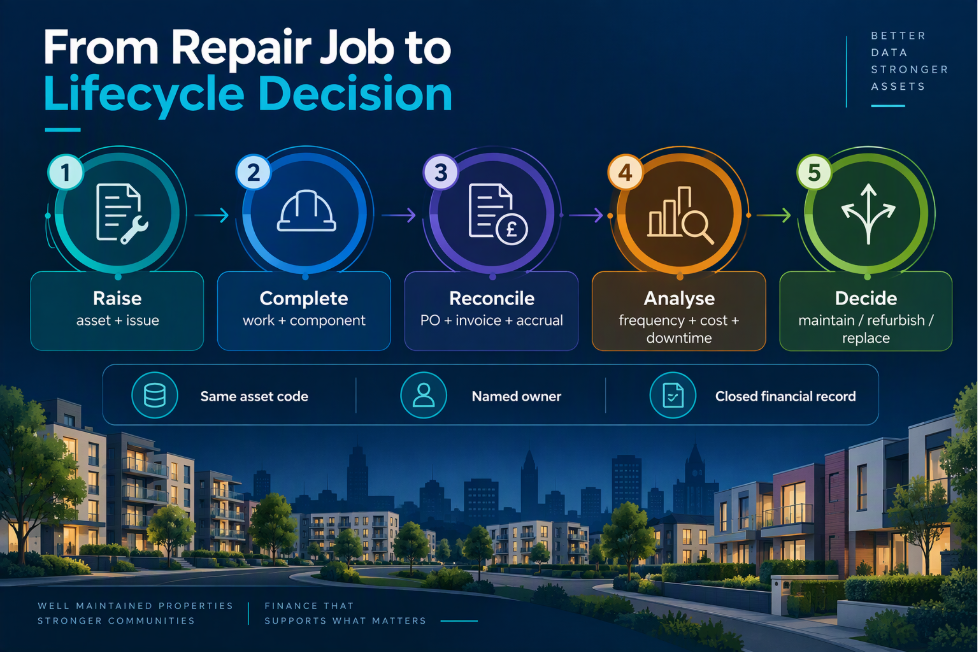
Capture the property, location, component, issue, priority and operational impact. Free text should sit beside controlled asset and cause fields.
The completion record should state the work performed, parts used, whether the repair is permanent and any follow-up required. This supports invoice review and failure analysis.
Match the job, purchase order, completion evidence, invoice and accrual. Allocate multi-site or multi-job invoices before posting so each asset retains its share of spend.
Review repeat jobs, cumulative cost, service interruption and contractor response. One expensive repair may be justified; several smaller interventions on the same component may signal a wider problem.
The maintenance history should inform the lifecycle plan, budget and timing of capital work. Record how the operational evidence changed the asset plan.
The same links improve month-end reporting, where incomplete repair records often appear as accrual uncertainty and unexplained property variances.
Property repair costs do not follow the accounting calendar neatly. Jobs may be complete while invoices are delayed, disputed or awaiting site confirmation. A reliable work-order record gives finance a better basis for accruals than the previous month’s run rate.
The accrual should draw from:
This creates a clearer distinction between cost timing and cost control. A late invoice may affect the posting date, but the portfolio should still recognise completed work in the right period and retain the evidence behind the estimate.
With the period cost settled, finance can compare contractors on more than invoice value.
Contractor reporting is often split between service levels and finance spend. The useful view combines both: low cost carries little value if the repair fails, evidence is poor or the same asset returns to the queue.
A practical contractor scorecard should include:
Interpret the scorecard in context. A contractor handling complex legacy assets may cost more than one working on newer stock, so asset age, access, location and job complexity should remain visible.
RELATED CASE STUDY: See how QX helped a UK student accommodation provider connect site purchasing, purchase orders, budget control and invoice accuracy through a tailored workflow.
Contractor performance explains part of the spend. Lifecycle reporting shows whether the asset itself is changing the cost pattern.
There is no single cost threshold. The decision becomes clearer when repair frequency, cumulative spend, downtime, contractor effectiveness and remaining useful life point in the same direction.
Finance can then show the full history behind a capex request: jobs, costs, accruals, downtime and previous interventions. That is more persuasive than a one-line replacement request and more useful for ranking investment across the portfolio.
For the portfolio view to hold, the same logic needs to survive across properties, systems and local operating teams.
The pack should move from spend totals to management questions. It can remain compact if each measure leads to a decision.
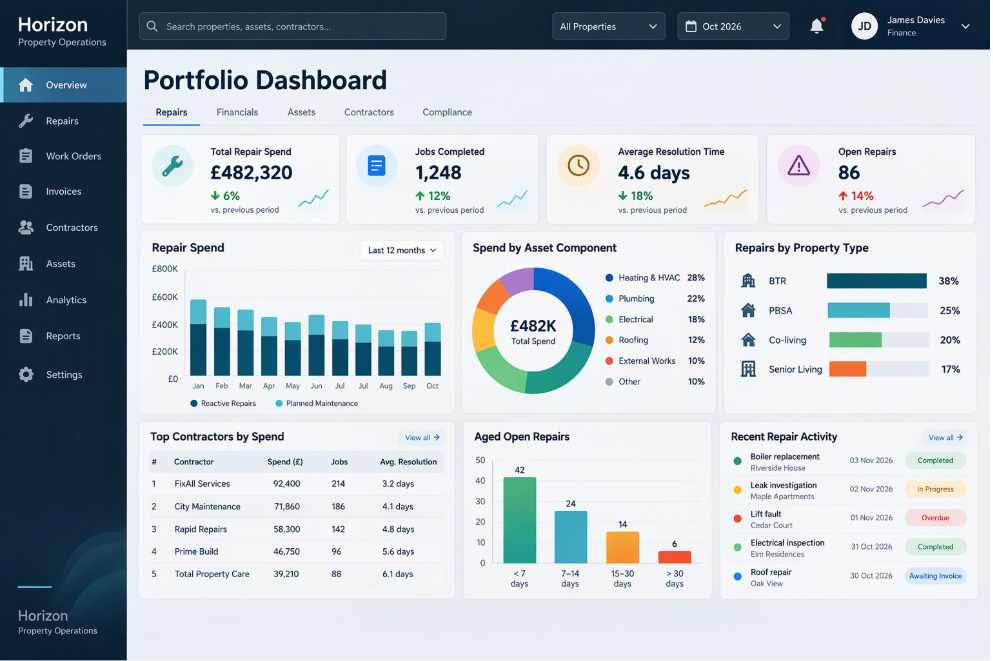
A useful portfolio view brings together cost, open work, contractor performance and repeat asset issues. Finance should be able to move from headline spend to the property, component or job driving it without rebuilding the analysis.
| Reporting Lens | Measures | Decision |
| Cost control | Actual, accrual, commitment and variance by property and category | Is the period cost complete and correctly allocated? |
| Operational pressure | Jobs raised, ageing, emergency work and downtime | Which assets or sites need immediate attention? |
| Repeat failure | Jobs and spend by asset, component and cause | Where is reactive work becoming structural? |
| Contractor performance | Cost, response, resolution and invoice accuracy | Which suppliers deliver usable value? |
| Lifecycle outlook | Cumulative cost, condition, planned replacement and forecast | Which assets should move into capex planning? |
The report should allow drill-down from portfolio to property, asset and job. It should also reconcile to the general ledger. A dashboard that cannot tie back to posted and accrued cost will lose credibility when management challenges a trend.
RELATED INSIGHTS: See how consistent property definitions and reporting capacity support portfolio visibility in Mind the Gap: Where PBSA Demand and Finance Capacity Diverge.
QX Global Group supports property-level accounting, purchase-to-pay, reconciliations, accruals, capex schedules, month-end preparation and management reporting. For repairs and maintenance, the work begins with a common link between the operational job and the financial record.
Within the client’s systems and policies, QX can help maintain coding structures, reconcile work orders and invoices, prepare repair accruals, analyse spend by property and contractor, and build reporting schedules that preserve asset-level detail. Property managers retain operational priorities, contractor appointments, repair decisions and capital approval.
This can create a cleaner route from daily activity to portfolio review. Finance can spend less time reconstructing what happened, while property and asset teams receive cost information traceable to the job, component and decision behind it.
RELATED CASE STUDY: See how QX helped a UK multi-site property operator create standardised reporting, consolidated budgets and drill-down visibility across its portfolio.
Repairs data becomes financially useful when the job, asset, contractor and cost remain connected from request to close. That connection improves accruals, contractor review and property reporting before it reaches lifecycle planning.
Start with a common asset code, named ownership and a closed financial record. Then report repeat work, cumulative cost and downtime alongside the ledger. The portfolio can see where spend reflects normal maintenance and where it signals a larger asset problem.
Property management accounting services add value by keeping that structure consistent across sites and systems. The result is stronger cost control today and better evidence for future investment.
Need a clearer financial view of repairs across your portfolio? Talk to our team about connecting operational repairs data with accruals, contractor reporting and lifecycle planning.
Property management accounting services connect work orders, assets, contractors, invoices and accruals through consistent coding. This allows finance teams to compare repair cost, frequency, downtime and outcomes across properties, then identify trends that require operational or capital action.
Consistent coding ensures every repair is linked to the correct property, component, contractor, cause and accounting category. It prevents similar jobs from being fragmented across the ledger and makes portfolio comparisons, accruals and lifecycle analysis more reliable.
Repairs data can reveal cumulative maintenance cost, repeat failures, emergency call-outs, contractor performance, downtime and unresolved commitments. When reconciled to the ledger, these measures show whether spend reflects routine maintenance or a deteriorating asset.
Repairs data supports lifecycle planning by combining frequency, cumulative cost, operational disruption and remaining useful life. Asset teams can use that evidence to compare continued maintenance with refurbishment or replacement and rank competing capex priorities.
Yes. Outsourced property accounting can improve data quality by applying common coding, reconciliation and reporting rules across properties. The operator retains asset and contractor decisions while the provider keeps operational records and financial postings consistently connected.
QX supports coding, work-order and invoice reconciliation, accruals, contractor-spend analysis, capex schedules and property reporting. Delivery follows the client’s systems and controls, while property managers retain repair priorities, supplier appointments and capital approval.
Trusted vendors have specialist experience across property management, BTR, student accommodation and other living sectors. They should understand service charges, recoverables, repairs, multi-entity accounting and property-level reporting, with references from comparable UK portfolios.
Providers offering dedicated, named finance teams generally deliver stronger continuity than shared processing pools. Confirm who is assigned to the account, how backups are cross-trained and how property, system and reporting knowledge will be retained.
Strong providers support private equity owners with consistent management information, measurable KPIs and transparent governance. For property portfolios, they should preserve asset-level detail while reporting cost, performance and lifecycle risk clearly across the ownership period.

Education:

Nishant Kumar is a senior commercial leader with 20+ years of experience supporting hospitality and accommodation businesses through technology-enabled outsourcing and operational transformation. At QX Global Group, he works with property owners, asset managers, and hospitality leaders across the UK and Europe to improve profitability, modernise back-office operations, and build scalable operating models. His expertise spans finance and accounting, payroll, and digital enablement for multi-property and franchise-led hospitality organisations, with a strong focus on cost optimisation, standardisation, and automation-led efficiencies.
Expertise: Hospitality and accommodation outsourcing, Multi-entity finance transformation, Shared services and global delivery models, Automation-led cost optimisation, Strategic commercial advisory
Originally published Nov 12, 2026 12:11:59, updated Nov 12 2026
Topics: Finance & Accounting Outsourcing, Property Management
12 Nov 2026
Living platforms increasingly span more than one product. A group may operate BTR homes, student acc...
Read More10 Nov 2026
BTR, PBSA and co-living may now sit in the same investment platform, but their finance definitions h...
Read More09 Nov 2026
For a lot of property accounting teams, the close still runs well into the second week of the month....
Read More06 Nov 2026
At ten properties, monthly reporting is manageable. Someone exports the numbers from the property sy...
Read More