Topics: Finance & Accounting Outsourcing, Property Management
Posted on May 05, 2026
Written By Nishant Kumar




Property management accounting challenges are often described as a function of scale. More properties, more entities, and more reporting requirements are expected to create complexity.
In reality, most organisations already have the fundamentals in place. Systems exist, controls are defined, and reporting structures are well understood. This is also why many turn to specialised accounting services for property management as they scale, not to rebuild the function, but to bring greater consistency across it.
The difficulty begins when portfolios expand.
As new properties are added through acquisitions and consolidation, different systems, accounting treatments, and reporting approaches begin to sit alongside each other. Individually, they work as intended. Over time, however, those differences start to accumulate.
This is where areas such as service charge accounting property management, client money compliance property management, and property management financial reporting begin to feel harder to manage. Not because they are unfamiliar, but because they are no longer consistent across the portfolio.
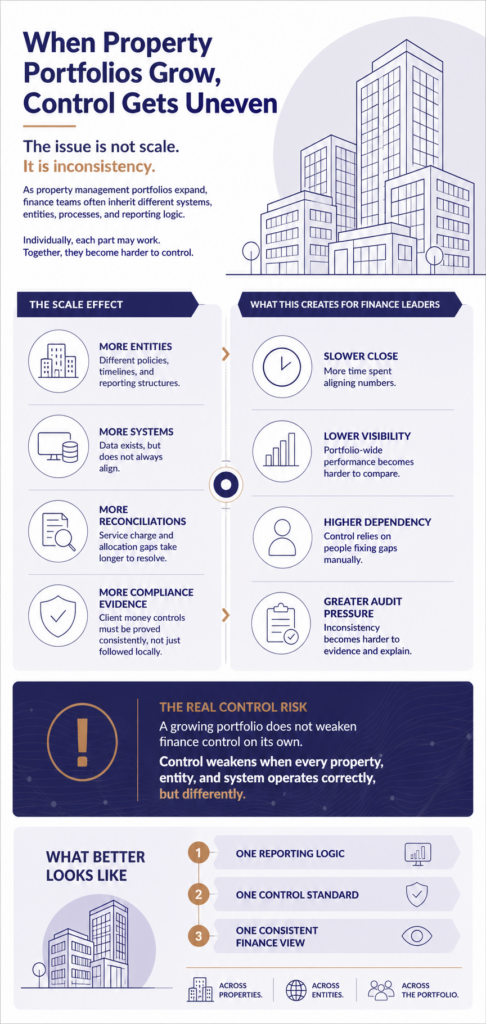
Growth in property management rarely happens in a uniform way. It is typically built over time through a combination of new developments, acquisitions, and portfolio consolidation.
Each addition brings its own way of working. A system that was already in place. A reporting structure that made sense for that entity. A set of accounting practices shaped by its own history.
At a property level, these differences are manageable. Teams understand their systems, and reporting works within those boundaries.
The shift happens when these portfolios are brought together.
Different entities now sit within a single operating structure. Financial data needs to be aligned. Reporting needs to be comparable. Decisions depend on a consistent view across the portfolio.
What worked independently starts to require coordination.
It is not the number of properties that creates difficulty. It is the lack of alignment between them.
Over time, this introduces a more structural form of pressure:
Control does not disappear.
It becomes harder to maintain evenly.
In practice, this shift becomes visible in a few recurring areas.
Most portfolios operate across a mix of property management platforms and accounting tools, often inherited through acquisitions or introduced at different stages of growth.
Each system performs effectively within its own environment. The challenge begins when those environments need to connect.
Differences in data structures, reporting formats, and system logic mean alignment is rarely automatic. Financial information often needs to be adjusted before it can be consolidated. Reporting becomes less about extraction and more about interpretation.
Over time, this creates a pattern that finance teams recognise quickly. Data exists, but cannot always be used as-is. Systems function, but do not integrate cleanly. Reporting is available, but requires additional effort to make it consistent.
Systems rarely fail in isolation. The difficulty lies in getting them to support consistent real estate financial reporting across the portfolio.
As portfolios grow, so does the number of legal entities. Each entity brings its own accounting policies, reporting timelines, and internal processes, often shaped by how it was originally structured or acquired.
Individually, these entities function as expected.
The challenge emerges when consolidation is required.
Intercompany transactions need to be aligned. Accounting treatments may differ. Chart of accounts structures are not always consistent, and reporting timelines may not fully match.
What begins as a technical exercise in consolidation gradually becomes a structural challenge.
Multi-entity accounting management in this context is less about combining data and more about resolving differences before that data can be relied upon.
This leads to a familiar reality across growing portfolios:
Each entity continues to operate effectively on its own. The difficulty lies in bringing them together into a single, coherent reporting framework.
The impact of these structural issues becomes particularly visible in service charge accounting property management.
At an individual property level, service charge accounting is typically well understood. Processes are defined, and reconciliation follows established patterns.
The complexity increases when multiple properties are viewed together.
Different approaches to cost allocation, timing differences, and variations in accounting treatment begin to surface. Reconciliation across properties becomes more time-consuming, and consistency becomes harder to maintain.
This is where service charge reconciliation starts to require more intervention than expected.
It is not that service charge accounting is inherently difficult.
It becomes difficult when consistency across properties cannot be assumed.
A similar pattern applies to client money compliance property management.
In the UK, UK client money regulations are well defined. Requirements around segregation, reporting, and audit are clearly understood.
At a single-entity level, compliance is typically manageable.
The challenge emerges when these requirements need to be applied consistently across multiple entities and systems.
Differences in processes, system configurations, and reporting approaches can create gaps in how client fund segregation is implemented. These gaps are not always immediately visible, but they increase audit sensitivity and operational risk over time.
Compliance is not the issue. Consistency of compliance is.
If you are seeing growing complexity across your portfolio, this piece explores where it typically begins and how teams are starting to address it. Take a few minutes to read: Why Property Management Accounting Fails as Portfolios Scale (and How to Fix It)
As these issues build, they begin to affect property management financial reporting more directly.
Reporting remains in place, but the effort required to produce it increases. Data needs to be aligned, adjusted, and interpreted before it can be relied upon.
This creates a number of practical consequences:
Control is still present across the organisation. The challenge is that it is no longer uniform.
Maintaining a consistent, reliable view of performance across the portfolio becomes more demanding.
Addressing these challenges is less about adding more controls and more about creating alignment across the portfolio.
Leading operators focus on simplifying structure, standardising processes, and making systems work together rather than in parallel.
In practice, this involves:
For organisations operating across complex, multi-entity portfolios, achieving consistency often requires a combination of accounting expertise, process discipline, and system understanding. This is where specialised accounting services for property management begin to play a more structural role, particularly as portfolios expand beyond what existing teams can easily standardise.
QX Global Group supports property management businesses by helping them bring structure to this complexity.
This includes:
A key advantage in this approach is the ability to improve financial control and reporting consistency without increasing headcount in proportion to portfolio growth. By combining structured processes, technology, and specialised talent, organisations can scale their finance function more efficiently.
If you are reviewing how your property management accounting is set up or scaling, it might be helpful to talk it through. You can book a short, no-obligation call to explore what that could look like in your context.
Growth and consolidation are natural parts of the property management sector. As portfolios expand, complexity is expected.
The real challenge lies in maintaining consistency.
As multiple entities, systems, and reporting structures come together, control becomes harder to apply evenly across the organisation. Addressing this requires a more structured approach to accounting, supported by aligned processes and systems.
For organisations operating at scale, this is what ultimately determines the reliability of their financial reporting.
Accurate service charge accounting property management requires consistent processes across properties, clear cost allocation methods, and structured reconciliation frameworks. Standardisation across the portfolio helps reduce discrepancies.
UK client money regulations define how client funds must be held, reported, and protected. They require proper segregation, transparent reporting, and audit compliance across all entities managing client funds.
Multi-entity accounting management becomes complex due to differences in accounting policies, reporting timelines, and system structures across entities. Consolidation requires alignment before financial data can be used effectively.
Improving property management financial reporting involves standardising reporting structures, aligning systems, and reducing manual adjustments through process consistency and automation.
Systems that support integration, standardised data structures, and automated reconciliation processes are most effective in streamlining accounting operations across property management portfolios.

Education:

Nishant Kumar is a senior commercial leader with 20+ years of experience supporting hospitality and accommodation businesses through technology-enabled outsourcing and operational transformation. At QX Global Group, he works with property owners, asset managers, and hospitality leaders across the UK and Europe to improve profitability, modernise back-office operations, and build scalable operating models. His expertise spans finance and accounting, payroll, and digital enablement for multi-property and franchise-led hospitality organisations, with a strong focus on cost optimisation, standardisation, and automation-led efficiencies.
Expertise: Hospitality and accommodation outsourcing, Multi-entity finance transformation, Shared services and global delivery models, Automation-led cost optimisation, Strategic commercial advisory
Originally published May 05, 2026 01:05:31, updated May 14 2026
Topics: Finance & Accounting Outsourcing, Property Management
15 Sep 2026
Every compliance obligation a finance team meets requires data. Be it tax filings, statutory reporti...
Read More14 Sep 2026
A control failure doesn’t announce itself. It hides in the one routine a single trusted person own...
Read More11 Sep 2026
Picture a 90-unit association collecting around $290 a month per home. The books live in a spreadshe...
Read More10 Sep 2026
Late March 2026. Boardrooms across UK hospitality did the same sum. Days before 1 April, the n...
Read More