Topics: Finance & Accounting Outsourcing, Finance and Accounting Transformation
Posted on November 12, 2026
Written By Pardeep Sangwan




Living platforms increasingly span more than one product. A group may operate BTR homes, student accommodation and co-living, or add senior living through acquisition. Finance then has to decide what genuinely belongs in one operating model.
Shared processes can remove duplicate systems and teams, but the accounting rules still need to reflect each sector’s contracts, resident model and control requirements.
The finance model needs common execution for genuinely repeatable work, supported by explicit sector rules where accounting treatment or judgement differs. That boundary should shape the systems, service scope and governance used across the portfolio.
Living capital is already crossing sector boundaries. CBRE’s Q3 2026 UK Living Investment figures recorded £1.9 billion of investment in the quarter and £8.8 billion year-to-date across single-family housing, multifamily and PBSA. The reporting challenge grows when those assets sit under one owner, platform or finance function.
Shared finance can create genuine scale. A single supplier master, close calendar, reconciliation standard, and control framework are easier to govern than separate versions for every product. The difficulty appears when standardisation meets economics: rent structures, concessions, resident charges and property metrics do not become identical because the finance team is centralised.
Senior finance therefore needs a boundary between common execution and sector judgement. This boundary should be designed before work is migrated, automated, or outsourced.
The simplest way to draw it is to separate the process from the rulebook.
The operating platform can be common across BTR, PBSA, co-living and senior living. The rulebook attached to each asset still needs to preserve the revenue model, resident relationship and property economics.
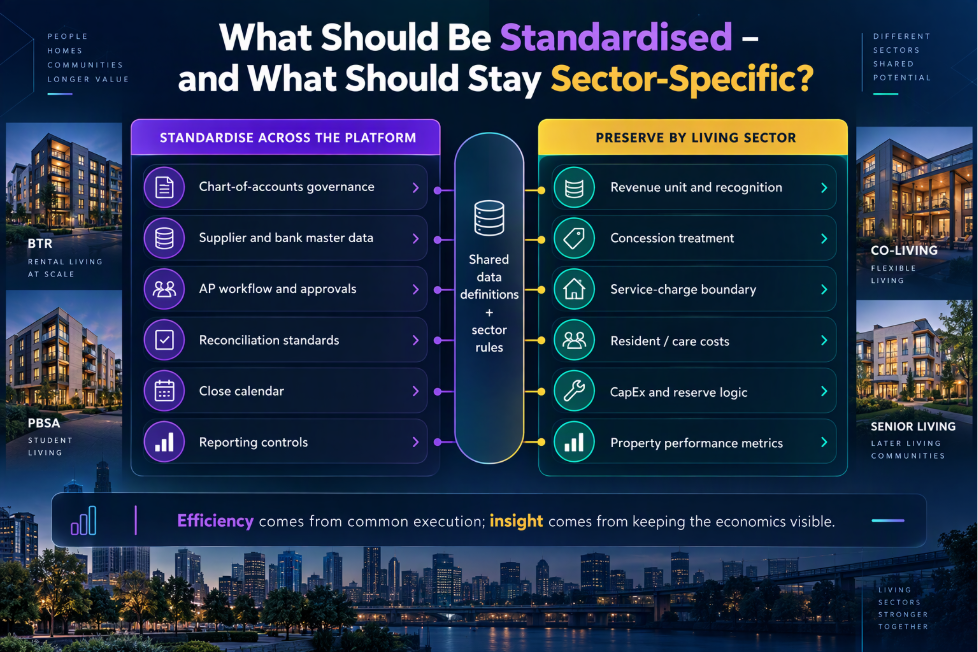
The platform should make execution consistent without turning sector-specific accounting instructions into one generic rulebook.
The first design decision is which activities genuinely benefit from one standard.
Processes can be standardised where the control objective and evidence are the same across sectors. The operating detail may vary, but the workflow should not need a separate finance model for each asset.
Supplier onboarding, invoice validation, coding structures, approval routing, exception ownership and payment preparation can follow one control model. Local service-charge or care-related coding rules can sit underneath it.
The reconciliation standard, ageing, evidence and review timetable should be common even when the underlying account relates to rent, deposits, resident funds or another sector-specific balance.
One close calendar can govern journals, accruals, reconciliations and reporting sign-off across the platform. Sector workbooks can feed the calendar without creating separate close disciplines.
Entity, property, supplier and account masters should have one ownership model. Sector tags and dimensions preserve the distinctions needed for analysis.
Version control, review, materiality, commentary ownership and audit trails can use the same standard even when the performance metrics differ.
These are good candidates for automation, shared-service delivery and common SLAs because the repeatable work is visible and measurable. They create scale without deciding how a BTR concession, PBSA deposit or senior-living resident fee should be treated.
Keep sector-specific rules where the resident contract, product design or regulation changes recognition, classification, approval or reporting. This is a rule-ownership question, not another portfolio-comparability framework.
| Areas | Why It Differs | Finance Rule |
| Revenue unit | Home, bed, room, or resident | Keep the native unit and define any common financial denominator separately |
| Revenue recognition | Lease, licence, service or care-related income | Follow the contract and accounting policy applicable to the sector |
| Concessions | Rent-free, promotional, scholarship or bundled-service support | Preserve reason, cohort and period allocation |
| Service charges / resident costs | Separate recovery, bundled cost, care or hospitality element | Keep the cost and recovery boundary visible |
| CapEx and reserves | Building lifecycle, room refresh, amenity investment, care environment | Apply one approval framework while retaining sector-specific asset logic |
| Performance metrics | Occupancy, effective rent, NOI, bed performance, resident fee mix | Do not use one metric definition where the denominator or cost boundary differs |
Group reporting can still use harmonised dimensions, provided the underlying sector policy and result remain traceable.
A practical finance model therefore needs a formal boundary between the common platform and the sector rules.
Use the matrix before centralising, outsourcing or automating a process. It places work in the shared platform, the sector rulebook or a governed middle layer.
| Decision Test | Default Position | Control |
| Same control objective across sectors? | Standardise the process | Use common workflow, SLA and evidence standard |
| Same data definition, but different sector calculation? | Standardise the data structure; preserve the rule | Store common fields and retain sector logic in controlled mappings |
| Different commercial or regulatory treatment? | Keep sector-specific | Document policy, ownership and approval by sector |
| High transaction volume and low judgement? | Good outsourcing / automation candidate | Transfer repeatable execution with measurable service levels |
| Material judgement or resident / investor sensitivity? | Retain internal decision rights | External support may prepare evidence; client approves the judgement |
| Metric used for group comparison? | Create a governed management bridge | Show adjustments from sector result to group measure and keep them reversible |
The matrix avoids a false choice between full standardisation and four separate finance models. Processes and capacity can be shared while sector rules remain controlled.
This becomes especially important when finance execution is moved outside the internal team.
Outsourcing works best where the process can be documented, measured and reviewed consistently. A mixed portfolio needs one delivery model with clear sector instructions.
A specialist team can support accounts payable, bank reconciliations, general-ledger processing, accrual schedules, month-end preparation, property reporting and data maintenance across sectors. The shared team works to one operating calendar and control standard, while sector instructions determine how transactions are classified and reported.
Operators choosing to outsource finance and accounting should keep contractual interpretation, pricing policy, concession strategy, care-related judgements, material CapEx decisions and final reporting approval with the relevant internal teams. Those decisions carry sector knowledge and commercial accountability that a common processing model should support, not absorb.
The retained team owns policy, material exceptions, judgement and performance interpretation. The outsourced team owns consistent execution, evidence and escalation.
A cross-sector model succeeds only if the governance is strong enough to stop shared execution from diluting sector expertise.
Use two governance layers: platform governance for delivery and sector governance for accounting rules and judgement. The review calendar can be shared; decision rights should remain separate.
| Governance Layer | Review | Decision Owner |
| Platform delivery | SLAs, close performance, reconciliation ageing, data quality, exceptions and capacity | Shared finance / service leadership |
| Sector rulebook | Revenue policy, concession treatment, cost boundaries and property metrics | Sector finance lead / controller |
| Change control | New products, acquisitions, systems and changes to accounting instructions | Finance leadership with relevant operating owner |
| Portfolio reporting | Group adjustments, management bridges and definition changes | Group finance / investment reporting owner |
The model should be easy to explain to a controller, asset manager and investor. If a metric cannot be traced to the sector accounts or an exception cannot be assigned to an owner, the platform has become too abstract.
QX Global Group supports property accounting, accounts payable, reconciliations, month-end preparation, management reporting, data standardisation and shared-service delivery across real estate portfolios. The delivery model can use one finance operating rhythm while retaining documented accounting instructions for different living products.
For a mixed portfolio, the practical work sits in the hand-offs: common entity and property mappings, controlled master data, sector-specific coding guides, consistent reconciliation evidence and reporting packs that preserve the detail behind group measures. That gives internal finance teams a stable platform without asking one set of metrics to describe every asset.
The client retains revenue policy, lease or resident interpretation, sector-specific compliance, CapEx priorities, investment judgement and final sign-off. QX provides the repeatable processing, documented controls and scalable capacity around those decisions. Here’s what this looks like at scale…
The problem: A global real estate company was operating finance through non-standard processes that needed to be consolidated into a more consistent shared-services model. The transition also had to protect continuity across a large property-accounting operation.
The solution: QX built a team of more than 100 property-accounting professionals and helped move the client to consolidated, standardised and documented finance processes. The transition was phased and delivered remotely, with no disruption to ongoing operations.
The impact: The model delivered 1.8 million GBP in annual savings while maintaining 99% adherence to SLAs. The relevance here is the operating model: common processes and scalable delivery can sit across a complex real estate platform, while asset- and sector-specific accounting rules remain governed separately.
Living sectors can share finance infrastructure without sharing every accounting rule. AP, reconciliations, close, data governance and reporting controls are natural candidates for one platform; revenue, concessions, resident costs, CapEx logic and property metrics still need sector ownership.
Start by documenting the processes that have the same control objective across the portfolio. Then identify the measures and judgements whose meaning changes by sector. That boundary should shape the systems, outsourcing scope and governance model.
Living Sector finance models work when scale and specificity coexist. The platform reduces duplication; the sector rulebook keeps management information commercially useful.
Building a finance model across more than one living sector? Explore QX Global Group’s UK finance and accounting services or talk to our team about a delivery model that standardises repeatable finance work while preserving sector-specific controls and reporting.
Living sectors are becoming more interconnected as investors and operators build platforms spanning BTR, PBSA, co-living and senior living. Shared capital, systems and operating infrastructure create opportunities for common finance processes while sector economics remain distinct.
Process metrics such as close timeliness, reconciliation ageing, data quality and exception resolution can be standardised across sectors. Property metrics such as occupancy, effective rent, service charges and NOI require controlled definitions before they are compared.
Sector-specific accounting preserves the revenue, resident-cost, service-charge and CapEx treatments that explain each asset’s performance. Finance can still produce group reporting, but the underlying property result remains traceable and commercially meaningful.
Outsourcing can provide one delivery team for repeatable accounting processes across sectors. The provider follows documented workflows and sector coding rules, while internal teams retain policy, commercial judgement, material exceptions and final reporting approval.
Operators should separate shared execution from sector-specific rules. Standardise master data, AP, reconciliations, close and reporting controls, then document the revenue, concession, resident-cost, CapEx and performance definitions that remain specific to each sector.
QX supports property accounting, payables, reconciliations, close, reporting, data standardisation and shared-service delivery. Clients retain sector policies and judgement while QX applies documented controls and accounting instructions across the portfolio.
Trusted vendors have genuine property-sector depth across property management, BTR, student accommodation and senior living. Evaluate service-charge knowledge, multi-entity accounting, property reporting, systems experience and evidence from portfolios with comparable operating complexity.
Strong providers support sponsor-owned businesses with disciplined reporting, measurable KPIs and transparent governance. They should preserve asset-level detail, meet demanding close timetables and provide management information that supports value-creation plans throughout the ownership period.
Providers combining consulting and delivery can centralise multi-site finance effectively by harmonising processes, coding and controls before consolidation. The aim is one governed operating model, with local or sector-specific rules retained where the economics require them.
Strong vendors use named leadership, defined escalation routes, joint steering meetings and regular QBRs. Governance should cover SLA performance, data quality, continuous improvement, automation opportunities and scope changes, with decision-makers present when action is required.

Education:
MBA (Finance), B.Com (Hons)

Pardeep Sangwan is a seasoned finance leader with over 17 years of experience in global shared services, business transformation, and finance operations. At QX, he drives digital innovation, process automation, and GenAI implementation across R2R, P2P, and O2C functions. With deep expertise in stakeholder engagement, alliance partnerships, and pre-sales solutioning, Pardeep brings strategic direction and operational excellence to large-scale transformation programs.
Expertise: Business Transformation, Digital Innovation, GenAI, R2R, P2P, O2C, Finance Shared Services, Process Automation, Global Delivery, Stakeholder Engagement, Pre-Sales Solutioning
Originally published Nov 12, 2026 01:11:39, updated Nov 12 2026
Topics: Finance & Accounting Outsourcing, Finance and Accounting Transformation
12 Nov 2026
Repairs data usually begins life as an operational record: a leak, a failed pump, a broken entry sys...
Read More10 Nov 2026
BTR, PBSA and co-living may now sit in the same investment platform, but their finance definitions h...
Read More09 Nov 2026
For a lot of property accounting teams, the close still runs well into the second week of the month....
Read More06 Nov 2026
At ten properties, monthly reporting is manageable. Someone exports the numbers from the property sy...
Read More