Topics: Finance & Accounting, Finance & Accounting Outsourcing
Posted on August 03, 2026
Written By Rajen Sachaniya




The CFO’s job has grown faster than the function beneath it. Strategy, technology, capital allocation, ESG, board scrutiny — all of it now sits with the finance leader, while the operating model doing the actual work often looks much the same as it did five years ago.
UK finance leaders are entering the year in a defensive posture, with cost control and cash preservation displacing growth as the priority. At the same time, boards want faster insight, regulators want more, and the talent needed to deliver both is harder to find than it has been in a decade.
None of these pressures are new on its own. What makes 2026 different is that they are arriving together. And that is why the conversation around finance and accounting services has shifted from “how do we process the work more cheaply” to “how do we build a finance function that can actually carry what leadership now expects of it.”
The pressures on UK finance leaders are converging from four directions at once, and each one reshapes what CFOs need from their finance and accounting (F&A) function.
Economic defensiveness has taken hold. Cost and cash have moved to the top of the agenda, ahead of growth investment. Quarterly forecasting is no longer enough in this environment; rolling short-term cash visibility is becoming standard practice. Finance is being asked to see further ahead, more often.
The talent shortage is structural, not temporary. Around three-quarters of UK accounting professionals are within fifteen years of retirement, while fewer people are entering through the traditional ACCA and CIMA routes. A third of UK businesses struggled to recruit for finance roles last year. The pipeline is narrowing at both ends, and it will not correct itself quickly.
Regulation is adding weight. With UK Sustainability Reporting Standards moving ESG towards mandatory, audited disclosure, sustainability data now has to meet the same standard as financial data. That is a finance responsibility, not a side project.
And the demand for real-time insight keeps rising. Boards want to understand not just what happened, but what is about to. That expectation is difficult to meet on legacy systems and stretched teams, which is precisely why more UK businesses are rethinking how their accounting outsourcing services and wider finance models are structured.
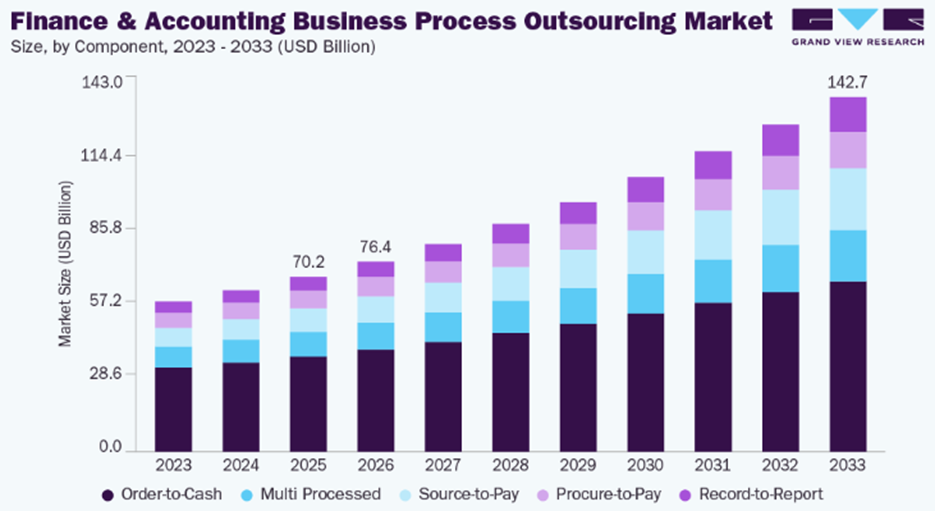
Outsourcing finance used to mean offloading the work nobody wanted in-house. Move the transactional stuff somewhere cheaper, keep the judgment close, and count the savings. That model worked for years. It is now running out of road.
That changes what finance and accounting outsourcing has to deliver. A provider who just processes invoices faster is solving an old problem. The question now is whether a partner can help close faster, forecast better, and hand leadership something it can actually use.
This is where outsourced finance and accounting services stop looking like a back office and start acting like an extension of the finance team. In 2026, good partnerships are judged on the decisions they enable, not the transactions they clear. For anyone who has treated F&A outsourcing purely as a cost lever, that is a real shift in what “good” means.
AI is the headline, and UK CFO confidence in it has jumped sharply in two years. What’s more telling is where it’s landing. The early value is in the routine work, reconciliations, close, variance analysis, reporting, where automation is turning week-long processes into a couple of days.
That enables a faster, more continuous close. When the underlying work is clean and automated, month-end stops being a scramble and the numbers arrive early enough to act on. AI-driven financial reporting and predictive analytics sit on the same foundation, giving boards a forward view instead of a rear-view one.
A few other shifts worth naming:
The thread running through all of it: finance automation and finance transformation services are no longer about doing the same work faster. They change what finance can produce in the first place.
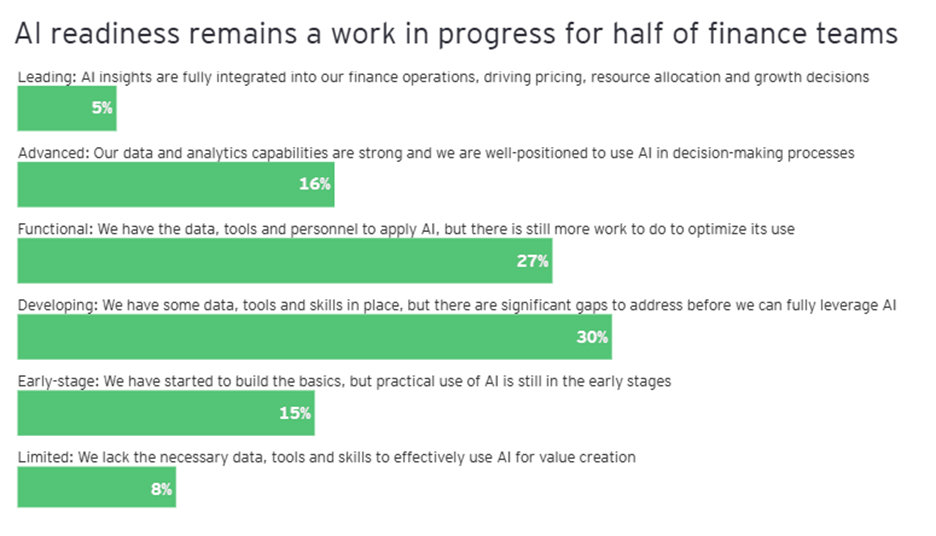
Most finance models were built for a monthly rhythm and a full in-house team. Neither holds up well in 2026. Headcount is flat or shrinking at most companies, and more of the work is moving into shared services and centralised teams.
That puts standardisation and governance at the centre. A finance function running four versions of the same process across three entities cannot automate cleanly, report consistently, or scale without adding people.
Hybrid delivery is becoming the default rather than the exception. Onshore judgment, offshore and nearshore capacity, and a shared platform underneath, blended into one operating model rather than bolted together. Done well, finance outsourcing services stop being a separate arrangement and become part of how the function is designed. That is usually the point where finance transformation services start delivering scale instead of just savings.
RELATED CASE STUDY: F&A Operations Transformation For a Global Real Estate Company Through Shared Services
For years, the finance conversation was mostly about efficiency. Do it faster, do it cheaper, do it with less. In 2026, resilience sits right alongside it.
The reason is the environment. Geopolitical shocks, supply chain wobbles, and an interest rate cycle still working through its effects have made predictability harder to come by. Finance leaders are responding by watching cash more closely, with rolling short-term forecasting becoming standard rather than something reserved for a crisis.
Resilience shows up in a few practical places. Risk management and compliance that hold up when a regulator or auditor looks closely. Business continuity does not depend on two people knowing where everything sits. And cash flow visibility is clear enough that leadership can act early instead of reacting late.
The thread here is decision intelligence. A resilient finance function is one that keeps producing numbers leadership can trust when the decisions get harder. That is why strategic finance support is being valued less for the cost it removes and more for the confidence it gives when the picture is unclear.
Technology fails when it is dropped onto a process that was never sorted out first. A few things tend to get missed:
1. The confidence gap is real
Despite heavy investment, only about a third of CFOs feel confident they can drive real impact from AI. The spending is running ahead of the certainty.
2. More data is not better decisions
Most finance leaders say the volume of data they hold is clouding decisions, not sharpening them. Without clean, governed data underneath, more information just adds noise.
3. Automation amplifies whatever is already there
Point finance automation at a clean, well-owned process and it compounds the value. Point it at inconsistent coding and numbers no one trusts, and it just produces the same mess faster.
4. Transformation is already costing morale
Many teams are being drained by change before it delivers much back. That is usually a sign the shift was pushed onto a function that was not ready to absorb it.
5. Sequence is everything
Fix the process, define ownership, clean the data, get the operating model right. Then add the technology. Done in that order, the investment holds. Done in reverse, you are automating problems you have not solved.
The hard parts of real finance transformation services are still the human ones, people, process, governance, and data quality. Technology is the easy part to buy, and the last part to pay off.
RELATED BLOG: Top Finance and Accounting Outsourcing Companies in UK
Most of what makes finance transformation work has little to do with the technology itself. It comes down to whether the process, the people, and the governance underneath are strong enough to carry it. That is where QX Global Group tends to add the most value.
Rather than treating finance and accounting outsourcing as a way to move work offshore, QX works with UK finance leaders on the model itself, standardising processes, tightening governance, cleaning up the data, and then applying automation where it will actually hold. In practice, that support usually spans:
The aim is a finance function that can carry what leadership now expects of it, and keep carrying it as the demands grow. Talk to QX Global Group about building a finance function ready for what 2026 asks of it, not just what last year required.
Cost is no longer the main reason businesses look outward. Finance and accounting services are shifting toward capability, helping CFOs close faster, forecast better, and get insight they can act on. The value now sits in what the function can produce, not just how cheaply the work gets done.
Look for process depth, strong governance, and the ability to apply automation to workflows that are actually ready for it. A good provider brings clean, standardised processes, reporting that gives a forward view, and scalable capacity. The best outsourced finance and accounting services feel like an extension of the finance team, not a detached back office.
The early impact is landing in routine, high-volume work, reconciliations, close, variance analysis, and reporting, where finance automation is turning week-long processes into a couple of days. Applied well, it also supports AI-driven financial reporting and predictive analytics, giving leadership a forward view rather than a record of the past.
When the underlying work is clean and consistent, numbers arrive earlier and can be trusted. That is what turns finance from a reporting function into strategic finance support, giving leadership clearer cash flow visibility, better forecasting, and the confidence to act early rather than react late.
Judge a partner on the decisions they enable, not the transactions they clear. Assess process and governance maturity, security and compliance credentials, automation capability, and how well they scale with your business. The right finance and accounting outsourcing partner should strengthen control and insight, not just remove cost.
QX Global Group works on the finance model itself, standardising processes, tightening governance, cleaning data, and then applying automation where it holds. With deep UK finance expertise and scalable delivery, QX helps businesses build a future-ready function, which is why UK CFOs choose it as a finance and accounting (F&A) partner for transformation, not just outsourcing.

Education:
CMA, B.Com

Rajen Sachaniya is a CMA with over 16 years of experience in finance, accounting, FP&A, and commercial strategy. At QX, he plays a pivotal role in shaping financial direction through budgeting, policy design, and governance. His expertise spans treasury, taxation, legal, compliance, payroll, and multi-currency consolidation. Rajen is known for aligning cross-functional teams across operations, sales, recruitment, and support—ensuring strategic coherence and long-term business growth.
Expertise: Finance & Accounting, FP&A, Budgeting, Commercial Contracts, RFPs, Financial Governance, Cross-Functional Leadership
Originally published Aug 03, 2026 06:08:17, updated Aug 14 2026
Topics: Finance & Accounting, Finance & Accounting Outsourcing
25 Aug 2026
Student housing has a reputation for being one of the more resilient real estate asset classes. Dema...
Read More21 Aug 2026
The 12th Revised Edition of USALI became mandatory on 1 January 2026, and six months on, a lot of po...
Read More20 Aug 2026
On a June morning this year, retirement housing found itself in the one room operators would rather ...
Read More20 Aug 2026
Property management accounting used to be treated as back-office work that nobody thought much about...
Read More