Topics: Executive Recruitment, Headhunter Recruitment, Headhunters Recruitment For Senior Hiring
Posted on January 30, 2026
Written By Ranjana Singh




Senior hiring in the UK is no longer a straightforward exercise. Leadership talent pools are smaller, competition is intense, and the consequences of a wrong hire are far-reaching. Senior roles demand discretion, strategic alignment, and access to leaders who are rarely visible through job boards or applications. This is where executive search and headhunting services becomes essential.
This blog explains why headhunters recruitment is critical for senior hiring in the UK, how the headhunting process works, and why UK organisations and staffing firms rely on specialist partners to secure leadership talent with confidence and reduced risk.

Senior hiring operates in a very different market compared to mid-level or high-volume recruitment. The pool of experienced leaders in the UK is limited, and many of them are already employed in stable roles. They are not actively applying for jobs, which makes traditional recruitment methods ineffective.
Confidentiality is another major factor. Leadership replacements, succession planning, and transformation roles often need to be handled discreetly to avoid internal disruption or external speculation.
Most importantly, senior hires have a long-term impact on business performance, culture, and strategy. A poor leadership decision can affect an organisation for years, making specialist support essential.
This is why headhunters recruitment UK and headhunters recruitment for senior hiring require a proactive, research-led approach.
Headhunters recruitment is a proactive hiring approach designed specifically for senior and leadership roles. Instead of relying on inbound applications, headhunting recruitment focuses on identifying, approaching, and engaging suitable candidates directly.
This approach involves extensive market research, talent mapping, and relationship-building. Many candidates engaged through headhunting are passive professionals who are not actively job-seeking but may consider the right opportunity.
Headhunting in recruitment often overlaps with executive search recruitment, particularly for C-suite, director, and senior management positions. The emphasis is on leadership capability, cultural fit, and long-term impact rather than speed or volume.

The headhunting process in recruitment is structured, methodical, and highly confidential.
Headhunters begin by researching and mapping senior talent across industries, functions, and regions. This helps identify where suitable leaders are positioned in the market.
They then approach candidates discreetly, initiating confidential conversations focused on leadership style, career motivations, and strategic capability.
Beyond CV screening, headhunters assess cultural alignment, stakeholder management skills, and decision-making ability. Throughout the headhunting in recruitment process, they manage sensitive discussions, support offer negotiations, and guide candidates through transition, ensuring stability for both parties.
Senior leaders rarely apply for advertised roles. Most are already employed, performing well, and selective about career moves. Headhunters bridge this gap by using established professional networks, industry referrals, and direct outreach to engage leaders who would never appear in an open application process. This gives organisations access to a far deeper and higher-quality leadership pool.
Senior hiring often involves sensitive situations such as leadership replacements, restructures, or succession planning. In these cases, public job postings can create uncertainty internally and externally. Headhunters manage searches with discretion, approaching candidates privately and controlling information flow to protect business continuity, leadership credibility, and employer reputation.
Headhunters bring ongoing market exposure that goes beyond filling roles. Executive recruiters track compensation benchmarks, leadership movement, and competitor hiring trends across industries. This insight helps organisations set realistic expectations, position roles competitively, and make informed decisions rather than relying on assumptions or outdated market data.
The cost of a failed senior hire is high, both financially and operationally. Headhunters reduce this risk by conducting in-depth leadership assessments that evaluate decision-making style, influence, cultural fit, and long-term potential. This structured evaluation helps ensure the selected leader can perform effectively in real-world conditions, not just on paper.

Headhunters recruitment ensures senior hiring is strategic rather than reactive. Instead of waiting for applications, organisations gain direct access to leadership talent that aligns with long-term business goals, culture, and growth plans.
This approach leads to stronger leadership fit, higher placement success, and better retention outcomes. Headhunters also manage candidate engagement, assessment, and negotiation, reducing internal workload and enabling faster, more confident decision-making during critical leadership transitions.
Using headhunters recruitment ensures senior hiring is strategic rather than reactive. Organisations gain direct access to leadership talent aligned with business goals instead of waiting for applications.
This results in stronger leadership fit, higher placement success, and better long-term outcomes. Headhunters also manage candidate engagement and negotiation, reducing internal workload and speeding up decision-making during critical leadership transitions.
While both headhunters recruitment and traditional recruitment aim to fill roles, they operate in very different ways, especially when it comes to senior hiring. Understanding these differences helps organisations choose the right approach based on role complexity, risk, and impact
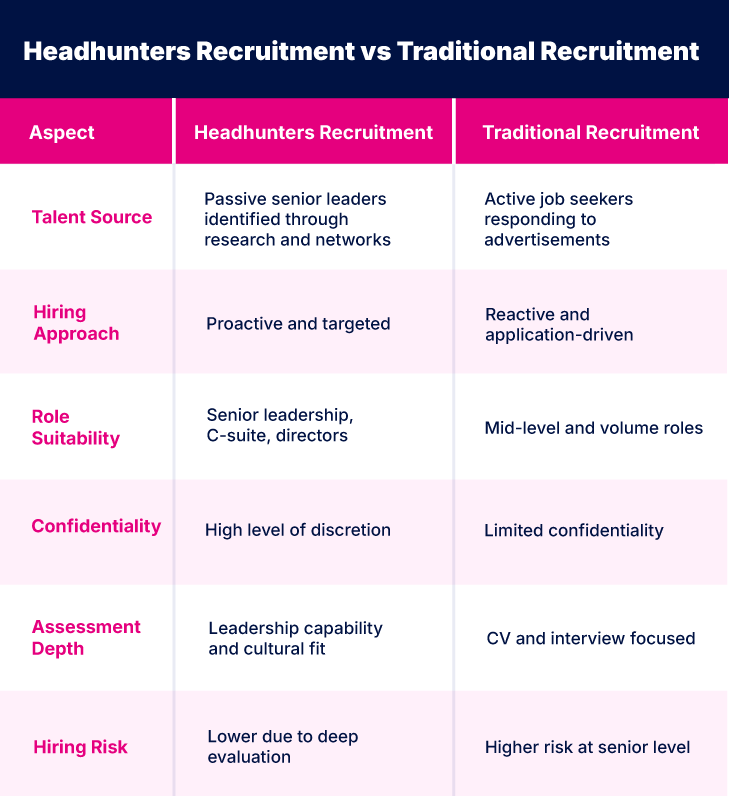
Headhunters recruitment focuses on passive senior leaders who are not actively job-seeking. These candidates are identified through industry research, professional networks, and referrals. Traditional recruitment, by contrast, primarily attracts active job seekers who respond to job advertisements or apply through career portals.
Headhunters take a proactive and targeted approach. They define leadership requirements upfront and go out to the market to find the right individuals. Traditional recruitment is more reactive, relying on inbound applications and screening candidates who apply for open roles.
Headhunters recruitment is best suited for senior leadership roles such as C-suite positions, directors, and specialist executives where decision-making and influence are critical. Traditional recruitment works well for mid-level roles and high-volume hiring where requirements are more standardised.
Confidentiality is a core strength of headhunters recruitment. Searches are conducted discreetly, which is essential for leadership replacements or sensitive appointments. Traditional recruitment offers limited confidentiality, as roles are often publicly advertised.
Headhunters conduct deeper assessments that focus on leadership capability, cultural alignment, and long-term potential. Traditional recruitment typically centres on CV reviews and interviews, which may not fully reveal leadership effectiveness.
Because of the depth of evaluation and targeted approach, headhunters recruitment significantly reduces hiring risk at senior levels. Traditional recruitment carries a higher risk when used for leadership roles, as surface-level assessments may not uncover deeper fit issues.
Also Read: How to Solve Biggest Executive Search and Headhunting Challenges In UK?
Headhunters form the foundation of executive search services. While executive search provides the strategic framework, headhunters drive the research, outreach, and relationship management needed to secure senior leaders.
Executive search recruitment is not transactional. It is a strategic hiring model focused on long-term leadership alignment. Headhunters ensure this process is informed, realistic, and aligned with organisational strategy.
UK organisations typically engage headhunters when leadership hiring carries high business impact and low tolerance for error. These situations often demand a level of discretion, market reach, and leadership assessment that traditional recruitment models are not designed to deliver.
Headhunters are commonly used for C-suite and board-level appointments, where decisions influence company direction, governance, and long-term performance. In such cases, organisations need access to proven leaders rather than a large pool of applicants.
They are also engaged for confidential leadership replacements, where publicly advertising a role could disrupt internal teams, investor confidence, or client relationships. Headhunters manage these searches discreetly, protecting business continuity.
During business transformation or rapid growth phases, organisations rely on headhunters to identify leaders with experience in change management, scaling operations, or entering new markets. Similarly, when roles require hard-to-find or niche senior expertise, headhunters use targeted research and industry networks to locate talent beyond traditional channels.
In these scenarios, traditional recruitment often lacks the reach, discretion, and assessment depth needed to deliver successful leadership outcomes.
Outsourced recruitment solutions enable organisations and staffing firms to handle senior hiring with greater expertise and flexibility, without the cost and complexity of building large in-house leadership teams. Instead of stretching internal recruiters across high-stakes roles, firms gain access to specialist headhunting skills focused on leadership search, assessment, and discreet engagement.
These services provide a scalable model for senior hiring. When organisations are expanding, restructuring, or managing multiple leadership requirements at once, outsourced recruitment services can quickly increase capacity without adding permanent overheads. Structured search processes, research support, and coordinated delivery also reduce the internal workload on leadership and HR teams.
As a result, senior hiring remains consistent, controlled, and professionally managed, even during periods of change or increased demand.
Without headhunters recruitment, organisations are largely restricted to active job seekers, which significantly limits access to proven senior leaders who are already performing in similar roles. This narrows the leadership talent pool and often forces hiring teams to choose from availability rather than true fit.
Senior hiring timelines also tend to stretch, as decisions are made with limited market insight into leadership availability, compensation expectations, or competitor movement. Without this context, organisations may misjudge both role requirements and candidate suitability.
There is also a higher risk of cultural and strategic mismatch. Leadership behaviours, influence, and long-term impact are difficult to assess through CVs and standard interviews alone. When senior hires fail, the consequences are significant, financial loss, team disruption, and reduced confidence among stakeholders.
QX Global Group supports UK organisations and staffing firms with professional headhunters recruitment and executive search recruitment backed by over 20 years of recruitment outsourcing experience.
QX combines executive search expertise with structured, research-led hiring processes to help businesses secure senior leadership talent discreetly and efficiently. By blending experienced recruiters, proven frameworks, and scalable delivery models, QX Global Group enables staffing firms to extend their executive search capability without expanding internal teams.
Senior hiring in the UK demands precision, discretion, and deep market understanding. Headhunters Recruitment unlocks access to leadership talent that traditional recruitment cannot reach.
By reducing hiring risk and improving leadership alignment, headhunting recruitment strengthens long-term business performance. For UK organisations and staffing firms, the right headhunting approach is not optional. It is essential.
Headhunters recruitment is most effective for C-suite, board-level, director, and specialist leadership roles. These positions require a high level of discretion, strategic assessment, and cultural alignment. Since the impact of these hires is significant, a specialist approach helps reduce the risk of costly mis-hires.
Headhunters use market mapping, industry networks, referrals, and targeted outreach to identify passive senior candidates. Rather than waiting for applications, they proactively approach leaders who have relevant experience and influence. This allows access to talent that traditional recruitment methods often miss.
Yes. Confidentiality is a core strength of headhunters recruitment. Senior leaders can be approached discreetly without advertising the role publicly, protecting business continuity, internal morale, and employer reputation throughout the hiring process.
Without specialist headhunters support, staffing firms often face limited access to passive talent and longer hiring cycles. There is also a higher risk of cultural misalignment, where candidates appear strong on paper but fail to deliver in practice. These factors increase the likelihood of leadership hiring failures.
Yes. Specialist headhunters recruitment supports industry-specific senior hiring by combining sector knowledge with targeted research. This approach helps identify leaders with relevant regulatory understanding, market experience, and operational expertise required in UK-specific industries.
Trusted headhunting recruitment partners typically help agencies identify hard-to-find candidates and build strong talent pipelines. QX Global Group supports headhunting activities through candidate research, market mapping, talent sourcing, and passive candidate engagement services.
Enjoyed our blog? Discover more about how our recruitment outsourcing process can slash your costs by up to 60%! Take the next step—book a call by entering your details.

Education:
B.Com(Hons), Delhi University

Ranjana Singh is a data-driven B2B content marketer who loves creating well-researched content and blending it with storytelling. At QX, she leverages data insights and lead analysis to craft high-performing LinkedIn campaigns, blogs, newsletters, and sales collateral that drive MQLs and brand visibility across the US and UK markets. Her work is rooted in performance—every strategy starts with deep analysis of content metrics, funnel behavior, and audience engagement trends to deliver measurable marketing impact.
Expertise: Data-Backed Content Marketing Strategy, SEO & Organic Growth, LinkedIn & Newsletter Marketing, MQL Attribution & Lead Source Analysis, Recruitment Industry Marketing (US & UK),
Originally published Jan 30, 2026 02:01:49, updated Aug 28 2026
Topics: Executive Recruitment, Headhunter Recruitment, Headhunters Recruitment For Senior Hiring