Topics: Healthcare Recruitment, Healthcare Recruitment Outsourcing
Posted on February 05, 2026
Written By Ranjana Singh




Healthcare workforce shortages continue to place significant strain on hospitals, clinics, care homes, and community healthcare providers across the UK. Rising patient demand, staff burnout, high attrition, and an ageing population have made healthcare recruitment increasingly complex and time-sensitive.
Many recruitment providers find that traditional hiring models alone are no longer sufficient to keep services running safely and efficiently. This has resulted in organisations turning to Healthcare Recruitment Services to strengthen staffing capacity, reduce hiring delays, and maintain continuity of care. This blog explains how healthcare recruitment services work, the value they deliver, and why they are essential in addressing ongoing workforce shortages.
The UK healthcare sector is experiencing persistent and widespread workforce shortages. Demand for healthcare professionals continues to grow across acute care, primary care, and social care settings, while supply struggles to keep pace. Shortages are particularly evident among nurses, allied health professionals, and frontline support staff.
These healthcare workforce shortages directly impact patient outcomes, increase waiting times, and place additional pressure on existing staff. Traditional in-house recruitment teams often lack the scale and speed required to manage this level of demand, making structured healthcare workforce shortage solutions increasingly critical.

Healthcare recruitment services support recruitment firms by managing the full hiring lifecycle in a structured and efficient way. Recruitment partners handle candidate assessment and interview coordination by pre-screening professionals for skills, experience, and role suitability, which reduces the burden on clinical leaders and shortens hiring timelines.
They also manage interview scheduling to improve decision-making speed. In addition, these services offer both temporary and permanent placement support, helping organisations address urgent short-term staffing gaps while also building long-term workforce stability. This balanced approach ensures flexibility without compromising continuity of care.
Beyond placements, recruitment partners provide ongoing workforce support through talent pooling, maintaining a pipeline of pre-qualified candidates ready for deployment. This allows healthcare organisations to respond quickly to future vacancies, minimise recruitment delays, and avoid service disruption.
Healthcare recruitment teams begin by working closely with providers to understand where staffing gaps exist and why. This includes reviewing service demand, shift coverage issues, patient volumes, and the specific skills required for each role. By understanding both short-term pressures and long-term workforce plans, recruitment efforts are aligned with operational priorities and patient care needs rather than ad-hoc hiring.
Once requirements are defined, recruitment partners use specialist healthcare talent networks, databases, and referral channels to identify suitable professionals. Each candidate goes through an initial screening process to verify clinical qualifications, relevant experience, availability, and role suitability. This step ensures only job-ready candidates are shortlisted, reducing time spent by internal teams on unsuitable profiles.
Recruitment services take ownership of managing regulatory and compliance documentation, including licenses, certifications, background checks, and right-to-work verification. All credentials are tracked and stored centrally, ensuring every placement meets healthcare regulations and is audit-ready. This significantly reduces compliance risk and administrative workload for healthcare providers.
After selection, candidates are placed efficiently, with a strong focus on speed for urgent or last-minute staffing requirements. Recruitment partners also support onboarding by coordinating documentation, induction steps, and role expectations. This helps new hires integrate smoothly into clinical teams and begin contributing with minimal disruption.
Beyond individual placements, recruitment partners maintain active talent pipelines tailored to the provider’s ongoing needs. These pipelines enable faster future hiring, improve workforce continuity, and reduce dependence on repeated reactive recruitment. Over time, this approach supports more stable staffing and better workforce planning.
Healthcare recruitment services play a direct role in helping providers manage ongoing staffing pressures. Below is how these services address workforce shortages in practical, day-to-day operations.
Recruitment services maintain pools of pre-vetted healthcare professionals who are ready for deployment. This allows providers to fill roles quickly without starting recruitment from scratch. Faster access helps stabilise staffing levels during critical shortages and reduces service disruption.
Established talent networks and streamlined screening processes significantly shorten hiring timelines. Candidates are already assessed for skills, availability, and compliance before shortlisting. This is especially valuable during periods of high demand or urgent staffing gaps.
Recruitment services enable providers to adjust staffing levels based on patient volumes, seasonal pressures, or service changes. This flexibility allows organisations to respond quickly without long-term commitments. It also helps prevent overstaffing during quieter periods.
Outsourcing recruitment removes time-consuming tasks such as sourcing, screening, and coordination from internal teams. This frees HR and clinical managers to focus on staff wellbeing, engagement, and retention initiatives. Reduced workload also improves internal team efficiency.
Maintaining consistent staffing levels ensures services run smoothly and safely. Recruitment services help minimise gaps that can lead to delays, cancelled appointments, or increased pressure on existing staff. This directly supports better patient outcomes and care quality.
Healthcare recruitment services support both short-term flexibility and long-term workforce stability. Below is the infographic content, followed by an explanation of each element.
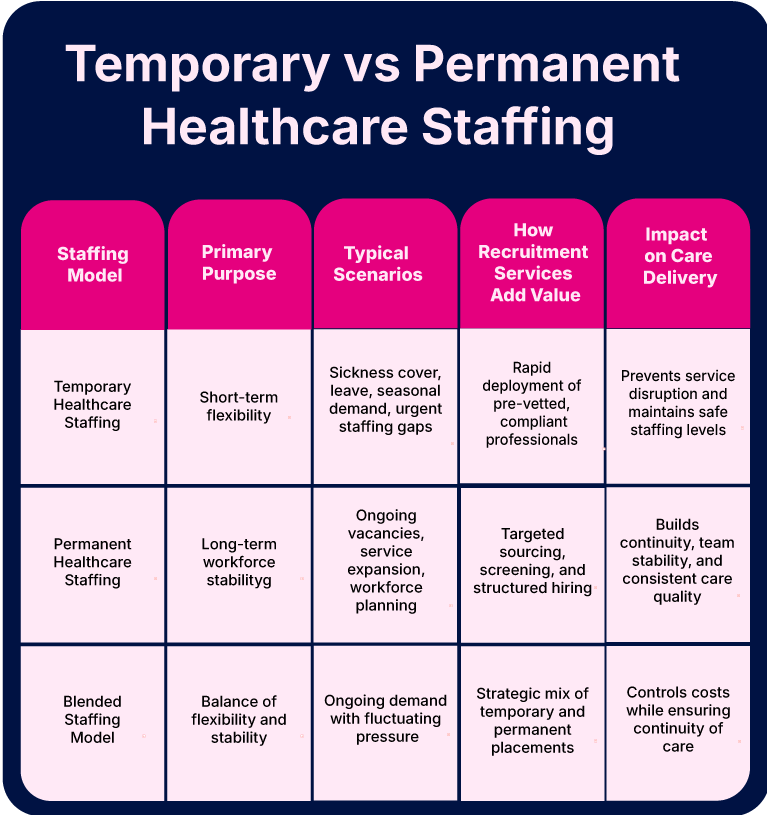
Temporary staffing is essential when providers face short-term gaps due to sickness, leave, or sudden demand spikes. Recruitment services ensure fast access to compliant professionals, preventing service disruption.
Permanent placements support long-term workforce stability and reduce reliance on temporary cover. Recruitment services help source candidates aligned with organisational values and long-term needs.
Many providers use a combination of both approaches. Recruitment services help balance flexibility and cost control while maintaining consistent standards of care.
Using healthcare recruitment services delivers both immediate operational relief and long-term workforce stability. Below is how providers benefit in practical, measurable ways.
Healthcare recruitment services shorten hiring timelines by using pre-screened candidates and established healthcare talent networks. This removes delays caused by repeated advertising, screening, and shortlisting. Faster hiring ensures critical roles are filled quickly, reducing pressure on existing staff and preventing service disruption.
Recruitment services provide access to healthcare professionals who may not be actively applying through traditional channels. This includes hard-to-find specialists, locum professionals, and experienced clinicians. Broader reach improves the likelihood of filling niche or high-demand roles effectively.
Centralised management of credentials, registrations, right-to-work checks, and background screening ensures every placement meets regulatory standards. This reduces the risk of compliance failures, audit issues, or governance gaps. Providers gain confidence that staffing decisions support patient safety and regulatory requirements.
Outsourcing recruitment removes time-intensive tasks such as sourcing, screening, scheduling, and documentation from internal teams. HR and clinical managers can then focus on workforce engagement, training, and retention. This improves internal efficiency without expanding recruitment headcount.
Healthcare recruitment services allow providers to scale staffing levels up or down based on patient volumes, seasonal trends, or service changes. This flexibility helps organisations respond to demand without committing to long-term staffing costs. It also prevents overstaffing during quieter periods.
Ongoing access to talent pipelines enables proactive workforce planning rather than reactive hiring. Stable staffing levels reduce burnout, improve team continuity, and support consistent standards of patient care. Over time, this strengthens service reliability and workforce resilience.

While healthcare recruitment services are highly effective, they must be managed thoughtfully to ensure long-term value, quality of care, and cost control. Below are the key challenges providers should actively monitor.
Healthcare recruitment partners must have a strong understanding of sector-specific regulations, registrations, and governance requirements. Any gaps in compliance can expose providers to regulatory risk and patient safety issues. Clear compliance processes and regular checks are essential.
Temporary or contract staff should meet the same professional and clinical standards as permanent employees. Without proper screening and role alignment, variations in care delivery can occur. Recruitment services must ensure consistent quality across all placements.
Over-reliance on agency staffing without workforce planning can lead to rising costs over time. Providers should use recruitment services strategically, balancing temporary cover with permanent hiring where possible. A planned approach helps control spend while maintaining flexibility.
External staff need structured onboarding and clear role expectations to work effectively within existing teams. Poor integration can affect team morale and operational efficiency. Recruitment services should support smooth transitions into clinical and non-clinical environments.
Not all recruitment providers have the same level of healthcare expertise. Choosing partners with proven experience in healthcare recruitment is critical to ensuring quality, compliance, and reliable delivery. Long-term success depends on working with specialists, not generalist agencies.
Healthcare recruitment outsourcing becomes especially valuable when internal hiring models can no longer keep pace with service demand or workforce pressures. Providers should consider outsourcing recruitment in the following situations.
When roles remain unfilled for long periods, patient care and service quality begin to suffer. Recruitment outsourcing provides faster access to qualified professionals, helping providers stabilise staffing levels and reduce pressure on existing teams.
Healthcare demand often increases during flu seasons, winter pressures, or service surges. Recruitment outsourcing allows providers to scale staffing levels quickly without long-term commitments, ensuring services remain fully operational during peak periods.
When providers open new services, wards, or facilities, internal recruitment teams may struggle to hire at scale. Outsourcing recruitment supports rapid workforce expansion while maintaining compliance and quality standards.
Internal HR teams are often stretched managing multiple priorities. Recruitment outsourcing reduces the administrative burden of sourcing, screening, and coordination, enabling faster hiring without increasing internal headcount.
High turnover and burnout create ongoing recruitment pressure and disrupt care continuity. Outsourcing recruitment helps fill gaps quickly while giving internal teams time to focus on staff wellbeing, engagement, and retention strategies.
QX Global Group supports UK healthcare providers with scalable recruitment outsourcing solutions. By combining recruitment expertise with structured compliance processes, QX enables faster access to qualified healthcare professionals and supports continuity of care through flexible staffing models.
Healthcare workforce shortages are unlikely to ease in the near future. Healthcare Recruitment Services play a vital role in helping providers manage demand, reduce hiring delays, and protect continuity of care. Organisations that adopt flexible, outsourced recruitment models are better positioned to build resilient, sustainable workforces and deliver consistent patient outcomes.
Healthcare workforce shortages in the UK are being driven by a combination of rising patient demand, staff burnout, high attrition rates, and an ageing population. At the same time, fewer professionals are entering the workforce at the pace required to replace retiring staff. These pressures have made it increasingly difficult for healthcare organisations to maintain safe staffing levels using traditional hiring models alone.
Healthcare recruitment services reduce time-to-hire by using established talent networks and pre-screened candidate pools. Candidates are assessed for skills, availability, and compliance before shortlisting, removing delays caused by repeated advertising and screening. Centralised coordination of interviews and documentation further accelerates the hiring process.
Yes. Healthcare recruitment services are designed to support urgent and last-minute staffing requirements. By maintaining pools of pre-vetted, compliant professionals, recruitment partners can deploy candidates quickly when unexpected gaps arise due to sickness, leave, or sudden increases in demand, helping prevent service disruption.
Recruitment outsourcing can support a wide range of healthcare roles, including nurses, allied health professionals, support staff, locums, and specialist clinical roles. Both temporary and permanent positions can be filled, allowing organisations to address short-term gaps while also building long-term workforce stability.
Healthcare organisations should consider outsourcing recruitment when persistent vacancies impact patient care, demand fluctuates seasonally, or internal recruitment teams lack the capacity to hire at scale. Outsourcing is also valuable during service expansion, periods of high staff turnover, or when compliance and speed become critical priorities.
Enjoyed our blog? Discover more about how our recruitment outsourcing process can slash your costs by up to 60%! Take the next step—book a call by entering your details.

Education:
B.Com(Hons), Delhi University

Ranjana Singh is a data-driven B2B content marketer who loves creating well-researched content and blending it with storytelling. At QX, she leverages data insights and lead analysis to craft high-performing LinkedIn campaigns, blogs, newsletters, and sales collateral that drive MQLs and brand visibility across the US and UK markets. Her work is rooted in performance—every strategy starts with deep analysis of content metrics, funnel behavior, and audience engagement trends to deliver measurable marketing impact.
Expertise: Data-Backed Content Marketing Strategy, SEO & Organic Growth, LinkedIn & Newsletter Marketing, MQL Attribution & Lead Source Analysis, Recruitment Industry Marketing (US & UK),
Originally published Feb 05, 2026 02:02:10, updated Feb 16 2026
Topics: Healthcare Recruitment, Healthcare Recruitment Outsourcing
23 Jul 2026
A hospital needs ten nurses by next week. A long-term care facility needs licensed therapists i...
Read More31 Mar 2026
A client sends a requirement for 10 nurses. They need profiles in 24 hours.Compliance must be perfec...
Read More11 Dec 2025
UK recruitment firms are under growing pressure to hire qualified and compliant healthcare staff at ...
Read More30 May 2023
Are you looking for ways to optimise your healthcare staffing company’s recruitment process an...
Read More