Topics: On Demand Recruiting, On Demand Recruiting Services
Posted on January 09, 2026
Written By Ranjana Singh




This is a common challenge for U.S. staffing firms. One new client win, a sudden hiring spike, a niche role that needs extra focus, or a temporary recruiter shortage, and internal teams can quickly feel stretched. This is where on demand recruiting services come in.
Instead of hiring full-time recruiters, on demand recruiting services acts as a plug-and-play extension of your hiring team. It steps in during busy periods and scales down when demand drops. From sourcing and screening to shortlisting and full cycle hiring, it works like an extra pair of hands, only when you need it.
On-demand recruiting is a flexible hiring solution that allows staffing firms with flexible recruitment support that can be activated when hiring demand spikes and paused when it slows.
Unlike traditional recruiting models, which often involve contractual commitments or in-house teams, on-demand recruiting is:
This model works particularly well for staffing firms that face sudden hiring spikes, struggle with niche or hard-to-fill roles, experience recruiter capacity gaps, or deal with an overflow of open requisitions that start impacting SLAs.

Here’s how on-demand recruiting fits into the day-to-day operations of U.S. staffing firms and helps them scale hiring without disrupting existing teams or processes.
On-demand recruitment services are built to mirror how staffing firms actually operate, where hiring demand rarely stays constant. Instead of forcing firms into fixed contracts or permanent hiring, these services offer flexible engagement models that can be adjusted based on workload.
Some staffing firms use hourly recruiter support when they need short-term help to manage a temporary spike in open requisitions. Others opt for project-based recruitment delivery when supporting a specific client, location, or hiring mandate. For firms with steady but fluctuating demand, monthly or subscription-based recruiter pods provide ongoing support that can be scaled up or down as needed.
On-demand recruiters are designed to work as a natural extension of a staffing firm’s internal recruitment team, rather than as an external vendor operating in isolation. They follow the same processes, tools, and quality standards as in-house recruiters.
Depending on the firm’s needs, on-demand recruiters can support candidate sourcing, screening and qualification, shortlisting and submittals, interview coordination, or even partial and full-cycle hiring. This allows staffing firms to offload specific recruitment tasks without losing control over client relationships or candidate experience.
Because on-demand recruiters integrate into existing ATS platforms, workflows, and communication tools, the transition is smooth and causes minimal disruption to ongoing hiring operations.
One of the biggest advantages of on-demand recruiting is how quickly recruiter capacity can be adjusted. Scaling recruitment support does not require lengthy hiring cycles, extended onboarding periods, or long-term employment commitments.
When hiring demand increases, staffing firms can instantly add recruiter capacity to handle additional requisitions. When demand slows, that support can be scaled back just as easily. This flexibility allows firms to respond quickly to changing market conditions without carrying excess recruitment costs.

From faster hiring to better cost control, on-demand recruiting offers practical advantages that directly impact how staffing firms operate and grow.
On-demand recruiting allows staffing firms to scale hiring output without increasing permanent recruiter headcount. Instead of committing to full-time hires, firms can add recruiter support when demand rises and reduce it when hiring slows. This approach works well in markets where hiring volumes change quickly and long-term commitments feel risky.
With additional recruiter capacity available almost immediately, staffing firms can move faster on open roles. Backlogs reduce, requisitions get attention sooner, and urgent client requirements are handled without delay. SLAs become easier to manage, even during peak hiring periods.
Traditional in-house recruitment comes with fixed costs such as salaries, benefits, downtime during slow periods, and bench risk. On-demand recruiting replaces this with a variable, usage-based model where firms pay only for the support they need. This makes it easier to manage recruitment costs without sacrificing delivery.
Many on-demand recruitment providers offer recruiters with experience across specific industries and hiring models. Whether it’s IT staffing, healthcare recruitment, engineering roles, or MSP and VMS-driven hiring, staffing firms can quickly access the right expertise without having to hire and train specialists internally.
By offloading sourcing, screening, and administrative recruitment tasks, internal recruiters are no longer stretched across too many requisitions. This allows senior recruiters to focus more on client relationships, account management, and candidate interactions.
When recruiters have manageable workloads, candidate quality improves. Focused screening leads to stronger shortlists, better submissions, and more relevant candidates reaching interview stages.
On-demand recruitment services often provide visibility into recruiter activity and pipeline performance. Staffing leaders can track productivity, understand where bottlenecks exist, and adjust hiring efforts based on real-time data.
To understand the value of on-demand recruiting, it helps to see how it compares with traditional in-house hiring models used by staffing firms.
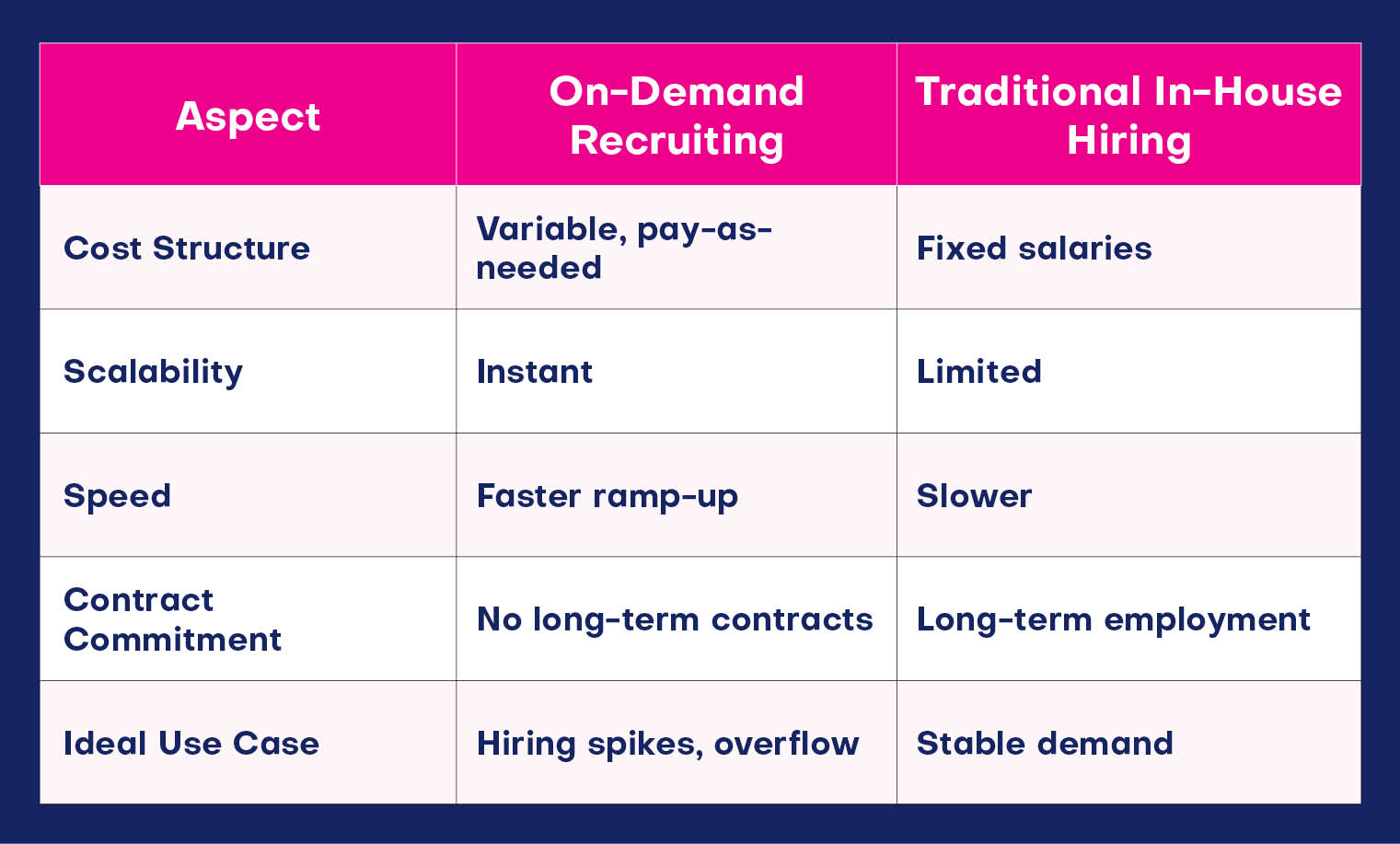
Traditional models are built for steady, predictable demand, where recruiters are hired full-time and costs remain fixed regardless of workload. This works well when hiring volumes are consistent, but it becomes restrictive during sudden spikes or slowdowns.
On-demand recruiting, on the other hand, is designed for flexibility. Staffing firms can add recruiter support instantly when hiring demand rises and reduce it when volumes drop. Costs stay variable, ramp-up is faster, and there’s no long-term employment commitment. This makes on-demand recruiting a better fit for hiring surges, overflow requisitions, or short-term capacity gaps, while traditional hiring suits firms with stable, long-term demand.
On-demand recruiting isn’t needed all the time, but there are clear situations where it makes the biggest difference for staffing firms. On-demand recruitment for staffing firms works best when:

Like any hiring model, on-demand recruiting comes with a few challenges that staffing firms should be aware of before getting started. Common challenges include:
When external recruiters support hiring, they need time to understand your staffing firm’s culture, values, and tone. Without proper alignment, communication with candidates may not fully reflect your brand.
On-demand recruiters must quickly learn role details, client expectations, and internal processes. If onboarding is rushed or unclear, it can slow down delivery in the early stages.
When multiple recruiters are involved, candidate experience can vary. Clear guidelines around communication, screening, and follow-ups help maintain consistency across all interactions.
Strong communication and documented processes are essential when working with external recruiters. Without them, updates can be missed and recruitment workflows may become fragmented.
However, these challenges are manageable with structured onboarding and regular communication.
Staffing firms use on-demand recruiting in different ways depending on their hiring needs, team structure, and growth plans. Below are a few of the most common recruiting models used by US staffing firms.
The right model depends on hiring volume, urgency, and internal team structure.
When staffing firms explore on-demand recruiting, the biggest concern is not just flexibility — it’s whether the support will actually fit into their way of working. This is where QX Global Group stands out.
QX Global Group is a global recruitment outsourcing provider with 20+ years of experience supporting staffing firms across the U.S. and UK. We work as an extension of internal recruiting teams, helping firms scale hiring without adding permanent headcount.
We support staffing firms with outsourced recruitment services, including on-demand recruiting, to manage hiring spikes, niche roles, and recruiter capacity gaps. Our recruiters align quickly with client requirements, ATS workflows, and delivery expectations, making it easier for firms to scale hiring while maintaining quality, visibility, and cost control. To know more about us, and how we can help you, fill out the form below.
U.S. staffing firms use on-demand recruiting to manage hiring spikes, overflow requisitions, niche roles, and sudden recruiter shortages. It helps them meet client demand without committing to full-time hires. This model allows teams to scale support up or down based on workload.
Yes. On-demand recruiting replaces fixed recruiter salaries with flexible, usage-based pricing. It also removes bench risk, meaning firms only pay for support when they actually need it, improving overall cost control.
On-demand recruitment is short-term and tactical, ideal for urgent or fluctuating hiring needs. RPO, on the other hand, is a long-term, strategic partnership where an external provider manages part or all of the recruitment process. Many firms start with on-demand support before moving to RPO.
Yes. Many on-demand recruiters specialize in niche verticals and understand MSP and VMS hiring models. They can manage complex requirements, compliance checks, and client-specific processes effectively.
Staffing firms should choose on-demand recruiting for short-term needs, sudden demand spikes, or project-based hiring. RPO is better suited for organisations looking for long-term recruitment ownership and structured hiring transformation.
Yes. On-demand recruiters can support temporary, contract, and permanent hiring models. This flexibility makes it suitable for staffing firms serving diverse client needs across industries.
ROI is measured through faster time-to-fill, reduced cost per hire, higher recruiter productivity, and improved placement ratios. Firms also track candidate quality and client satisfaction to assess long-term impact.
Enjoyed our blog? Discover more about how our recruitment outsourcing process can slash your costs by up to 60%! Take the next step—book a call by entering your details.
Originally published Jan 09, 2026 09:01:12, updated Jan 09 2026
Topics: On Demand Recruiting, On Demand Recruiting Services
Resolve the talent gaps, reduce costs, and improve your margins
Get a Free Consultation