Topics: Finance & Accounting, Property Management
Posted on November 10, 2025
Written By Siddharth Sujan




Investors aren’t impressed by a tidy NOI slide anymore. They want to see what is moving the number, where risk sits, and how quickly you can course-correct. For the modern CFO, that shifts the job from compliance to confidence building. The Property Management CFO Playbook starts with clean data, real-time visibility, and reporting that answers the next question before it is asked.
This post shows how data-driven reporting in property management turns scattered feeds from leasing, ops, and accounting into one story investors can trust. We will cover the tooling behind credible property management CFO reporting, where reporting automation for property managers saves hours and removes errors, and how to present portfolio performance in a way that earns capital, not just approval. If you are ready to replace static packs with live, decision-ready views, this playbook is your starting line.
Investor expectations have shifted fast, and for CFOs, that means reporting can’t just tick the compliance box anymore. It has to inspire confidence.
Here’s what’s shaping this new reality:
This is where data-driven reporting changes the game. It turns raw numbers into insight — and that insight into credibility.
For today’s property management leaders, the CFO Playbook is all about control through clarity. It’s a mix of clean data, connected systems, and transparent communication that builds confidence with every report shared.
Manual consolidation is quickly becoming outdated. Modern CFOs are bringing accounting, leasing, and operational data together through cloud-based property management reporting tools. With a single dashboard, they can see what’s working, spot red flags early, and keep investors updated with real-time accuracy.
CFOs are no longer judged just on profitability — but on efficiency and foresight. That’s why reporting now includes metrics like tenant turnover, energy costs, and capital expenditure trends. When investors see how each decision impacts long-term performance, confidence follows naturally.
Speed and accuracy define great reporting. With automation in property management finance, repetitive processes like reconciliations, payables, and variance reports happen automatically. It saves hours, reduces human error, and keeps reporting cycles predictable. This is a simple but powerful way to build investor trust.
CFOs are turning to visual dashboards to make complex data instantly understandable. Investors can now explore performance metrics directly through secure, interactive portals — seeing NOI, occupancy, and expenses updated daily. That visibility replaces assumption with assurance.
Consistency is the foundation of credibility. By automating audit trails and enforcing standard accounting practices across entities, CFOs ensure every report is accurate, comparable, and compliant. Governance becomes seamless, not slow.
These pillars make up a property management CFO playbook built for trust, delivering clearer insight and stronger accountability.
RELATED BLOG: The hidden FP&A flaw in property management isn’t technology, but structure. Read the blog to learn how smart CFOs are redesigning it.
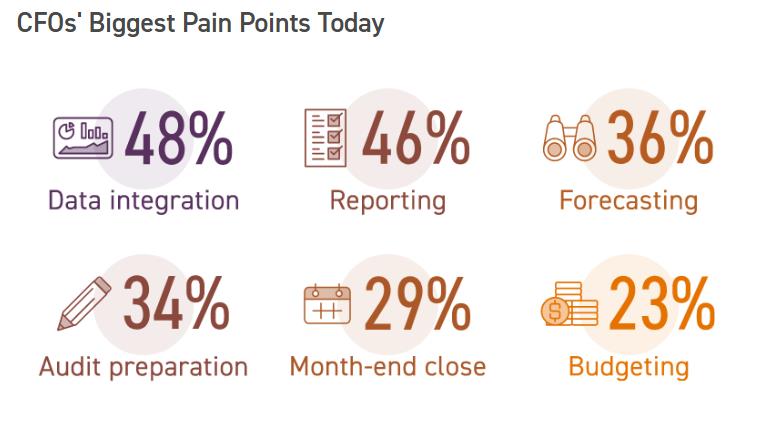
Even as technology reshapes the finance function, most property management CFOs still face structural hurdles that slow insight and erode investor confidence. Here are the key pain points:
Many property management companies still operate on multiple platforms for accounting, leasing, and maintenance. Without integration, reports require manual effort, slowing analysis and increasing the risk of inconsistencies.
Manual report preparation and inconsistent templates make it difficult to maintain accuracy at scale. The absence of reporting automation for property managers often leads to longer close cycles and audit delays.
Multi-region operators struggle to consolidate numbers quickly. Without a centralized view of performance across assets, property management CFO reporting becomes reactive instead of strategic.
Investors now want detailed breakdowns of performance — not just NOI and occupancy but expense ratios, ESG metrics, and forecast scenarios. Meeting this demand without automation can overwhelm finance teams.
Few internal teams have the expertise to turn data into actionable insight. This gap limits the potential of data-driven reporting in property management, making it harder for CFOs to communicate value effectively.
The takeaway: property management CFOs don’t lack data. They lack the systems and skills to make it meaningful.
Technology is redefining what financial leadership looks like in property management. CFOs are no longer just guardians of numbers; they’re architects of insight — using automation, analytics, and integration to deliver clarity at every level.

Building credibility with investors starts with structure. For property management finance teams, that means creating a data environment where every figure can be traced, verified, and turned into action. Here’s how leading CFOs are making that shift:
Begin by mapping where financial and operational data lives across accounting, leasing, and maintenance systems. A thorough data audit helps identify inconsistencies that weaken investor confidence and ensures the foundation for data-driven reporting in property management is solid.
Once data quality is established, connect it through a unified property management financial reporting tool or ERP system. This creates a single source of truth and eliminates manual consolidation — a major step toward accurate and real-time reporting.
Use reporting automation for property managers to generate key reports automatically, right from rent roll summaries to expense reconciliations. Automation speeds up close cycles and ensures every number is audit-ready & repeatable.
Invest in business intelligence platforms that visualize data intuitively. Dashboards help both internal teams and investors see performance trends without combing through static reports.
Metrics should go beyond NOI. Include ESG indicators, occupancy trends, tenant churn, and cash flow ratios. Aligning KPIs with what investors value most makes your reporting relevant and forward-looking.
RELATED BLOG: Month-end shouldn’t feel like a fire drill. See how the right checklist turns chaos into control. Read now!
At QX Global Group, we help property management finance leaders simplify reporting, automate processes, and communicate value with precision. Our property management accounting services are built to give CFOs and investors the clarity they need to move faster with confidence.
Here’s what sets our support apart:
If your finance team is ready to replace static spreadsheets with real-time insight, QX Global Group can help you build a CFO playbook designed for growth, accuracy, and accountability. Talk to our experts to explore how QX’s property management accounting services can transform your reporting.
Investors now expect more than basic NOI and occupancy figures. They look for a complete financial view that includes expense ratios, tenant retention, cash flow stability, ESG indicators, and debt coverage metrics. The most trusted property management CFO reporting frameworks connect these KPIs to operational performance, giving investors a clear line of sight from financial outcomes to strategic decisions.
Transparency signals control. When CFOs provide real-time access to portfolio data, investors see discipline, foresight, and accountability. Modern data-driven reporting in property management turns raw numbers into context, helping investors understand not just results, but the reasoning behind them. That visibility builds trust and strengthens long-term capital relationships.
Leading CFOs rely on property management financial reporting tools that centralize data from accounting, leasing, and operations into one dashboard. Automation platforms handle recurring tasks like reconciliations, payables, and variance reports, reducing errors and closing cycles faster. BI and visualization tools then translate that data into interactive dashboards. This forms a key part of effective reporting automation for property managers.
Modernization starts by auditing existing systems, identifying manual bottlenecks, and integrating automation within core workflows. By adopting cloud-based ERP systems and automated report generation, CFOs can eliminate redundant data entry and ensure every report is traceable, consistent, and audit-ready. This shift allows finance teams to focus on insight, which forms the foundation of a scalable CFO playbook for property management.
The best providers are usually FP&A, CFO advisory, or finance transformation partners that can turn financial data into a clear board-level narrative. The goal is not more dashboards. It is helping leadership explain what happened, why it happened, what it means, and what needs to happen next.
Look for partners that can support:
The right partner should help finance move from reporting results to shaping the conversation around performance, risk, and strategy.
QX Global Group partners with property management CFOs to streamline reporting, automate finance processes, and improve investor communication. Through advanced property management accounting services, QX delivers automation-driven accuracy, real-time dashboards, and skilled finance teams trained in U.S. real estate standards. The result is faster reporting, greater transparency, and a finance function built for growth and investor confidence.

Education:
B.A. - Mass Communication

Expertise: Finance & Accounting Thought Leadership, Transformation & Operating Model Storytelling, CFO & Executive-Level Content Strategy, Outsourcing, Shared Services & Global Delivery Narratives
Originally published Nov 10, 2025 09:11:55, updated Jun 01 2026
Topics: Finance & Accounting, Property Management
11 Sep 2026
Picture a 90-unit association collecting around $290 a month per home. The books live in a spreadshe...
Read More02 Sep 2026
Hospitality has become one of the most data-rich industries in the world. Every reservation, room sa...
Read More27 Aug 2026
In June 2026, Morgan Stanley and Ridgeback paid £1.045 billion for Metra Living, L&Q’s re...
Read More20 Aug 2026
On a June morning this year, retirement housing found itself in the one room operators would rather ...
Read More