Topics: Finance & Accounting, Order-to-cash cycle
Posted on February 13, 2026
Written By QX Global Group




Most revenue leakage does not show up as a single failure in the system. It shows up as a few hours lost here, a rework loop there, a dispute that sits too long, a payment that lands but does not get applied cleanly.
Individually, these issues look operational. Collectively, they create cash drag.
That is why finance teams are treating the order-to-cash process as a working-capital lever in 2026. Liquidity is being managed more tightly, and the tolerance for “cash that should have arrived” is shrinking.
This blog maps the order-to-cash process flow, highlights where revenue leakage in order-to-cash typically occurs, and lays out the early warning signals that show up before DSO spikes.
The order-to-cash business process covers every step from accepting an order to collecting and applying the cash. In practical terms, the end to end order-to-cash process links order management, credit decisions, billing, collections, cash application, and reporting.
When this chain runs clean, revenue converts to cash predictably. When it does not, the impact is rarely limited to receivables. Invoice disputes and administrative delays push payments out, while weak cash application creates “unapplied cash” that distorts ageing, DSO, and forecast accuracy.
In other words, O2C performance is not just an AR metric. It directly affects cash visibility, reporting confidence, and the finance team’s ability to explain or reduce variance.
In stable environments, minor inefficiencies in the order-to-cash process can remain hidden for months. In 2026, they surface faster.
Payment terms are stretching in many industries. Customers are scrutinising invoices more closely. Disputes are no longer resolved informally; they require documentation, system proof, and structured follow-up. At the same time, CFOs are under greater pressure to defend forecast assumptions and explain working capital movements.
The difference in 2026 is scrutiny.
Boards are asking harder questions about DSO stability. Lenders are examining receivables quality. Growth expectations are tied directly to cash conversion performance. That is why the order-to-cash business process is no longer viewed as back-office execution. It is a forward-looking cash control mechanism.
The order-to-cash process flow is often described linearly, but in reality it is interdependent. Weakness in one stage compounds downstream. A simplified view of order-to-cash processing includes seven connected stages:
Accurate contract terms, pricing, tax treatment, and customer master data. Errors here translate directly into invoice disputes later.
Defined credit limits, risk checks, and exposure monitoring. Weak credit discipline increases collection friction.
Timely, accurate, compliant invoice creation. Delays or errors at this stage are one of the most common sources of revenue leakage.
Confirmation that invoices are received, accepted, and dispute-free. Silence does not equal agreement.
Structured reminder cadence, prioritisation based on ageing and risk, and documented dispute resolution workflows.
Accurate matching of payments to open invoices. Misapplied or unapplied cash can inflate DSO and weaken reporting reliability.
Ageing analysis, DSO tracking, dispute monitoring, and short-term cash forecasting. This stage reflects the health of the entire end to end order-to-cash process.
When viewed end to end, the goal is not just faster collections. It is controlled conversion of revenue into cash, supported by visibility at every stage.
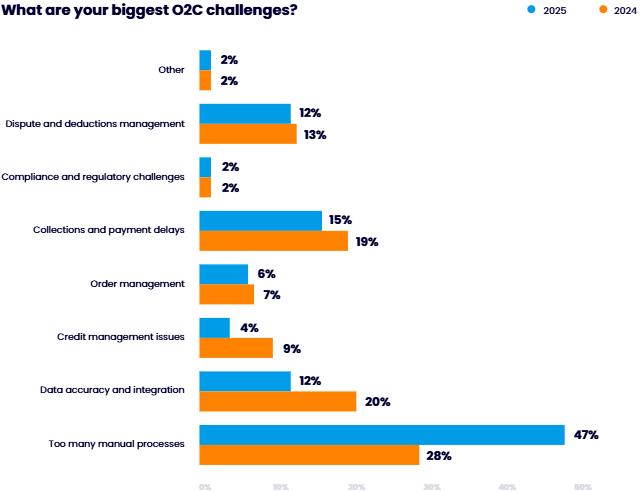
Revenue leakage rarely originates in collections alone. It begins earlier in the order-to-cash process flow and compounds as transactions move downstream.
Weak contract governance, inconsistent pricing logic, or incomplete customer data create friction at the start of the process. These upstream issues later surface as disputes, credit notes, and invoice corrections, driving invoice errors and revenue loss.
When invoice generation lags service delivery, the collection clock effectively starts late. Across volume, even small billing delays weaken the end to end order-to-cash process and stretch DSO quietly.
Disputes are rarely isolated events. They typically reflect breakdowns in documentation, contract alignment, or approval clarity. As resolution timelines expand, revenue leakage in order-to-cash increases through stalled invoices and repeated reprocessing.
Collections that depend on individual effort rather than structured prioritisation create uneven cash conversion. This reduces improving cash flow visibility and increases forecasting risk in O2C.
Cash received but not accurately matched to invoices distorts ageing reports and hides underlying performance gaps. Weak cash application undermines confidence in overall order-to-cash processing metrics.
By the time DSO rises materially, leakage has already compounded. The control advantage lies in identifying leading indicators inside the order-to-cash process flow.
These signals surface before DSO spikes. Monitoring them consistently allows finance leaders to address order-to-cash inefficiencies before leakage becomes visible at the board level.
Breakdowns in the order-to-cash process rarely reduce reported revenue immediately. They affect timing first.
A delayed invoice does not erase revenue. It shifts expected inflows. A growing dispute backlog does not change contract value. It changes predictability. A rise in unapplied cash does not reduce receipts. It weakens visibility. Over time, these timing distortions compound.
First, DSO begins to stretch before the underlying cause is fully visible. Collections teams may appear active, yet the upstream weaknesses in billing accuracy or dispute handling continue to slow conversion across the order-to-cash process flow.
Second, cash forecasting becomes less reliable. When invoice issuance is inconsistent or dispute resolution timelines vary, short-term projections become harder to defend. This increases forecasting risk in O2C, especially in growth environments where volume magnifies small variances.
Third, finance teams spend more time explaining gaps than correcting root causes. Instead of improving the end to end order-to-cash process, effort shifts toward variance analysis, manual reconciliations, and stakeholder reassurance.
In 2026, that confidence gap carries strategic consequences. Boards and lenders are less tolerant of forecast instability. Predictability is valued as much as growth. That is why strengthening the order-to-cash business process is no longer just an operational improvement. It is a risk management priority.
Automation does not fix structural weaknesses on its own. But when applied at the right stages, it materially reduces leakage across the order-to-cash process flow. Automation in order-to-cash processing typically strengthens five pressure points:
RELATED BLOG: How Order to Cash Process Automation Streamlines Finance?
The impact of automation is cumulative. It shortens billing cycles, reduces rework, stabilises DSO, and improves forecast reliability. However, automation works best when layered onto a clearly defined process. Without defined ownership, controls, and escalation paths, technology accelerates broken workflows.
In 2026, high-performing finance teams are combining disciplined process design with targeted automation. That combination reduces leakage before it becomes visible in headline metrics.
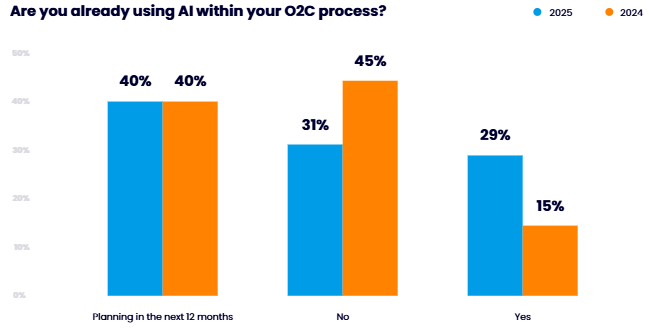
High-performing teams do not treat the order-to-cash process as a collections function. They treat it as a structured, measurable system.
First, the process is documented and repeatable. Execution does not depend on individual memory or informal escalation.
Second, ownership is explicit. Order validation, billing accuracy, dispute resolution, collections cadence, and cash application are clearly assigned. There is no ambiguity about who resolves exceptions.
Third, automation supports control rather than replacing it. Automated validation reduces invoice errors. Structured collections prioritisation improves follow-up discipline. Intelligent cash application strengthens improving cash flow visibility. In mature environments, automation in order-to-cash is embedded into workflow design.
Fourth, finance and operations are aligned. Billing triggers are tied to operational milestones. Disputes are fed back into upstream contract controls. Forecasting risk in O2C is monitored continuously, not only when DSO shifts.
RELATED BLOG: Guide to a Smooth Transition from In-House to Outsourced O2C Processes
QX Global Group supports U.K. businesses in strengthening their order-to-cash process through structured process design and scalable delivery capacity. Our order-to-cash services focus on stabilising process flow, reducing revenue leakage in order-to-cash, and improving cash visibility across billing, collections, and cash application.
We help finance teams:
As a provider of order-to-cash outsourcing services in the UK, we combine process expertise, automation enablement, and structured governance to help organisations convert revenue into cash more predictably.
Book a free, no-obligation discussion with our specialists to evaluate whether your current model is preventing leakage or allowing it to compound quietly.
The order-to-cash process covers every step from receiving a customer order to collecting and applying payment. It connects order validation, credit checks, billing, collections, cash application, and reporting into one end-to-end revenue conversion cycle.
The Procure-to-Pay cycle manages outgoing cash, from purchasing to paying suppliers. The order-to-cash process manages incoming cash, from invoicing customers to collecting payments. P2P controls cost outflow. O2C controls revenue inflow and working capital.
Revenue leaks most often occur in order validation, delayed billing, dispute resolution, inconsistent collections follow-up, and unapplied cash. These breaks in the order-to-cash process flow quietly extend DSO and distort forecast accuracy.
UK businesses can detect leakage early by monitoring invoice rework rates, dispute ageing, billing cycle time, unapplied cash balances, and short-term forecast variance. These leading indicators surface order-to-cash inefficiencies before DSO visibly spikes.
Weak credit control allows high-risk accounts to age without structured follow-up. This increases disputes, delays collections, and reduces improving cash flow visibility across the order-to-cash process.
Invoice errors trigger rework, dispute cycles, and delayed payments. While revenue remains recorded, cash conversion slows, creating hidden revenue leakage in the order-to-cash business process and increasing forecasting risk.
High-performing UK finance teams strengthen ownership at every stage, enforce billing discipline, automate validation and cash application, and monitor early warning signals consistently. A structured, measurable end to end order-to-cash process reduces leakage and stabilises cash conversion.

Originally published Feb 13, 2026 06:02:00, updated Feb 26 2026
Topics: Finance & Accounting, Order-to-cash cycle
02 Sep 2026
Hospitality has become one of the most data-rich industries in the world. Every reservation, room sa...
Read More27 Aug 2026
In June 2026, Morgan Stanley and Ridgeback paid £1.045 billion for Metra Living, L&Q’s re...
Read More20 Aug 2026
On a June morning this year, retirement housing found itself in the one room operators would rather ...
Read More18 Aug 2026
A closed sale is not the same as cash in the bank. The moment an invoice goes out, the P&L is de...
Read More