Topics: Finance & Accounting, Multifamily
Posted on November 13, 2025
Written By Siddharth Sujan




The multifamily market is entering a new phase with slower rent growth, higher financing costs, and sharper investor expectations. Margins are thinner, capital is more selective, and every reporting cycle now doubles as a performance review. The finance office sits at the center of it all, balancing liquidity, automation, and accountability across complex portfolios.
That is why 2026 will test how strategic the CFO role has truly become. The leaders who stay ahead are rethinking how data, forecasting, and governance work together as tools for control and confidence.
This blog explores the key multifamily CFO priorities for 2026, focusing on building real-time forecasting frameworks, strengthening investor reporting, and using automation to bring speed and accuracy where it matters most.
For multifamily operators, the CFO’s desk has become a command center. The role is no longer about recording results but about shaping them. As the market stabilizes, multifamily CFOs are being called to lead with foresight, not hindsight.
In 2026, the emphasis is on financial visibility, data-driven agility, and operational discipline. Finance leaders are expected to interpret numbers in real time, align stakeholders around shared targets, and anticipate risks before they reach the balance sheet.
The modern multifamily finance strategy blends technology with leadership. CFOs are deploying automation to free teams from manual work, investing in analytics to sharpen decision-making, and partnering more closely with operations to turn financial data into actionable insight. The goal is not just efficiency, but clarity and the ability to connect capital, performance, and growth with precision.
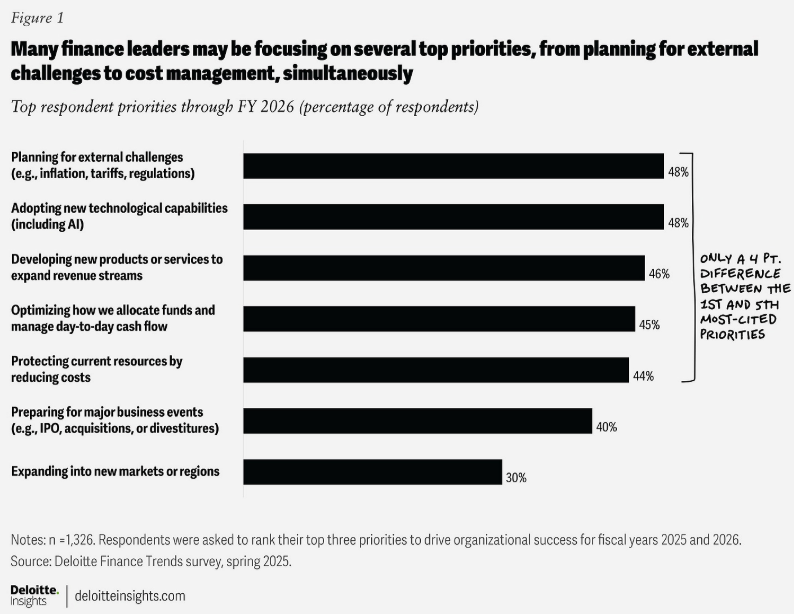
The next year will separate CFOs who simply manage finance from those who use it as a strategic lever. As the market stabilizes but pressure builds on NOI, CFOs are refocusing their energy on five clear priorities that define success in 2026.
Static budgets cannot capture the reality of today’s market. Financial planning for multifamily operators now depends on rolling forecasts, scenario modeling, and dynamic variance analysis that evolve with occupancy shifts, rent adjustments, and capital market swings. The goal is to give leaders the foresight to adjust before numbers go off course.
CFOs are adopting integrated planning tools that consolidate property data, automate forecast updates, and provide portfolio-level insights in real time. This allows finance teams to model risk, plan liquidity buffers, and align with investors around measurable financial outcomes.
Automation has moved from “nice-to-have” to “non-negotiable.” Automation in multifamily finance reduces time spent on repetitive tasks like payables, reconciliations, and reporting prep, allowing teams to focus on analysis and strategic review.
More importantly, it builds consistency and audit confidence. Automated workflows capture every transaction trail, reduce manual errors, and accelerate month-end close by days — sometimes weeks. For CFOs, automation is about freeing skilled accountants to drive value creation instead of chasing corrections.
Investors and boards now expect more than quarterly summaries; they want granular transparency into property-level metrics, expense drivers, and risk exposure. Multifamily accounting and reporting teams are upgrading dashboards and performance scorecards to deliver that clarity.
The most effective CFOs are using visualization tools that link real-time NOI data with KPIs like debt coverage, rent trends, and cash reserves. This depth of reporting allows faster capital decisions, builds stakeholder trust, and strengthens governance frameworks that withstand market scrutiny.
Operating expenses are growing faster than revenues across most portfolios. Insurance premiums, maintenance, and utilities continue to erode NOI, leaving little room for inefficiency. Leading CFOs are applying multifamily CFO challenges thinking to cost control — using vendor rationalization, spend analytics, and automation to identify hidden leakages and enforce procurement discipline.
The shift is from cost-cutting to cost intelligence. Instead of reactive trimming, CFOs are building benchmarks for every expense category, comparing sites, and renegotiating vendor terms using live spend data.
Capital is tight, and balance sheet agility defines who can grow in 2026. CFOs are using multifamily financial forecasting and analysis to guide refinancing, evaluate hold-sell trade-offs, and prioritize projects with the highest risk-adjusted returns.
Forward-looking debt management strategies such as laddered maturities, stress-tested refinancing models, and disciplined capex sequencing are now integral to the finance playbook. The best CFOs approach capital allocation as an opportunity to sustain flexibility and protect long-term value.
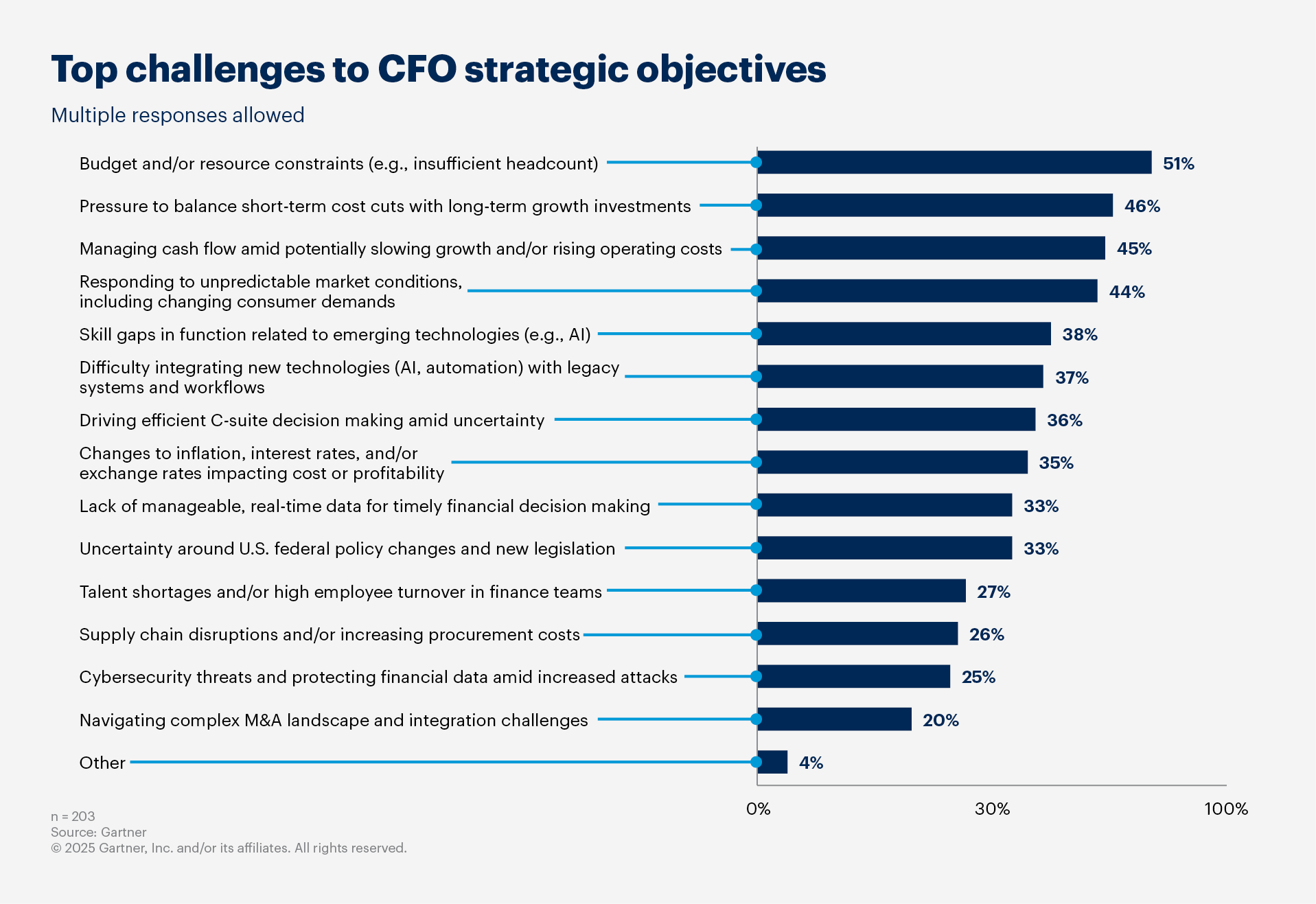
The path ahead looks steady on the surface but complex underneath. Behind stable rent trends lie sharper financing pressures, rising operating costs, and shifting investor sentiment. For multifamily CFOs, the challenge is not just to sustain growth but to do so under tighter financial discipline.
Higher interest rates and cautious lending have slowed refinancing cycles. Many operators face shrinking spreads between borrowing costs and property yields, forcing CFOs to revisit how capital is structured and deployed.
Investors expect predictable NOI and credible forecasting despite market uncertainty. CFOs must balance conservative projections with transparent reporting, proving that every dollar spent is defensible and every variance explained.
A recurring issue across the sector is limited in-house capacity for deep analysis. Many finance teams still rely on spreadsheets that struggle with multi-entity data. This is driving demand for multifamily financial forecasting and analysis support that integrates systems, people, and processes into one cohesive model.
Between SOX, ESG mandates, and regional reporting standards, compliance workloads are rising. CFOs need scalable controls that protect accuracy without slowing down operations.
As automation and AI become mainstream, the biggest risk is a knowledge gap. Finance leaders must upskill teams in analytics, reporting platforms, and governance to fully realize the promise of digital finance transformation.
These challenges underscore why the modern multifamily finance strategy must focus as much on process resilience as on profit margins.
Meeting these challenges often requires capacity and expertise that internal teams alone cannot provide. This is why many leaders are turning to finance and accounting outsourcing to support their 2026 roadmap.
Strategic outsourcing gives CFOs access to experienced analysts, automated workflows, and flexible delivery models without adding headcount. The result is faster reporting, stronger internal controls, and the ability to reallocate time toward forecasting, capital strategy, and investor engagement.
Outsourced partners bring three core advantages:
At QX Global Group, we partner with multifamily CFOs to build scalable, data-driven finance functions. Our dedicated offshore accounting teams are trained in U.S. real estate operations, equipped with automation-led tools, and aligned to your reporting cadence. We help finance leaders gain real-time visibility, reduce operational costs, and maintain complete control over performance.
Ready to align your 2026 finance strategy with sharper visibility and stronger outcomes? Talk to QX Global Group to explore how our multifamily accounting services can help your finance office lead with precision and confidence.
Automation in multifamily finance is helping CFOs move beyond manual, time-consuming processes. From accounts payable to bank reconciliations, automation reduces errors, shortens close cycles, and delivers consistent reporting. By standardizing workflows across properties, CFOs gain faster visibility into performance and free up their teams to focus on analysis, forecasting, and strategic planning rather than repetitive data entry.
The top multifamily CFO challenges in 2026 revolve around margin compression, limited access to affordable debt, and investor expectations for real-time reporting. Operating expenses continue to rise, while financing remains costly and selective. CFOs also face growing compliance requirements and skill shortages in analytics and automation — making efficiency, accuracy, and process control more critical than ever.
Effective multifamily financial forecasting and analysis gives CFOs a clearer view of where costs are increasing and where efficiencies can be created. Rolling forecasts and scenario modeling allow finance teams to anticipate the impact of rent fluctuations, insurance premiums, and capital expenditures. This helps leaders plan ahead, protect cash flow, and make data-backed decisions that stabilize NOI even as costs rise.
With revenues leveling off, every dollar saved goes directly to protecting NOI. Operating expense management has become a core lever for maintaining profitability. CFOs are deploying automation-driven spend analytics to track vendor performance, detect inefficiencies, and benchmark expenses across properties. The focus is shifting from broad cost cuts to intelligent, data-led cost control that sustains service quality while improving margins.
Partnering with finance and accounting outsourcing experts helps CFOs strengthen capacity without expanding internal teams. Outsourced delivery models provide access to skilled accountants, FP&A professionals, and automation tools that enhance reporting accuracy, accelerate month-end close, and streamline compliance. For multifamily operators managing multiple entities, outsourcing creates a scalable, cost-efficient finance backbone that aligns perfectly with 2026’s priorities speed, accuracy, and strategic control.

Education:
B.A. - Mass Communication

Expertise: Finance & Accounting Thought Leadership, Transformation & Operating Model Storytelling, CFO & Executive-Level Content Strategy, Outsourcing, Shared Services & Global Delivery Narratives
Originally published Nov 13, 2025 12:11:54, updated Nov 14 2025
Topics: Finance & Accounting, Multifamily
27 Oct 2026
On 20 October, the hospitality trade met for a Budget briefing in a pub. Where else? The Blue Boar, ...
Read More26 Oct 2026
Berkeley Group’s AGM on 11 September was meant to be routine. Most of it was. Enquiries were &...
Read More14 Oct 2026
Most multifamily finance teams have seen some version of this. A new ERP gets approved, an AP automa...
Read More02 Sep 2026
Hospitality has become one of the most data-rich industries in the world. Every reservation, room sa...
Read More